
“We’ve Left the Contemporary Era”
For several weeks now, a chant has been heard in the high-school marches: “We’re going to leave the contemporary era.” It isn’t a joke; it’s a prophecy. It comes from a generation born after 2002, fed up with an ever more violent neoliberal society — one that lets the spectre of the Le Pens and of war grow as its only horizons, that now speaks only to its old in the one worn-out language they understand, and that beats, maims or blinds its minors the moment they voice their unease and their anger. Rereading these days with the Situationists means learning to hear it.
On Sunday morning, France woke up once again with a ready-made vocabulary. “Disturbances,” “casseurs” (literally “smashers”), “looters,” “unacceptable violence”: the words were there before the images, and they ended up replacing them. The Interior Ministry had announced “disturbances” as early as Friday. On Saturday, reality fell into line: the story had been written in advance.
This vocabulary has been heard for more than half a century. The word casseur even got its own law: the so-called “anti-casseurs” law of June 1970, passed in the wake of May ’68, repealed in 1981, then revived under the same nickname in 2019 against the Yellow Vests. In between, it was used against the students of 1986, the winter Malik Oussekine died under police blows. It was used in Vaulx-en-Velin in 1990, during the 1995 strikes, then throughout the counter-summits, from Seattle in 1999 to Genoa in 2001. It hardened in autumn 2005, when the banlieues burned after the deaths of Zyed and Bouna in Clichy-sous-Bois, and there was talk of “racaille” (scum) and the “Kärcher” (pressure washer). Since then, it has been recited without anyone hearing it.
But France also woke up deaf to the other vocabulary, the one it doesn’t understand. “Mettre le zbeul” (stirring up chaos), “Bismillah, c’est les ténèbres” (“Bismillah, it’s darkness”), “six-seven,” “aura battles”: the language of the 2026 marches isn’t translated on the TV news; at best it is commented on as a curiosity. Power has its words for talking about youth, but it doesn’t understand the ones youth uses to talk about power.
More than sixty years ago, a handful of theorists gathered around the journal Internationale situationniste had understood that power governs not only the streets, but also the language that describes them. Attila Kotányi, Guy Debord, Mustapha Khayati: reread today, their texts shed more light on this weekend than many a TV panel.
Reading “gangland” where they write “neighbourhood”
In June 1960, in issue no. 4 of Internationale situationniste, Attila Kotányi published “Gangland and Philosophy.” He starts from a New York racketeering scene: one day a pleasant gentleman comes to offer you his “protection,” and only a fool asks against what. Kotányi turns this into a key for reading society as a whole: social organisation works as an imposed protection, which draws its legitimacy from threats it designates itself. And so the modern state is founded on an organised protection racket.
This protection doesn’t need to strike every day. Kotányi recounts the trial of a gangster whose main witness retracts on the stand, preferring five years in prison to speaking. He compares this omertà to a familiar experience: someone understands an argument against the established order, agrees with it, then the next day “no longer understands it.” In both cases, he says, it is fear at work. Socialisation governs not only our acts; it decides what seems “practicable” to us, and even “thinkable.” Power has no need to censor what we have learned not to think.
This racket has a territory, and Kotányi gives it a name borrowed from the slang of Chicago gangsters: gangland, the domain of crime. That territory is the neighbourhood. Here Kotányi is targeting the American urbanist Lewis Mumford, a great champion of the “neighborhood unit” from The Culture of Cities (1938) to his essay “The Neighborhood and the Neighborhood Unit” (1954). For Mumford, the neighbourhood is the healthy, organic cell of the city, the natural scale of community, to be preserved or rebuilt. Kotányi replies that it should instead be regarded as a pathological element, a gangland: without that, no “therapy” is possible. He is not attacking the residents, but the idea that the neighbourhood is a natural community, when it is a produced territory, carved up and mapped by those who “protect” it. In the same movement, he attacks academic urbanism, which defines “unsanitary” zones from the standpoint of neo-capitalism and renovates them according to its own criteria.
More than sixty years later, the word quartier has taken on in France the meaning Kotányi sensed. In the mouths of ministers and on TV sets, “les quartiers” no longer designate a neighbourhood but working-class banlieues: “quartiers sensibles” (sensitive neighbourhoods), “quartiers prioritaires” (priority neighbourhoods), “no-go zones” and “lost” territories that must be “reconquered.” The word has become a euphemism for poverty and immigration that avoids naming them, and urban policy, with its urban renewal programmes, has taken up Mumford’s therapeutic vocabulary. Power already speaks of the quartiers as a gangland, a lawless zone to be protected and to be protected against. Kotányi turned the image around: the real gangland would rather be the protection system that designed the housing estates.
Hence his method, a “little handbook of détourned vocabulary”: read gangland where they write “neighbourhood,” protection where they write “social organisation,” racket where they write “society,” conditioning where they write “culture.” Nothing to invent: you need only reread the words of power to see what they hide. Those words serve less to describe the world than to draw borders between those who are inside, those who are outside, and those who belong to crime.
Six years later, in issue no. 10 of the same journal (March 1966, sixty years ago), Mustapha Khayati published “Captive Words (Preface to a Situationist Dictionary).” In it he takes up the question Humpty Dumpty raises in Lewis Carroll: when people quarrel over the meaning of a word, the question is simply “which is to be master — that’s all.” For Khayati, language is not a neutral tool. Words work, and they work on behalf of the dominant order. Power doesn’t invent them, it captures them: it fixes their official meaning and puts them in the service of its organisation of life, the way prisoners are put to work. The dictionary becomes a police of meaning.
But captive words never let themselves be entirely tamed. They resist, they mutiny, and it is in these moments of insubordination of language that every revolt is prepared. Hence the project of a situationist dictionary, which would seek less to invent a language than to free existing words and restore the meaning power has confiscated from them. “Casseur” is a captive word. It says nothing about the person; above all, it deprives them of speech. Declaring that a young person emptying a shop window has “no political concern” spares you from asking them which one.
Three drawers for a crowd
The narrative of power and the media sorts the crowd demonstrating against it into drawers. The first holds the good demonstrator, bearer of “legitimate demands,” who marches along the declared route and goes home before nightfall. The second is that of the “ultra-left,” violent and highly politicised rioters. The third locks up the “casseur” and the “looter,” the “delinquent,” deemed to have no ideas at all: a body without thought, a hand without a head.
The story always begins the same way. People say they are sorry for the “good demonstrators.” They regret that the violence “drowns out their message,” that it “hijacks” their mobilisation, that it “plays into the hands” of those it opposes. The street draws a different conclusion: only violence gets you heard. For a month, the high-school students blockaded, marched and waved their placards. It took more than half a million demonstrators, accompanied by destruction and looting, for the president to address the nation solemnly.
And the drawers are not watertight. The good demonstrator stays in his only on condition that he disowns the others: let him be slow to condemn, and he is suspected of complicity. On Sunday evening, once again, the president called on parties, unions and organisations to condemn all violence unambiguously. A ban on political or trade-union movements is looming. And it is always power that decides who moves from one drawer to another.
The ultra-left, its blocs and its language
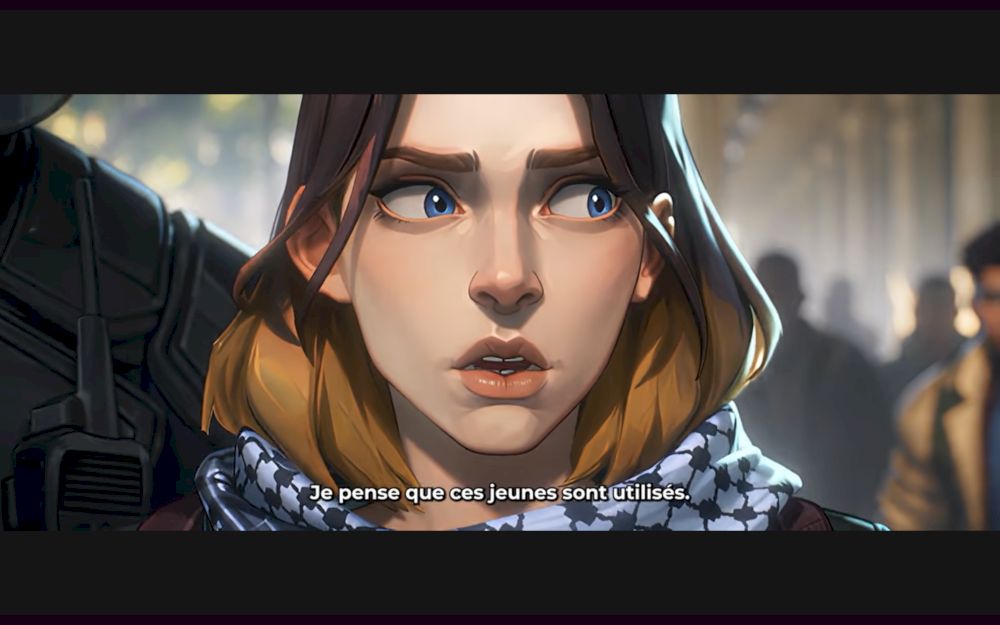
The second drawer deserves a closer look, because on one point the narrative tells the truth: the ultra-left has a body of thought. It is against capitalism and convinced that capitalism will not be overthrown through the ballot box, only through revolt, or alongside it. More broadly, it is a culture of street struggle. It has built its own world, its places, its rites, its songs and its vocabulary. That vocabulary, power and the mainstream media refuse both to hear and to use: they only ever speak of the ultra-left in their own language. For the word itself became a police category in 2008. With the Tarnac affair and the arrest of Julien Coupat, Interior Minister Michèle Alliot-Marie and the intelligence services popularised the “anarcho-autonomous movement” (mouvance anarcho-autonome) and the “ultra-left.” Until then a label confined to debates among Marxists, and one that none of those saddled with it ever really wore, the word became an intelligence category, and then the media’s name for the autonomes and the “black blocs.” It is the one Emmanuel Macron used on Sunday evening.
For this drawer identifies a uniform: the black bloc. That word was born in the early 1980s in the West Berlin police, who called the tightly packed contingents of autonomists the Schwarzer Block. It went international at the 1988 annual meeting of the IMF and the World Bank in West Berlin, was then appropriated as it crossed the Atlantic during the protests against the first Gulf War in 1991, and finally entered media vocabulary for good after the protests against the WTO in Seattle in 1999. In other words, the black bloc bears a name invented by the police and turned around by those it designated.
The blocs also have their language, and sometimes it fits in four letters: ACAB, for “All Cops Are Bastards.” Born in British working-class and prison slang, the acronym spread with punk and skinhead culture in the early 1980s, then reached football terraces and marches all over Europe. It is written on walls, tattooed on knuckles, encoded in numbers — 1312, from the letters’ positions in the alphabet. And it détourns itself endlessly: “All Cats Are Beautiful,” with cats drawn on banners to taunt prosecutions for insulting officers. In France, it has a cousin chanted in the marches since 2016: “Tout le monde déteste la police” (“Everybody hates the police”). TV panels hear only an insult in it; those who write it put a diagnosis into it: the police are to be judged as a function, not as a sum of more or less decent individuals. A function Kotányi called protection.
The “casseur”, the looter: the ones nobody ever asks
The ultra-left is at least credited with thinking, if only so it can be fought, because the ultra-left casseur attacks the symbols of capitalism. But the blind casseur and the shop looter don’t get that luck. They are presented as delinquents with no aim other than to wreck things and grab goods. No political opinion is granted them. Yet they reject, and to reject is already to think. Only, no one ever gets the chance to ask him what they think: they appear, smash, sometimes carry something off, are arrested or vanish. They are then silenced, or hide, return to their silence, their inner anger. Since they don’t speak, others speak for them, and the words “casseur” and “looter” once again stand in for a disqualifying answer.
The looter can be anyone. In the heat of anger, in the heat of action, in the window of radical freedom that has opened. In a country where more than 10 million people live below the poverty line, the looter expresses, for an instant, that taking one’s share of the outrageous display of unaffordable consumer goods is, after all, “fair game” — in the sense of a combat whose terms conform to the rules of conflict of the age: the contemporary age of generalised racketeering. And after all, as Konrad Becker reminds us in Dictionnary of Operations (Autonomedia, 2012), in the brand as in the riot, “Mimesis allows coming closer to others in regard to having company and finding out what the world is about.”
But perhaps he does indeed speak like Tony Montana, the anti-hero of Scarface, beneath his blimp reading “The world is yours”? Life is short, we are mortal, the rules are those of the dominant, who reproduce among themselves an ever-growing system of profit that works only for them. When you come from the margins, when you feel like a “junkyard dog”, you know you won’t get past this system in a single lifetime. So why respect its rules?
From Watts to Paris: the promise taken at its word
In August 1965, the Black neighbourhood of Watts, in Los Angeles, went up in flames. The entire American press spoke of rioters and looters. In December 1965, a Situationist International text attributed to Guy Debord, “The Decline and Fall of the Spectacle-Commodity Economy,” later reprinted in issue no. 10 of Internationale situationniste, took the opposite view: these looters were not thieves without a cause. They were taking the advertising of abundance literally. They are shown objects all day long; they want to use them now. The text adds an idea that hasn’t aged: the policeman is the servant of the commodity, the one who guarantees that a refrigerator remains an object that must be paid for. Looting suddenly reveals what hides behind the shop window: the uniform that guards it.
Replace the billboards of 1965 with the phone of 2026. Never has a generation been so constantly solicited by the commodity. It receives it in its pocket, from the influencer to the targeted ad, from waking to bedtime. And never has this generation been so certain it cannot afford it. Should we really be surprised that, for one evening, some abolished the distance between the screen and the thing? Debord, in his day, didn’t fool himself. He knew that the looting in Watts first realised the distorted principle of commodity society: “to each according to his false needs.” The consumer self does speak through the broken shop window, but in the act it is also the lie of abundance become truth in action, carrying both voices at once: that of the frustrated consumer and that of refusal.
“Bismillah, c’est les ténèbres”: when the police talk young
The movement’s most repeated slogan was not written by a high-school student. It reportedly comes from a Snapchat message attributed to an undercover police officer posing as a pupil to find out where the blockades would be. Its authenticity has not been established. But the caricature is perfect: a username, “Mamadou,” a clumsy mix of Arabic, slang and French, clichés piled on clichés about how “banlieue youth” are supposed to write.
It reads like an example straight out of Khayati. Power is not content with imposing its words; it also tries to speak the language of those it surveils. And it fails, because all it knows of that language is the stereotype it manufactured. The students did the rest: they picked up the phrase, wrote it in marker on their placards and turned it against its presumed author. A cop’s phrase turned rallying cry: the Situationists could not have dreamed of a better détournement.
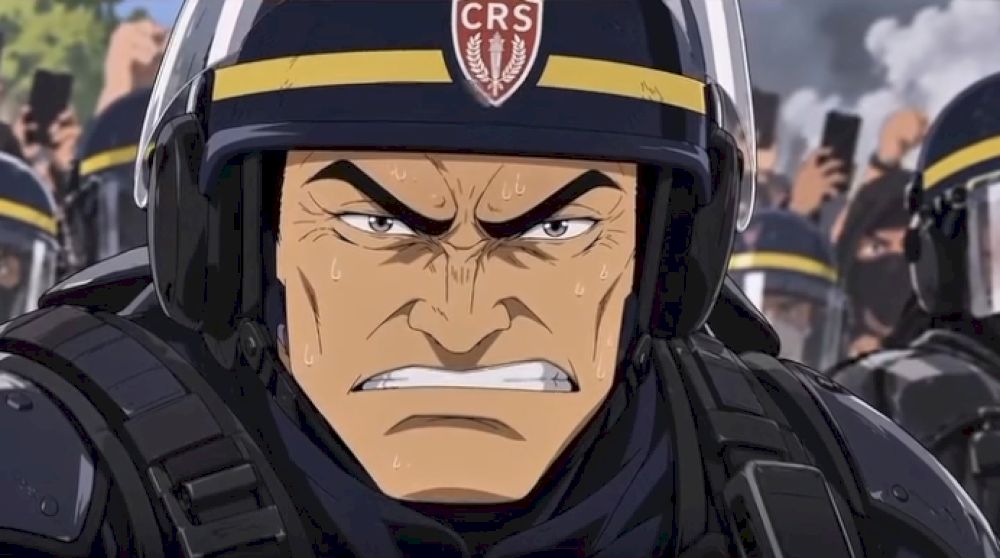
The rest of the repertoire follows the same logic. “Lecornu, t’es foutu, le 6-7 est dans la rue” (“Lecornu, you’re done for, the 6-7’s in the street”). “Ton budget, on le plie avec un scuba” (“We’ll wreck your budget with a scuba”). The “six-seven,” that absurd gesture born on social media, hands raised one after the other, has made its way into the marches, as has the “scuba,” a mimed dive with the nose pinched in one hand and a wave of the other. “Aura battles,” those duels of charisma, play out under the noses of the CRS riot police. Power sees childishness in all this. But when you are mocked in a language you don’t understand, you have already lost control of the narrative.
Gen Z calls on the roundabouts
On 7 September, an anonymous TikTok account set a date. The call circulated through former Yellow Vest networks, then met a high-school movement that was already massive. On 14 October, the Union syndicale lycéenne (a high-school students’ union) called on students to join the Yellow Vests’ day of action. The slogan going round said it bluntly: “Jaunes et jeunes, nos luttes se rencontrent” (“Yellow and young, our struggles meet”). And this meeting has a genealogy. In December 2018, at the height of the Yellow Vest winter, 151 high-school students in Mantes-la-Jolie were filmed kneeling, hands on their heads, facing the police. Those students are twenty-five today. Their younger sisters and brothers grew up with those images, and with those of the roundabouts. Their anger already has a history.
Détournement has also changed scale. The pirate flag from One Piece flies in French marches. On TikTok and Instagram, AI-generated videos turn real footage of the blockades into Japanese anime. They get millions of views. One of them ends on men in yellow vests and a promise: 17 October is coming, and so are the Yellow Vests. The convergence was staged before it happened, in the very language of the entertainment industry.
Voir cette publication sur Instagram
Debord saw the spectacle as a monopoly of the image held by power. That monopoly has cracked. A generation that grew up in the flow of screens has learned its grammar, and uses it to write its own serial. People now speak of “gilets jeunes” (“young vests”).
Power, for its part, answered with its usual words. It didn’t see a generation; it saw “casseurs.” It didn’t see the freeze on benefits, the price of petrol or overcrowded classrooms; it saw “disturbances,” which the interior minister and the media describe as happening “on the fringes” of the demonstrations. But when an entire age group takes to the streets, talking about fringes no longer makes sense.
Power also answered with its weapons. In late September in Tours, Maël, 16, lost the use of an eye during the blockade of his school. On 5 October in Lens, a 15-year-old demonstrator had his hand torn off by a grenade. And on 17 October, the list grew longer: in Saint-Étienne, a 17-year-old had his hand torn off by a police grenade, and in Mulhouse, a 17-year-old schoolgirl lost an eye. A generation is learning politics by counting its eyes and its hands.
Instagram screenshot. Credit: @madara.931_
A 17 October to leave the era
In history class, French students are taught that the “contemporary era” begins in 1789, with the storming of the Bastille. When they write that they are going to leave it, the classroom joke hides a dizzying ambition: to exit the “contemporary” that 14 July opened, with its institutions, its rituals and its way of doing politics. Another placard read: “Y’aura pas de 18 octobre” (“There won’t be an 18 October”). The next day came anyway, but the sentence said what it meant: we will not go back to normal.
21 April in reverse
On 21 April 2002, Jean-Marie Le Pen reached the second round of the presidential election. The country woke up stunned, and high-school students took to the streets in their hundreds of thousands to block him. Those marching today were born after that date. For them, the far right in the second round is part of the landscape: they saw it in 2017, then in 2022, before they were even old enough to vote. The “republican front” has shrunk to an instruction that is endlessly repeated to them.
The 21 April in reverse taking shape in the marches is the exact opposite of 2002: no longer a surprise that comes from above and must be warded off, but a surprise made from below, and hoped for. This generation is ready to fight for a 21 April in reverse to finally happen. And it wants to win the “insoumise” (“unbowed”) victory its parents never had — they who have done nothing but vote “against” for twenty-five years.
Sunday, 8 p.m.: the dictionary has spoken
Emmanuel Macron’s address this Sunday evening could have served as an illustration for Kotányi. The whole vocabulary was there. “Seditionists” from “ultra-left groupuscules,” joined by numerous “delinquents.” And that sentence which sums it all up: “Nothing justifies it, nothing explains it, nothing excuses it.” Before seeking to understand, the president decreed that there was nothing to understand.
Then comes the sorting, made explicit: on one side the demonstrators with legitimate demands, on the other those who smashed and looted, who must never be confused with them. And the sanction, worded like an invoice: “Those who looted must pay it back.” Debord would not have dared write it. Faced with a revolt that questions the commodity, power replies that the commodity must be paid for. It restores the shop window. As for the evening’s flagship measure, it entrusts prefects, together with mayors, with protecting towns, public buildings and shops, up to and including banning gatherings. Curfews soon followed. Kotányi wrote it in 1960: protection is the key word of the racket.
Youth did get a few sentences. The president acknowledged its deep anxiety and promised it a seat at the table, alongside unions, elected officials and employers. But not a word for its wounded, neither for the hand torn off in Saint-Étienne nor for the eye lost in Mulhouse. And not a word of its language. No “Bismillah,” no “six-seven,” nothing of the era it says it wants to leave. It is offered a chair in a meeting room of the contemporary era at the very moment it announces it is leaving. The promised dialogue begins with a complete misunderstanding.
Giving words back to those who lost them
The Situationists had no sociological survey to set against the official narrative. They had something better: a methodical suspicion of the words of power. We lack that suspicion. Each time we accept the word “casseur” without question, we also accept the conclusion it contains: that there is nothing to understand.
Yet there is a great deal to understand. A generation that is sold everything and refused almost everything. A generation that saw its elders blinded on the roundabouts and drew the lesson that politeness doesn’t pay. A generation that détourns the objects of commodity culture to make them its flags, and which, one October evening, détourned the shop windows themselves.
One can condemn; that is the job of ministers and of the news channels of the established order. One can also listen. Kotányi proposed reading racket where they write “society” and gangland where they write “neighbourhood.” The young people of 17 October never read him, but they asked the same question with the means they had: who protects whom, and against what? As long as we answer with the word “casseur,” they will be right to think that we have stayed behind in the era they have just left.