
Wet witches and rewilded biotech: bastard protocols for how to grow a homunculus (badly)
As the Feral Labs network’s “Rewilding Cultures” program draws to a close, it is publishing its third “Node Book,” titled “Fa Fa Futures.” Makery is publishing several essays excerpted from this freely available volume. This chapter by WhiteFeather Hunter discusses the feral turn through a feminist technoscientific methodology that reclaims the unruly, the embodied, and the affective within biotechnological practice.
The Feral Labs Node Books are a series of interconnected publications produced by the Feral Labs Network within the framework of Feral Labs (2018-2021) and Rewilding Cultures (2022–2026). Combining theoretical reflection, artistic research, ethnography, speculative writing, and visual documentation, the books foreground practice-based knowledge and experimental forms of collaboration. The Feral Labs Node Book #3: Fa Fa Futures explores how feral artistic and research practices interact with institutions, infrastructures, crises, and systems of control. The volume focuses on accountability, survival, care, and the continuation of practices beyond temporary funding structures.
Turning TechnoFeral
I begin this chapter by introducing the concept of the feral turn, borrowing from other onto-epistemological turns, such as the material turn in feminist technoscience. Where these previous turns positioned “matter” within philosophical discourse, the feral turn repositions theory within matter—within wildish ways of being and mucking about in a wet, leaky in-between—where theory is inseparable from the material/ecologies of bodies that enact it. Anna Tsing et al. have described the feral in terms of “ecologies that have been encouraged by human-built infrastructures, but which have developed and spread beyond human control” (1). Following this logic, feral practices, as I will discuss, facilitate a conceptual and methodological shift towards unruly modes of knowing/making that reclaim an impure, uncontrolled sense of the material self within technoscientific experimentation; here, ferality counters the threat of stasis/stagnation that would stymie psychic and collective individuation. To provide concrete examples of this, I will demonstrate how the feral turn is epitomised by bio-art and bio-craft (as I practice it) that deviates from institutionalised systems of canonised and even “innovative” compartmentalised knowledge, to root into deviant, fleshly interiorities: fluids, tissues, hormonal cycles, and cellular processes as active sites for creating resistance and regeneration.
Yvonne Billimore writes in the introduction to Feral Labs Node Book #2: Feralities that “[o]ften bound with negative associations and oppressive dimensions, the term feral has long been used to demonise and exclude those deemed untameable, those who step out of line, human and more-than-human. Yet, more and more of us humans acknowledge our inseparability with ferality and embrace it as a positionality: a refusal to be tamed” (2). To build on this reclamation of ferality as a mode of defiance in the face of homogeneity and demonisation, I position the feral turn in feminist technoscience adjacent to the concept of ruderal witchcraft, articulated by Margaretha Haughwout and Oliver Kellhammer (3). In A Ruderal Witchcraft Manifesto, Haughwout and Kellhammer locate resistance, ferality, resilience, and magic in disturbed or marginal landscapes—particularly those characterised by unmitigated, ambivalent weediness. While ruderal witchcraft tends to the power of mutability of external ecologies, the feral turn in feminist technoscience applies these logics inward towards the visceral, leaky, insistent, and sometimes volatile terrain of the body.
Ferality, as it relates to witchcraft in my work, reframes intuition and interoception as wildish sites of speculative practice, animated through ritual, co-creative protocols, and bastardised science. Thus, to turn feral is to rewild method by generating knowledge that is deeply affective, materially unstable, and interchangeably situated, especially in response to corporatised biotechnology. I engage biotech and its proto-cols as spellwork to claim epistemic autonomy, through menstrual blood, mucus, stem cells, saliva, sperm, and other traditional materia magica. This positioning also aligns with what has been described as the “material spiritual” (4), following the legacy of influential American sociologist and science studies scholar Susan Leigh Star. Firstly, Star offered a scaffold for reclaiming material agency while confronting political structures embedded in lab-based knowledge. She explained how such work operates within ecologies of knowledge, and “by ecological we mean refusing social/natural or social/technical dichotomies”; specifically, by asking material questions, such as “What is the material basis for practice? Who owns the means for knowledge production?”, while also horizontalising science itself as “just something that people do together”. Working in this way “challenges the moral order of science and technology making—and in turn places us in a complex, often tense moral position” (5). Further to this, Star has referenced Bruno Latour and Steve Woolgar to analyse the “progressive stripping away of contextual information about [scientific] production, with the end result being a fact bare of its own biographical information”. She discusses this as ethnomethodological act-making, a process which came under critical scrutiny following the publication of Latour and Woolgar’s book Laboratory Life: The Construction of Scientific Facts (6). This ethnomethodological act-making is precisely the material spiritual strategy (and philosophy) I have come to subversively employ with my laboratory video performance works, towards feminist aims.
Feral feminist technoscience (which I have previously named technofeminist witchcraft) is a mode of inquiry that merges critical legacies of feminist technoscience with interpersonal aspects of creativity to refuse reductionist institutional logics and compartmentalised, depersonalised/sanitised methods. Where mainstream technoscience stipulates objectivity, sterility/distance, and control, feral feminist technoscience deliberately embraces subjectivity and mess. It binds knowing to empiricism through unfolding, lived experiences, finding catalysis through bleeding and ejaculating bodies, hormonally shifting states, and rogue lab work. In this, meaning is constructed and deliberately prioritised through the performance of feminist critique (as ritual), along with the technoscientific and artistic artefacts that arise from such experimentation. Feral, in this framing, names the unruly body within the spaces it inhabits, an intra-ferality. Similarly to weeds that push through the cracks of concrete walkways that have been ruptured by tree roots, so too do certain cultural sites allow conditions for unlicensed growth within institutional frameworks. Artist residencies often occupy such fertile breaks: half-inside, half-outside the institutional apparatus, recognised but not entirely controlled. These are boundary spaces, ruderal spaces, spaces that witches are known to frequent, as Haughwout and Kellhammer have described. Resonant with ruderal witchcraft, actions within and upon these sites can be used to remediate the knowledge silos that choke research within formalised fields of specialisation. Through the permissive ambiguity of an artist residency, one can enact experiments that would be far more difficult in fully surveilled institutional laboratories. Protocols can be jockeyed and bastardised, disciplines entangled, and in the case of my examples here, failures left to transform through decomposition.
To enter a residency with a feral orientation is to treat it as a site of rapid germination: to take up its thinly eked-out resources and persist in creative disruption, relatively ungoverned. In my practice, such artist residencies have functioned as generative, materially complex laboratories, in a broad sense. These zones become sites of biotechnological intervention and deep engagement in community co-creation. In this chapter, I present three case studies of such residency spaces, where ferality, as witchery and feminist tech disruption, was encouraged to flourish. Two of the three residencies are within the Feral Labs Network.
From field to flask—seed, spell, and stem cell
My feral trajectory unfolded across a continuum of short-term projects that map a movement from landscape as laboratory to biolab as ritual terrain, with each residency site catalysing different forms of methodological divergence. The origin point was the Museum of Witchcraft and Magic in Boscastle (UK), where I engaged the smurry crags of Cornwall as a generative, occult site for bibliographic and artistic inquiry. Here, bastard protocols were first conjured through a ritual using improvised instruments and donor bodily materials, to disrupt lineages of sterile lab work by embedding it in shit, flowers, and folklore (Fig. 1). This phase was followed by the TTTlabs BioFeral.BeachCamp in Crete, which served as an interstitial zone that bridged landscape and laboratory. This 10-day residency encouraged experimental co-creation with other artists and researchers, where I was again able to coalesce ritual and rogue protocol through choreographed performance and video production, using donor body materials towards (possible, unconfirmed) human in vitro fertilisation. Finally, through a three-month residency with Cultivamos Cultura, co-hosted by the Graça Lab at the Gulbenkian Institute for Molecular Medicine (uLisboa), I advanced this trajectory into the domain of wetlab experimentation using primary-sourced, wild-type cells from my own body. Here, the feral turn became literal: my menstrual cells and accompanying vaginal microbiota entered the petri dish as both clinical samples and co-creative agents in standard tissue culture experiments, towards speculative aims. Across this continuum, the residencies enacted a rewilding of technoscience itself, where the site of knowledge-making wavered between canonical lab and haunted field.
Within my interconnected activities, the residency structure served as co-agent in my hacked methodologies. Each site offered a unique ecology through which to enact protocols that meandered around the rules of traditional biotech, regenerative medicine, and taboo. For example, the ritual crafting of bastardised homunculi using my menstrual fluid with donor sperm bled into the transformation of menstrual stem cells into neuronal types in a speculative line of sexed organogenesis, the details of which will follow. Such materials and methods further fostered the build of a new biotech apparatus through a later, additional artist residency … though that is a story for another chapter. Through process, place, and participant agency, the residencies became hotbeds of epistemic leakage; they enabled outgrowth beyond scientific boundaries as well as reclamation of bodily autonomy through improvised technoscientific space—from the prim garden box of a medieval village museum, to an open-air art annex, to infiltrated lab bench, and beyond. I propose that in this way, artist residencies can be conceived of as feral co-producers, as zones of fugitive research-creation that upends bureaucracies: living, weedy/seedy (ruderal) environments where distributed agency, human and more-than-human, cellular and symbolic, unsettles and rewrites the confining logic of the institutional lab.
Case study I: Conjuring the bastard—The Museum of Witchcraft and Magic (UK)
This case study discusses the site where my bastard protocols originated, through a queered concoction for artificial life. This site, not a laboratory in the conventional sense, provided the initial conceptual and material ground for initiating a feminist technoscientific method that would later become central to my recipe. I first discovered the proto-being called homunculus within the archival records and occult library of the Museum of Witchcraft and Magic during an artist residency in late 2022. I returned in 2024 to culminate that research into an exhibition around the theme of occult blood. Numerous works in the collection of the museum, including arcane manuscripts and contemporary artworks, referenced this synthetic human-in-a-bottle. The homunculus, a curious alchemical experiment, represents one of the foundational fantasies of patriarchal science, rooted in concepts of “preformation”: the belief that sperm contains a miniature man, already formed and ready to slime into being like a soaked chia seed.
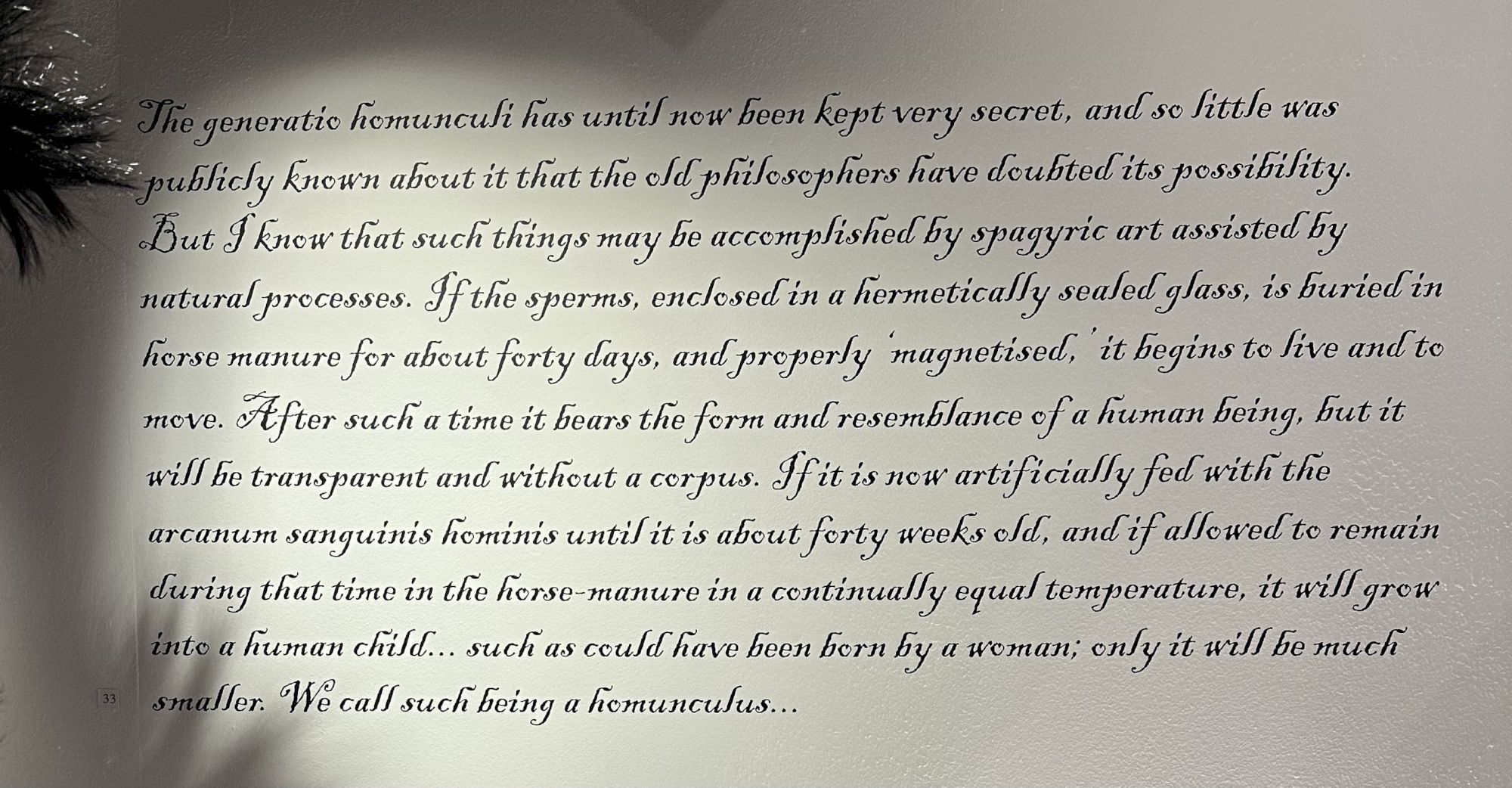
This proto-scientific myth envisions the creation of human life without need for a uterus, ovum, or any participation of a reproductive cis-woman at all—just sperm incubated in glass, placed inside a horse’s “belly” and nourished with a secret male blood nutrient: arcanum sanguinis hominim (Fig. 2). Essentially, the homunculus presents human conception sterilised of female flesh, blood and, importantly, pleasure, while under technomasculinist control. The recipe, developed by early modern alchemist Paracelsus, set a chilling precedent in its erasure of the maternal and resultant abuses of the more-than-human. From Paracelsus’ rapey equine incubator to modern biotech’s continued preference for bovine, equine, or human male blood in tissue culture protocols, this gynephobic lineage persists—a legacy of technological supersession of the unruly and often uncooperative, cyclical female body. This is what my work means to rupture in a return to wildish ways: utilising stigmatised and self-sourced (“wild-type”) blood and cells, as well as implementing affect, consent, queer pleasure, and multiplicity.
During my residency, I discovered a specific, anomalous document within the museum’s archive: a hand-drawn illustration from the Richel Collection, inscribed with text detailing what seemed to be a creative variation or folk adaptation of the Paracelsian homunculus procedure (Figure 3). Unlike the canonical version that relied on sperm, this version substituted menstrual blood towards more feral results: producing a medieval basilisk—a noxious, hybrid creature comprised primarily of cock and snake. I treated this document as an operational script to be reactivated through my own contemporary practice.
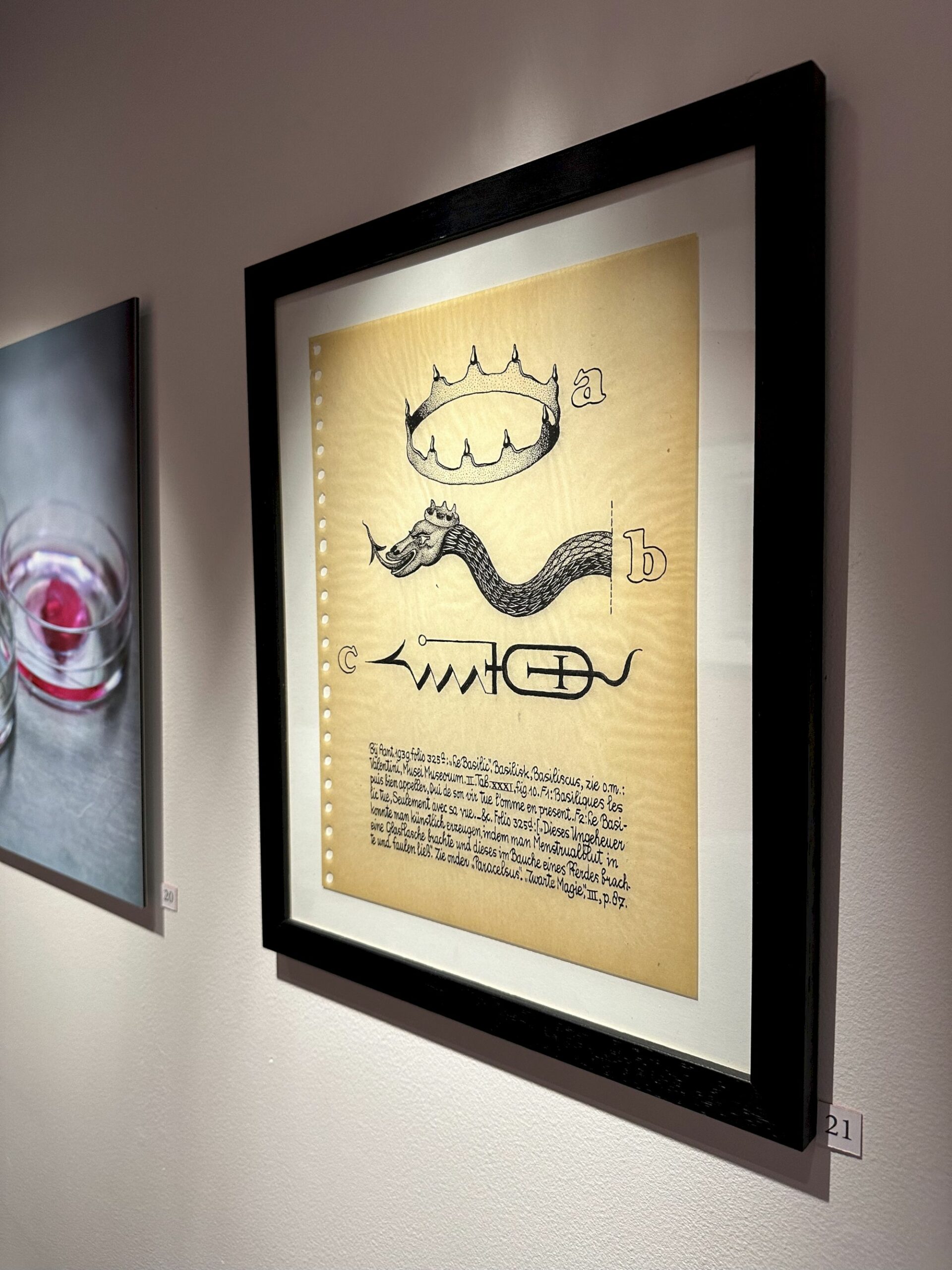
The bastard protocol I developed from this illustration centred my own uterus as both a biologically and mythically dynamic zone, whose shed regenerative capacities provided a material and metaphorical base for in vitro monster conjuration. By engaging the document through an iterative process of interpretation, assemblage, and material testing, my methodology shifted from researcher-as-observer to practitioner-as-participant. The Museum’s own framing of knowledge contributed to this methodological play: its objects are categorised by function as well as by magical and cultural significance. This blended positioning, which placed importance on both utility and meaning, opened space to engage the archive as a co-agent in activating my experiment.
My protocol was as follows: Mix an illegitimate scientist (me) with an additional three queer witches—all gay men—to surreptitiously concoct an in vitro beast. This protocol is non-monogamous; it cannot be faithfully reproduced but only shift with each cycle, body, and configuration of season, sky, or ecology. Results are not guaranteed. Promiscuity is encouraged.
I gathered my intimate collective of witches during a lunar eclipse, when all things dastardly or mutant or socially cataclysmic might come to pass; this occasion was used to ritually transgress norms of reproduction perpetuated in Western technoscience (and in apotropaic rituals historically used during eclipses to waylay birth defects). The materials we carefully gathered from ourselves are all seemingly non-reproducing and socially rejected: menstrual blood, signifying a so-called “failure” to impregnate, with spermatozoa from bodies not interested in the inside of a vagina nor convergence with uterine walls. Such fluids are typically deemed waste; read: tainted surplus and perverse ooze, never meant to carry forward a patriarchal lineage. However, under the obscurity of our dark celestial event, they became potent together. As Haughwout and Kellhammer explain, “[t]he wastelands are a power that conjure witches into being”. Our shady materials became portentous, potentially able to call forth a creature even more profane than that in the original recipe—a feral humanimal to confound Paracelsus’ androcentric creation. What might emerge was not entirely the point, though we did of course fantasise its possibilities.
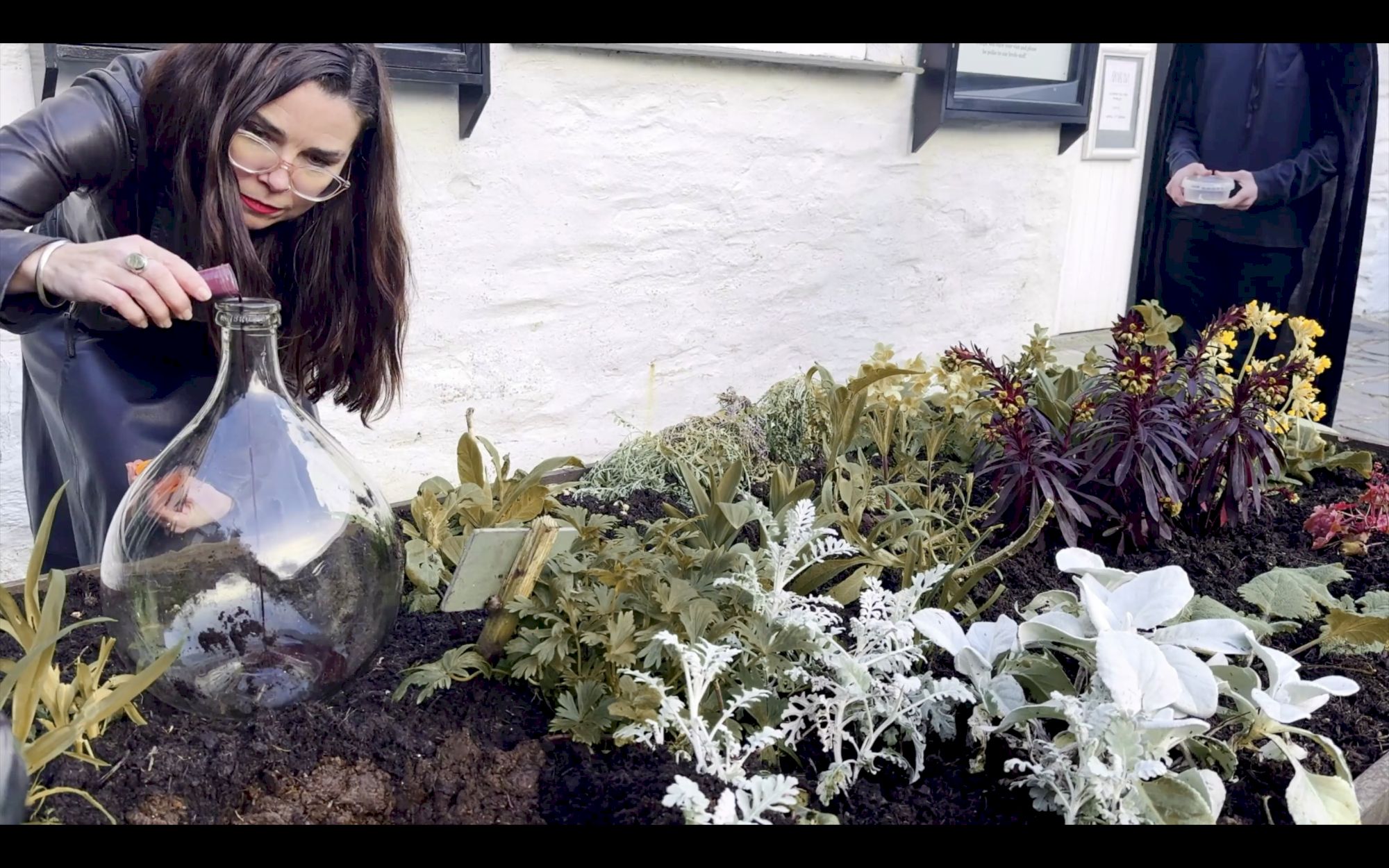
After ceremonious in-cantation of our mucusy fluids together into a curved, glass wombspace, we ensconced the carboy in a pit filled with fresh manure acquired from an equestrian neighbour. Our mix would incubate in its fecal cradle for a festering 40 gestational weeks—hidden out of sight, or occulted, within a deceptively quaint country garden box (Figure 4). The polite English flora (along with arrhythmogenic plants such as aconite, or “monk’s hood”) became camouflage, hiding esoteric-artistic ferment beneath the protection of heart-stopping, decorative distraction (Figure 1). As Haughwout & Kellhammer have explained, “ruderal witches must be at times tactically poisonous, ugly, unreadable, or dangerous in order to elude … forms of accumulation and extraction”. Our slith’ry offspring would be well guarded against any premature digging.
The truly bastard part of the protocol was in its refusal of domestication, opting instead for reproductive nonconformity and risk-taking. In our heretical act, my intention was to foil the tidy sequestering of reproductive technologies in the hands of corporatised research models and spaces through our enactment and adaptation of progenitor scripts. What was carried forward into materialisation was its next iteration in an equally mythologised place: Crete.
Case study II: Fringe entanglements—Ionian University (Greece)
TTTlabs BioFeral.BeachCamp, organised by the Ionian University, took place on the island of Crete, at the Athens School of Fine Arts Rethymno Annex. As part of the wider Feral Labs Network, TTTlabs encourages creative uncertainty through spontaneous, sometimes uncomfortable collaboration with (mostly) strangers, within the context of new reproductive technologies.
In this instance of TTTlabs, the topic of zombies, or the half-animate/re-animated was included, adding camp macabre to the mix. Regarding this, and pertinent to my interests, “[r]uderal witchcraft is a practice of conjuring the dead. Ruderal ecologies already perform necromancy …”. I will revisit this concept in interpreting laboratory procedures in my next case study, but what I’m interested in here is Haughwout & Kellhammer’s notion that witchiness resides in the refusal to incessantly drive forward into the catastrophes of future “progress”, and instead embrace hidden knowledges where meaning is found in the “moral claims of the past”. Indeed, with species disappearance and capitalist interests in commoditising de-extinction technologies, we are already in the Necrocene (7) or, further, the Neganthropocene (8), a realm not merely of extinction but of managed extinction. With TTTlabs BioFeral.BeachCamp, biotech was stripped of the glossy institutional “innovation” veneer and controlsto be reconfigured as a feral practice where failure, cannibalism, undead mess, and ancient myth had chaotic potential for moral reconfiguration and the generation of new approaches and perspectives.
In this new context, my bastard homunculus protocol was adapted in collaboration with Canadian filmmaker Elizabeth Littlejohn into a communal ritual experiment and performance-based video production. While the original ritual at the Museum of Witchcraft and Magic had queered and inverted the Paracelsian protocol by blending it with a hermetic basilisk recipe, our Cretan iteration expanded my site-responsive praxis through localised mythic references. We gave it the title Mooncalf Homuncularium, and we used specific props to cue Ariadne and the Minotaur (Figure 5). A red cord was unwound as a bloodline tether, not only to evoke menstrual continuity and our speculative bio-lineage but also to symbolise Ariadne’s leading role in labyrinthine navigation—and the myth’s contemporaneous connotation of unravelling ethical dilemmas (Figure 6). Further to this, the minotaur, a hybridised bastard child, stemmed from the bestial lust of Cretan witch and moon goddess Pasiphae after she mated with a magnificent white bull. As such, this myth also referred to the Mooncalf project of my earlier speculative biotech works that were part of my doctoral research. These quiet associations underlying more overt, profane acts were subconsciously revivified and reworked through our engagements with situated cultural history.
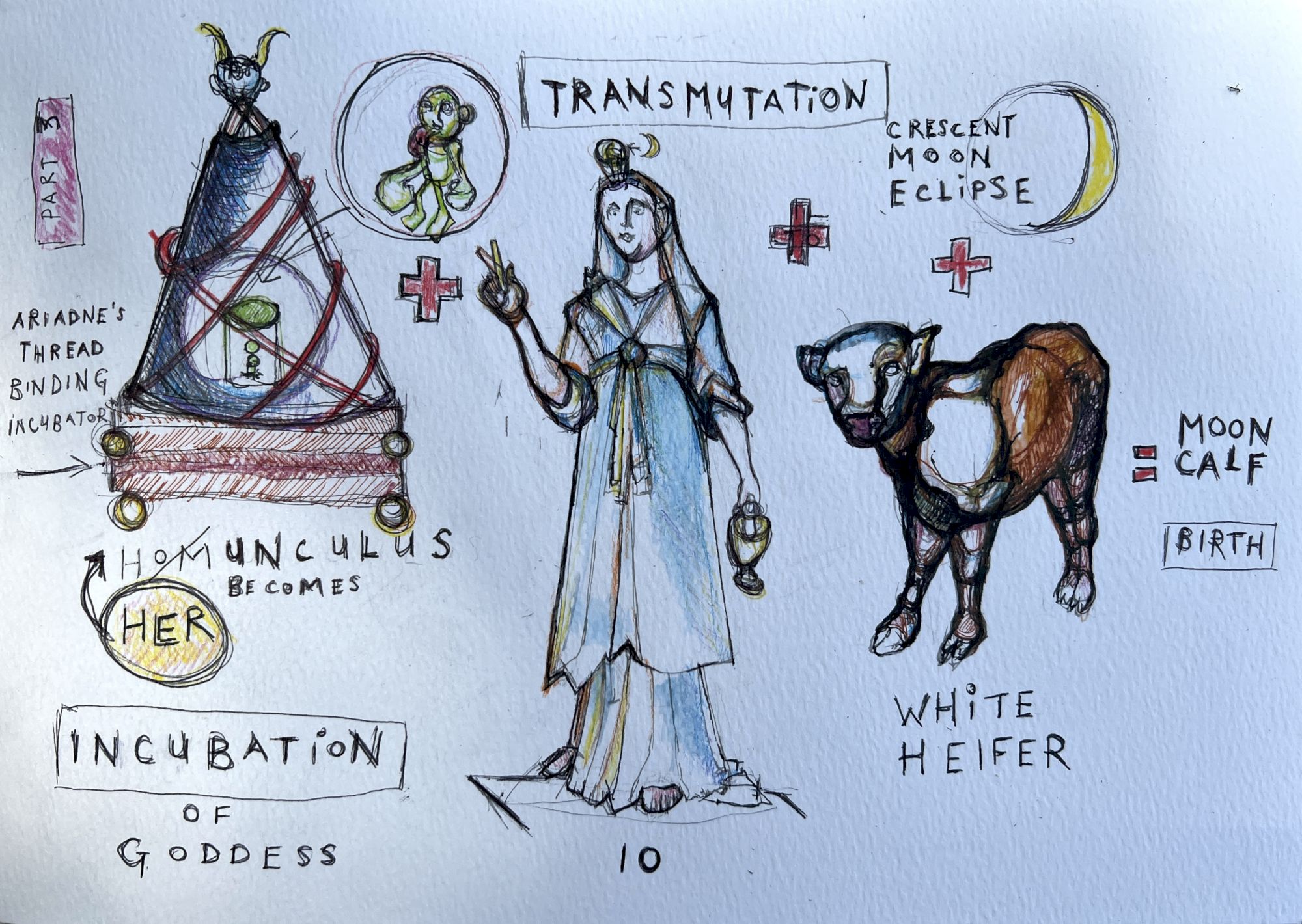
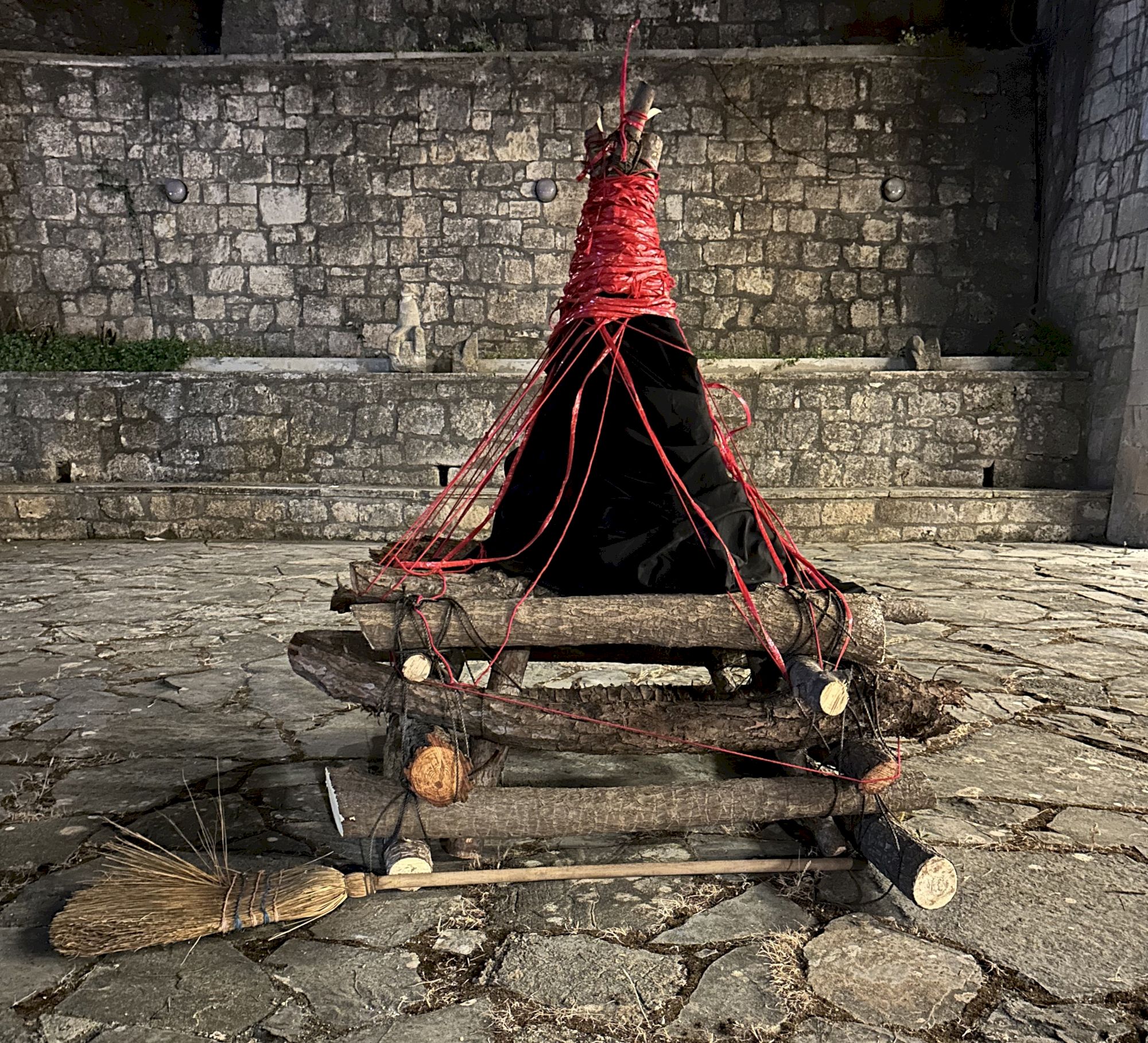
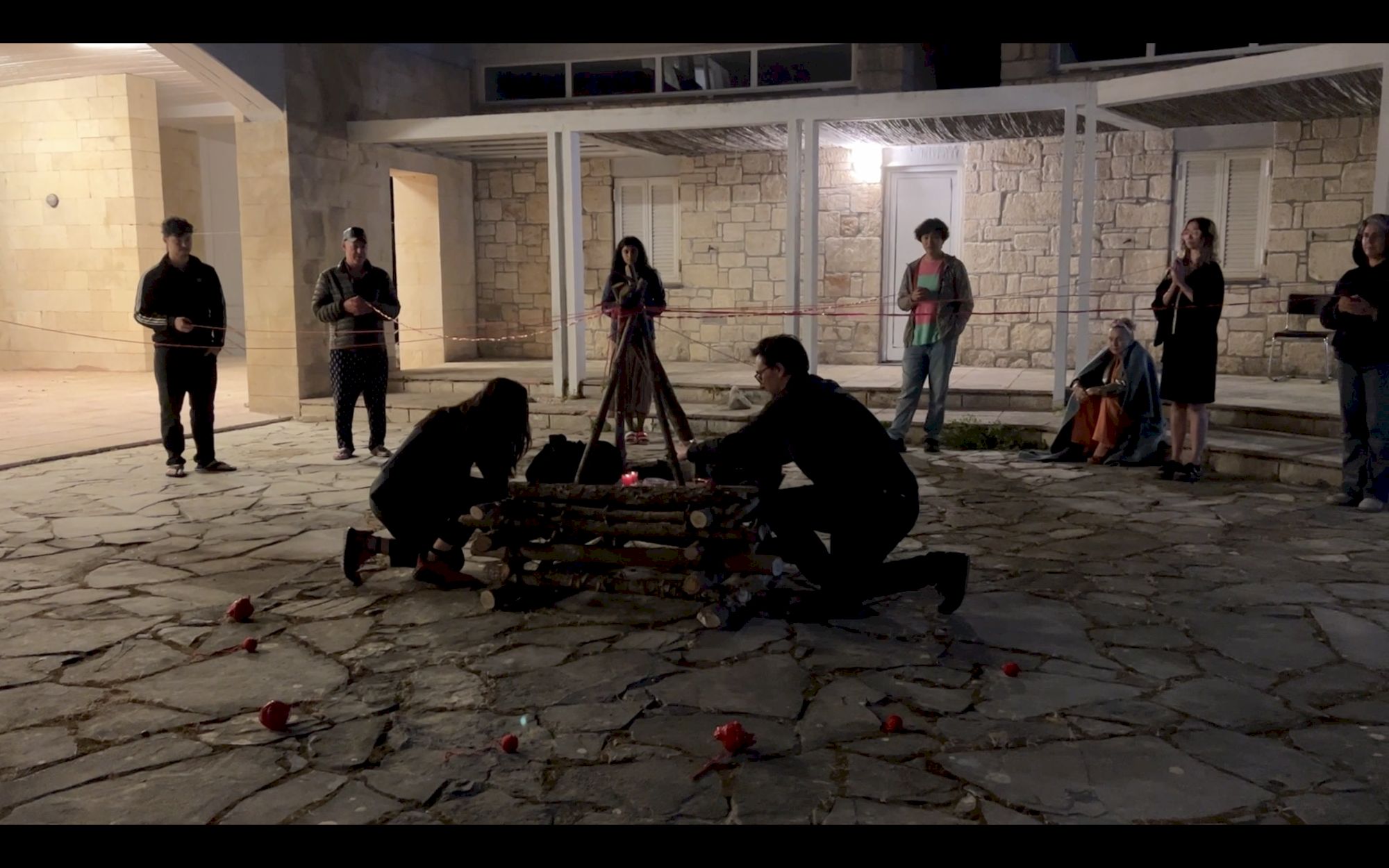
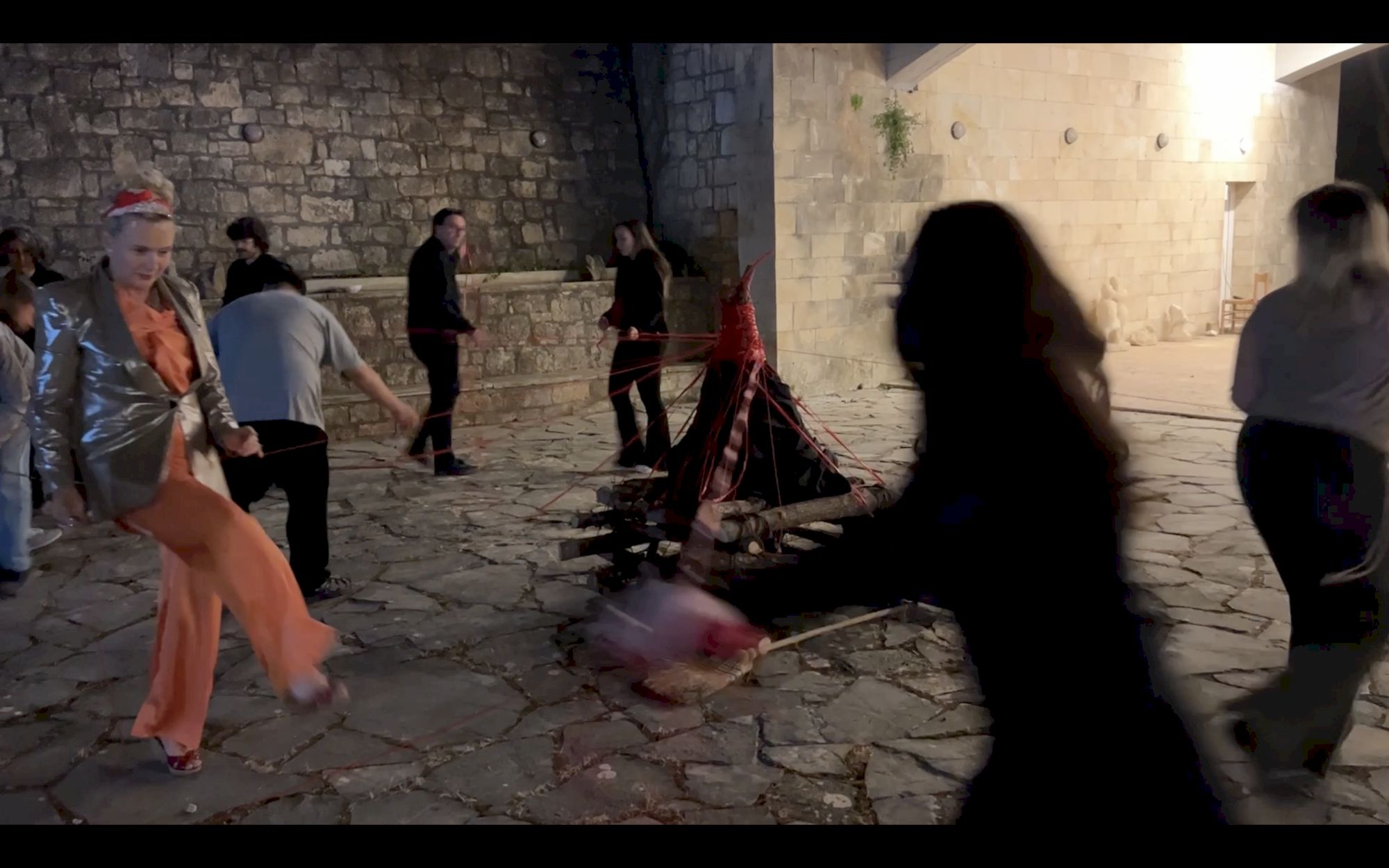
Our ritual preparations included group construction of an incubation hut from foraged tree limbs on-site at the annex, bound and stitched together with our red cord. Under my loose choreography, residency participants gathered around the hut in a wide circle to make body fluid offerings from their pre-collected samples (Fig. 7). Again, the event coincided with a celestial event: this time, a solar eclipse. Through a processional line of willing participants, menstrual blood, sperm, saliva, tears, plant resins (and who knows what other undisclosed substances) were contributed to a single glass vessel housed in the hut. These contributions triggered a spectrum of affect: at times sombre, other times ridiculous. Rather than directly mimic “life” as Paracelsus had formulated it, our movements were to return laboratory processes to a relational, ecological, and unruly state. Intentionally infusing microbial and social contamination into the vessel seeded new possibilities for creation, whether that be the temporary fertilisation of a shed egg cell contained in the menstrual fluid and mixed with donor sperm, or otherwise. Again, in this space, the possibility of creation did not reside in producing a viable embryo but in the performative act of collective contribution and then letting the work fester in its own mythopoesis. We sealed our ritual with a clumsy adaptation of a traditional fertility rite (a maypole dance), each participant holding the end of a segment of red cord affixed to the incubation hut (Fig. 8). Weaving haphazardly under and over each other, clockwise and widdershins, this dance was the literal materialisation of our bound energies: awkward, playful, breathless, and futile. Our makeshift laboratory, built from the landscape and now activated, was later placed back into the same landscape as a permanent, albeit mostly organic installation—to be slowly absorbed back into the ruderal terrain.
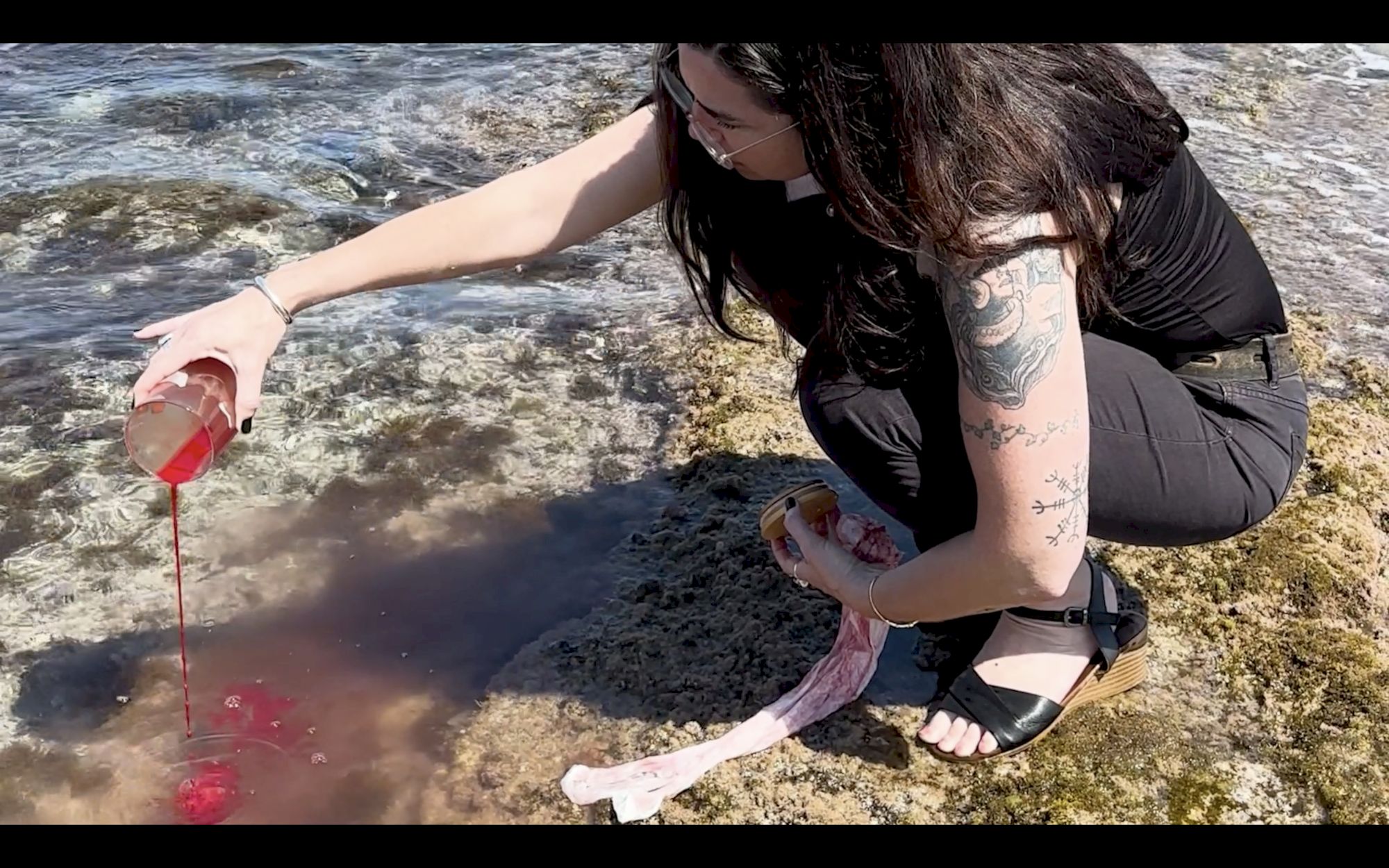
The carboy from the first ritual in Cornwall thus became a “boundary object” as described by Leigh Star—for me, it signified a feral process, its story retold, method re-bastardised, and then re-enacted in a new landscape. Performing such intimate acts with strangers, in a strange place, utilised discomfort as a technique. Discomfort, as a feral measure, works to make obvious any cultural underpinnings of what may be presumed as science and its implications. In the end, the TTTlabs ritual protocol, like the witchcraft museum protocol, didn’t yield a conventional result; no homunculus stirred as an in vitro miracle of science and art, that I know of. What emerged was an embodied experience in techniques of magic, activated through collaboration as a methodology that perverts the sanctity of technoscience with the mess of blood, dance, desire, and in the end, the cleansing buffer of seawater (Fig. 9).
Case study III: signs of bastardisation—Cultivamos Cultura (Portugal)
The final stage of my feral trajectory led me to the institutional laboratory of Dr Luis Graça at the University of Lisbon, through a partnership with Cultivamos Cultura. This residency represented a pivot from speculative ritual to that of reproductive biotech proper—yet, perhaps, not so proper. Where earlier sites engaged the landscape as laboratory, the Graça Lab was a space of (permitted) infiltration and ritual residue. After fulfilling the mandatory vaccination requirement, administered at a kitchen table as makeshift medical office, I was authorised to work with the “wild-type” cells I sourced from my menstrual fluid.
The techniques I employed, neuronal induction and differentiation protocols (to shapeshift stem cells into brain cells), are standard in stem cell research, yet they became haunted by continuity, carrying biochemical echoes of my prior engagements in Cornwall and Crete. The same kind of stem cells swishing in the fluids of my earlier rituals were now my choreographed participants in petri dishes; I imagined the samples might have carried the layered memory of their collection: moon phase, menstrual cycle, atmospheric conditions, medical intervention (which delayed my menses), and creative intention. Echoing Star’s material spiritual inquiries, particularly the question of “who will see the spaces between” (9), I pondered: were these cells entangled with their shit-cradled cohorts across interdimensional space? In this context, ritual science met regenerative medicine. Every cellular morphology was coaxed by bodily and planetary forces from which the cells had emerged, and these aspects would not be erased by usual requirements for anonymity in clinical studies. The grafting of the personal and the communal ritual onto the lab constituted a bastardised technoscience that refuses to sever knowledge from body and intuition from innovation.
Watching fresh cells, taken directly from my menstrual cup and animated through live cell imaging microscopy, gave me the opportunity to interpret their visible changes symbolically: as sigils, a new vocabulary of meaning where innate tendencies (autopoiesis) of my material body were influenced by micro amounts of biochemical growth factors I’d added to them. Brain-derived neurotrophic factor (BDNF) and other liquid messengers triggered morphological responses, such as axonal-like elongations that became visual markers of an emergent language I strived to decipher: signs of experiment success, failure, or perhaps another indicator? (Fig. 10) What was a successful experiment, anyway? Following Latour’s observations of lab work “guided by an invisible field” and aligning with Star’s impetus to invent languages that examine hierarchies of credibility in science and technology studies, I was inspired to author(ise) my own nonverbal tome of cellular meanings, presenting a kind of cellomancy. Thus, my reading of cellular behaviour laid the foundation for what would become a new work, titled Z-stack (Fig. 11).
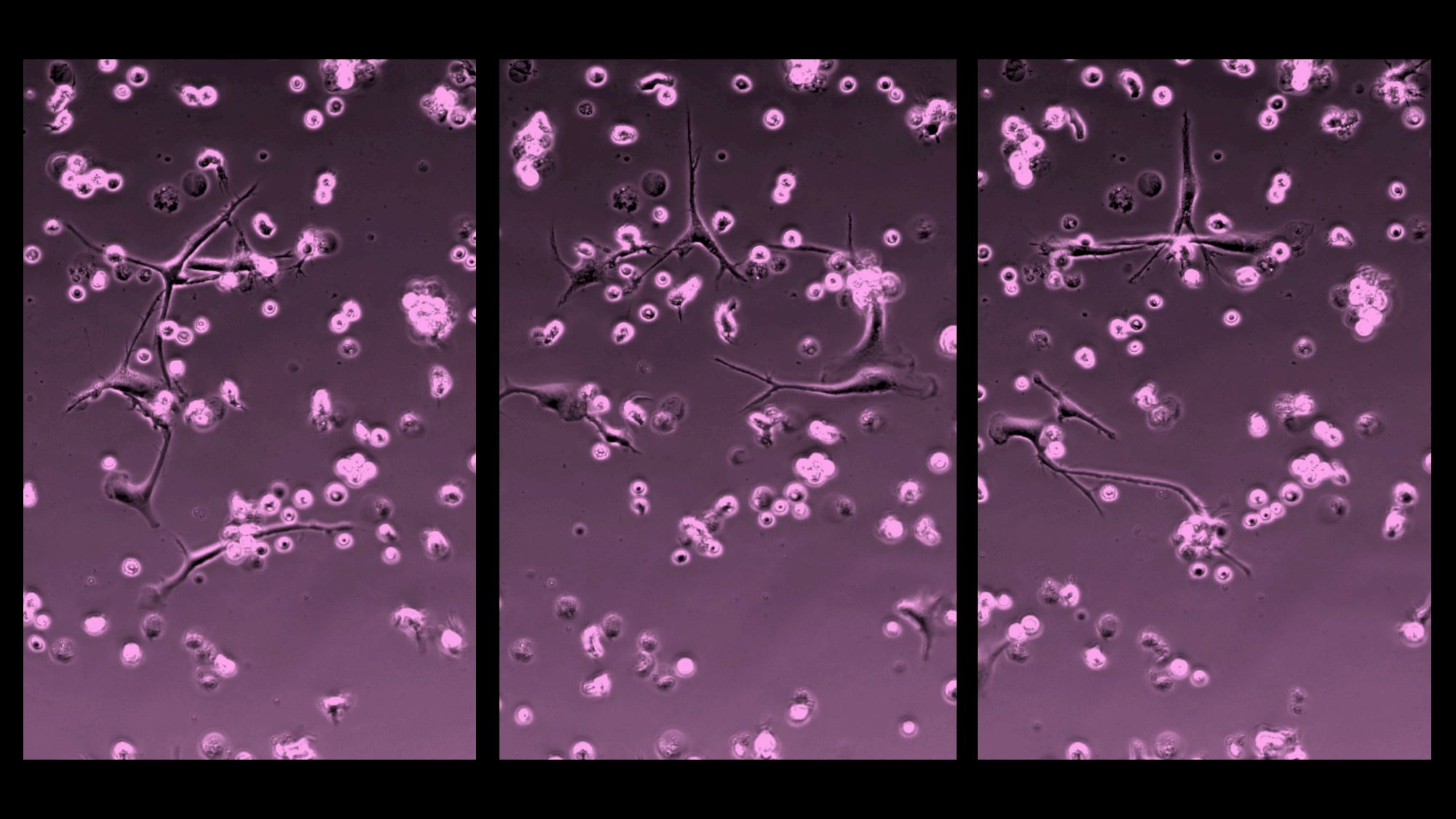
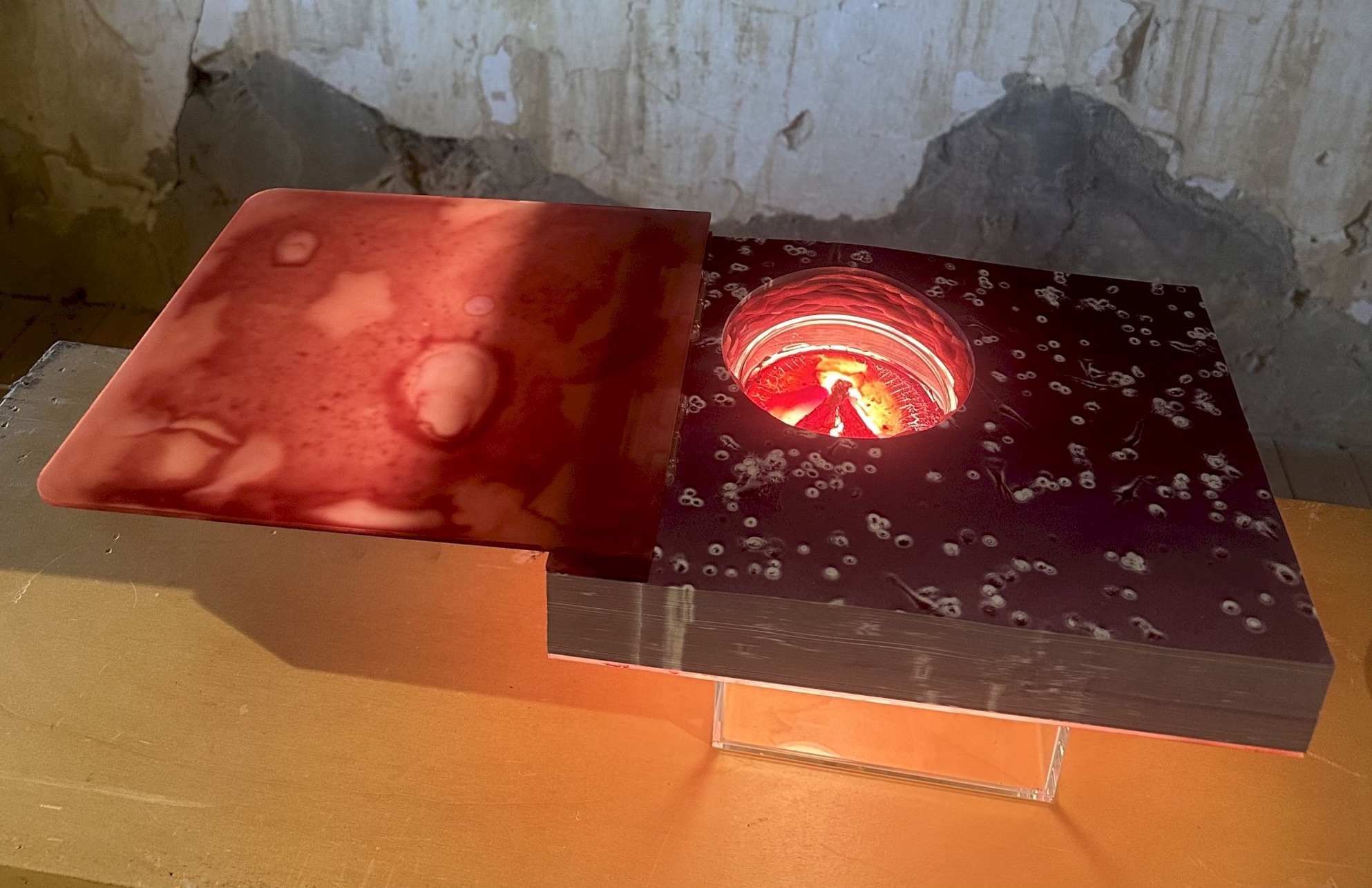
The process of inspecting the microscopic time-lapse frames (over 1200 of them) visually revivified and shifted the temporal choreography of cell activity. I materialised this dance across the dish into printed and handbound books; the book pages, made from a temporally sequential (Z-axis) stack of images, could be read by another individual by thumbing through the pages (Figure 15). Framing the cells as an archival conjuration text tied back to my earlier research at the Museum of Witchcraft and Magic, where living records shifted with time and morphed into new cultural adaptations. Likewise, the now-dead (bleached and dumped as biohazardous) cells would re-animate repeatedly through manual engagements, hearkening back to the BioFeral.BeachCamp zombie inculcation. But more than this, treating the differentiating stem cells as both research material and articles of meaning pushed against dominant frameworks of scientific investigation that deliberately obscure anecdotal narratives or personally identifying information. My approach instead re-personalised the cells as subjective, responsive, and transformative within the cycles of my own history and in the hands of my audience. This reframing is central to concepts fuelling the feral turn, where we understand “science as radically contextual and problematic venture with a very problematic social mandate” (10)—where the lab is never neutral, the protocol never truly faithful, and the body never fixed, nor passive.
Theory in the flesh: Feral Feminism (aka TechnoFeminist Witchcraft) as method
Where human intervention, including tech interventionism, collides with ferality is through the concept of “rewilding” (as previously mentioned) that animates the Feral Labs network. Rewilding is not, however, a concept exclusive to subversive biotech practices and philosophies. Colossal Biosciences, a US tech start-up giant interested in ecological reconstructivism through so-called “de-extinction” experiments presents rewilding within its epistemological motives for restoration, control, and capital-backed conservationism. They use genome editing and surrogate species in attempts to revivify fuzzy, charismatic megafauna like the woolly mammoth. Their model, emblematic of conventional biotech aims, overlaps with technocratic ambitions to treat ecology as a programmable interface; this, towards a remedy for our current catastrophe (fitting in with the “Neganthropocene”). The wild here is engineered back into a facsimile existence, domesticated through science, and made legible to dominant frameworks of progress and utility. As such, it is legitimised.
The figure of the bastard sits outside of heteronormative reproductive conventionality. Bastards are not legitimised by sanctioned systems of lineage, bloodline, or patriarchy but born of disruption and transgression, both personal and social. In this light, my protocols, formed in the fissures between sanctioned laboratory practice and embodied witchcraft, take on a bastard form. They are thus illegitimate by institutional standards, yet possibly fertile—meant to multiply possibility versus replicate an external authority.
In the dish, the “bastard” lineage is cellularly manifest. This is where ruderal and bastard collapse into one another to rewild: both are figures of emergent life via disturbance events. The “ruderal” in my technofeminist witchcraft practice draws from the disrupted ecology of the shedding uterus; I conceive of the uterus as a ruderal zone through the ways that stem cells are both hormonally razed/released and begin to rebuild the endometrium after each menstruation. It is a continuously regenerative, vibrant, and dynamic boundary space in constant flux, providing the material for most of my biotech experiments and witchcraft rituals (what I refer to in this chapter as bastardised protocols).
The shedding uterus is also a biome of transformation, ripe with not only agency but mythopoetic potential. The menstrual blood medium does not fester, moulder, or become externally “contaminated” in the way other cell (mono)cultures can. Its commensal species of microbes or other factors native to the fluid seem to assist in protecting the cells from invaders; the usual antibiotic soup to control for a cell culture without microbial agents is not required (11). This is relevant both in the sense of social contamination through the Homuncularium rituals but also in the case of my later stem cell differentiation experiments.
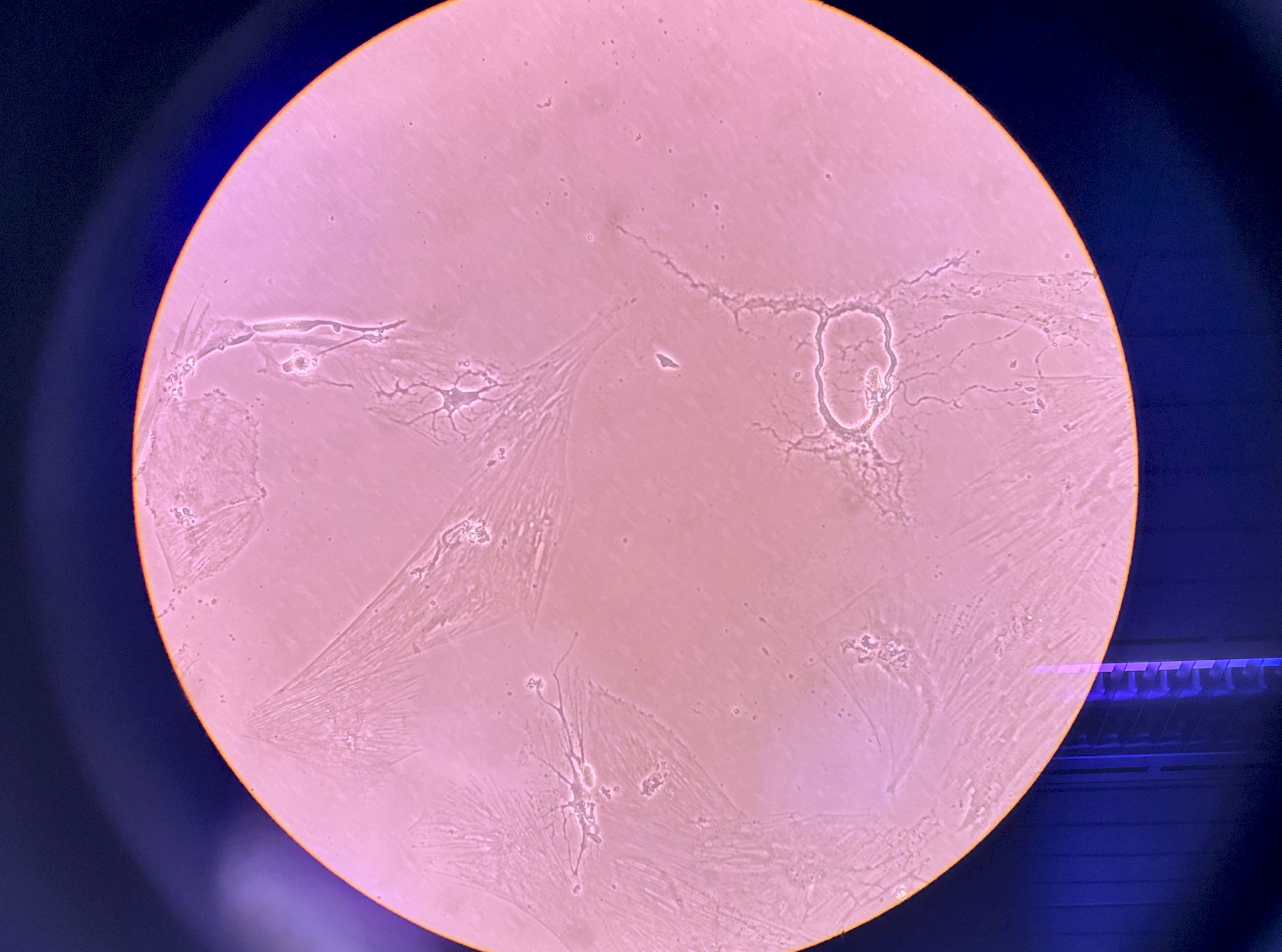
Further, my endometrial cells are not derived from standardised cell lines; they are categorised within bioscience nomenclature as a “wild-type”, being freshly sourced from my own flesh, hormonally conditioned by the unique and variable ecology of my body. They refuse universalisation or reduction; their proliferation is weedy, even astonishing (my first reaction to witnessing their rate of growth) (12). They outpace commercial fibroblasts and form uncanny morphological structures that could be seen to embody both science and spell (Fig. 12). Additionally, these cells are often frozen through cryogenic protocols to later be revivified when needed. This important measure of necromancy ensures continuous supply and enables production of new knowledge throughout my now wildly unpredictable, perimenopausal cycle—and backup in case of human error.
Ruderal plants thrive in contaminated soil, while bastard protocols thrive in the contaminated epistemic terrain of feral lab practices—where scientific legitimacy has been nudged, queered, re-evaluated, and either worked around or with. In this way, feral feminist technoscience doesn’t meekly seek inclusion in the dominant knowledge regimes; rather than feast on the dead (13), we call them up to learn from them. My bastardised protocols dirty institutional biotech, seed it with rogue products and intent. They ask: What new knowing might emerge when we stop sanitising/standardising methods and acknowledge the (sometimes pleasurable) filth of the body? What regenerative power lives in disavowed zones of uterine blood, queer semen, discarded tissues, awkward or uncontrollable tears, and other mucosal spillages? What new feral feminist futures can I conjure into being?
Wetness as epistemology
Wetness is a condition of vitality. If knowledge in patriarchal science has been encoded as clean, contained, and ultimately intellectually and institutionally dry, then feral feminism insists on wetness. In my protocols, knowledges pool, leak, circulate; they are inseparable from feeling, excretion, secretion, touching, rubbing, bumping, and masturbation. To treat menstrual blood, semen, saliva, and tears as epistemic agents is to accept and acknowledge them as unruly, embodied, and innately resistant to control. In this, feral rewilding is permissive. Instead of engineering extinction backwards, it births a future through embodied, bastardised protocols. It demonstrates the concept that rewilding goes beyond ecology, as a queer methodological stance. As such, where Colossal operates in a framework of ecological control, my work, through the artist residencies I have discussed, utilises uncertainty, eroticism, and co-creative rituals. It locates the wild in an intimate, highly personal and relational bioscope, versus the far-off tundra. It is a refusal to let lab practices remain domesticated by technomasculinist orders of sterility, reproducibility, and control. Through this agenda, my work sits within, and extends, feminist technoscience. To rewild biotech is to reintroduce its materials into unruly, erotic relation with their ecologies and retell the stories of those ecologies. It is also to rewild the self, to claim the researcher not as detached observer but as participant, witch, lover, and queer accomplice. Rewilded methods are not necessarily aiming towards production of stable knowledge, but to cultivate futures alive with the uncontainable, the uncomfortable, the hybrid, and the bloody bastard.
Notes:
(1) Tsing, Anna L., Jennifer Deger, Alder Keleman Saxena et Feifei Zhou, 2021. Feral Atlas. The More-Than-Human Anthropocene. Stanford, Stanford University Press.
(2) Billimore, Y. (2024). Introduction. In Y. Billimore, T. Dolinšek, & U. Veber (Eds.), Feral Labs Node Book #2: Feralities (pp. 6–13). Ljubljana: Bioart Society and Zavod Projekt Atol.
(3) Haughwout, M., & Kellhammer, O. (2025). A Ruderal Witchcraft Manifesto. In S. Chaudhuri & J. Ward (Eds.), The Witch Studies Reader (pp. 420–435).
(4) Puig de la Bellacasa, M. (2016). Ecological Thinking, Material Spirituality, and the Poetics of Infrastructure. In Boundary Objects and Beyond: Working with Leigh Star (pp. 0).
(5) Star, S. L. (2016). Revisiting Ecologies of Knowledge: Work and Politics in Science and Technology. In Boundary Objects and Beyond: Working with Leigh Star (pp. 0).
(6) Latour, B. (1986). Laboratory Life: The Construction of Scientific Facts. Princeton, NJ: Princeton University Press.
(7) McBrien, J. (2016). Accumulating Extinction: Planetary Catastrophism in the Necrocene. In J. W. Moore (Ed.), Anthropocene or Capitalocene? Nature, History, and the Crisis of Capitalism (pp. 116–137). Oakland, CA: PM Press.
(8) Stiegler, B. (2018). The Neganthropocene. Open Humanities Press.
(9) Puig de la Bellacasa 2016: 48
(10) Star 2016: 14
(11) I have kept tubes and syringes of menstrual fluid for months in my fridge at home, with no signs of contamination: no smell, no filamentous mouldy structures, no bubbling fermentation whatsoever.
(12) In fact, they proliferate so rapidly that I had to resist the folly of self-diagnosis of possible cancer; the only other cells I’d seen in such accelerated mitosis were HeLas (cervical cancer cells used in many lab experiments).
(13) McBrien 2016: 116
Additional bibliography:
Alaimo, S., & Hekman, S. (2008). Material Feminisms. Bloomington, IN: Indiana University Press.
Barad, K. (2003). Posthumanist Performativity: Toward an Understanding of How Matter Comes to Matter. Signs: Journal of Women in Culture and Society, 28(3), 801–831.
Barad, K. (2007). Meeting the Universe Halfway: Quantum Physics and the Entanglement of Matter and Meaning. Durham, NC: Duke University Press.
Bennett, J. (2010). Vibrant Matter: A Political Ecology of Things. Durham, NC: Duke University Press.
Bluemink, M. (2021). On Psychic and Collective Individuation: From Simondon to Stiegler. Epoché Magazine, 40. Retrieved from Epoche Magazine.
Cultivamos Cultura. (2025). Microdocs (Residencies) XXXIII – WhiteFeather Hunter [Video]. Vimeo.
Hunter, W. (2020). Mooncalf: “Unclean meat”. Technoetic Arts, 18 (Taboo–Transgression–Transcendence in Art & Science), 205–222.
Hunter, W. (2023). Mooncalf Menstrual Meat (MMM). Continuum, 37(5), 576–594.
Hunter, W. (2025). Arcanum Sanguinis: Occult Blood. In: WhiteFeather Hunter.
Bowker, G. C., Timmermans, S., Clarke, A. E., & Balka, E. (Eds.). (2015). Boundary Objects and Beyond: Working with Leigh Star. Cambridge, MA: The MIT Press.
Parsaloglou, S. (2025, September 1). Media. TTTlabs Ionian University.
Simondon, G. (2020). Individuation in Light of Notions of Form and Information (T. Adkins, Trans.). Minneapolis: University of Minnesota Press.
Read the extended version in Feral Labs Node Book #3: Fa Fa Futures