
Crips, cryptids and imaging other beings
As the Feral Labs Network’s Rewilding Cultures programme (2022–2026) comes soon to an end, Makery publishes a series of essays drawn from the 2024 Feral Labs Node Book #2 and the upcoming #3 issue. In this essay Lyndsey Walsh takes on a personal approach to embodying ferality through the lens of art practice that engages with their lived reality and queer crip positionality.
Even from the start, everyone agreed: there was just something so undiagnosed about me. While not everyone could put their finger on it, I exuded a Crip “rizz”, plagued by conditions shifting between the labels of chronic, genetic, and developmental: my body, being, and experiences, all rendered subjects of ongoing peer-reviewed dispute and study.
Becoming a specimen caught up in the clinical gaze at such a young age has profoundly impacted how I have come to interact with the world. Whether it be by doctors, a case worker, or a government official, my viewpoint can often only be considered when I live up to certain regulations and expectations created to define what it means to be disabled, either as a checkmark or a selection of some diagnostic criteria.
Disability falls into what crip theorist Kelly Fritsch references of feminist disability studies scholar Alison Kafer’s naming as “an ableist failure of imagination” (1). Fritsch further explains, “this ableist failure of imagination exposes how it is the case that disabled people are increasingly included and integrated into western neoliberal economies and social life and, yet, disability simultaneously remains a deeply and profoundly undesirable category of being” (2). This “ableist failure of the imagination” follows an ongoing societal insecurity concerning its own negative perception of disabled people, as evident in the shifting language used to categorise and interact them.
One of these labels is the term “special needs”, which refers to anyone with needs that reject compulsive able-bodiedness. This is a label that I have become overly familiar with. From my early years spent segregated from my peers in special education or granted inclusion through an affordance of institutionally offered accommodations, “special needs” has come to be a label where the slogan “you’re not different; you’re just special” gives way to a depoliticised “you’re not disabled; you’re just differently abled”.
Designer, researcher, and disability justice organiser Aimi Hamraie and critical disability studies scholar and crip theorist Kelly Fritsch explain that the language of “special needs” points to a major pitfall in the role of political correctness to define disability in a way that pleases an ableist worldview (3). The language of “special needs” seeks to eliminate disabled people as effective agents in the material-discursive world (4). Instead, Hamraie and Fritsch explain that it infantilises disabled people as mere subjects that can only exist under the rule of institutionalised care regimes (5).
Jenny Corbett has also found the term “special” to be “obtuse”, denoting it to a category of difference that renders someone to be “powerless” but in a way that is seemingly “nice” (6). Its phrasing does this by seeking to control disability, disabled people, and the ways that so-called “niceness” can be afforded to them (7).
This is most clearly apparent in sports, where disabled athletes are often excluded from competing alongside able-bodied athletes. These exclusions and confinements to disability-only sports competitions are justified as a kind of “niceness”, as it would be “unfair” to require disabled athletes to adhere to the competitive bodily standards of able-bodied athletes. However, at the same time, many accommodations, prostheses, and technological extensions used by disabled athletes to move through the world are considered threats by able-bodied people to what is “fair”.
Corbett explains that the term “special” has had a historical systemic practice of processing differences. Originating from the mid-1960s through the 1970s, individuals were given this label as a method of confining and excluding them, thereby maintaining the notion that institutions remain “structured”, retaining their power (8). However, this combination of confining and excluding is anything but nice. Instead, it points to a larger issue of a societal need to control and define disability for disabled people and the struggle that accompanies these experiences.
Yet, the term “special needs” is more than a linguistic restraint. Laid out by the able-bodied, it ensnares disabled people inside all-too-extra “special” frameworks. While these frameworks may be directed toward inclusion, diversity, and access, they often emerge as a form of pandering by a seemingly progressive generosity. Hamraie and Fritsch explain that there is a predominant view that if someone’s “special needs” can be met, the user-experience problem of disability can be solved and the “pitiful” state of disabled people and their “defects” can be redeemed (9).
Disability is more than often framed as something to be handled, reared, and controlled by the institution: through doctors, educators, parents, politicians, civil engineers, inventors, etc. Disabled people can only enter spaces of meaning-making when “granted” access to them by institutions, instead of when these spaces are reclaimed, hacked or the access is self-granted.
To escape the ensnarement of “special” and the apparent failure of the ableist imagination is to go feral, an act of Crip. Hamraie and Fritsch explain that Crip practices exist as non-compliant forms of knowing-making (10). They inherently embody wild and resilient ways of being and engaging with the world and systems while simultaneously threatening to dismantle—and at times actively escaping—the very infrastructure that builds and maintains barriers directed at controlling when and how people are included.
In the context of Hamraie and Fritsch’s work, they refer to knowing-making as a form of practice emerging from feminist Science and Technology Studies’ (STS) critical concept of technoscience, whereby there is a “productive and non-innocent entanglement of scientific knowing and technological making” (11). Knowing-making has been further critically expanded upon and explained in Hamraie’s book Building Access: Universal Design and the Politics of Disability.Here Hamraie outlines knowing-making as political with dominating institutionalised formats have historically asserting a knowing-making regime of what Hamraie calls “access-knowledge”, which framed disabled people as users in social models of disability (12).
Concerning technology, politicised practices of non-compliant knowing-making have been thoroughly described and outlined by Hamraie and Fritsch in their Crip Technoscience Manifesto (2019). In this essay, I will interweave crip practices with notions of ferality, exploring how the queer metaphor of cryptids as an “unknowable wildness” can be extended and appropriated. Along the way, I will outline some of the problems associated with ableist failures of imagination when constructing narratives. I will examine these intersections in the context of my work Self-Care, focusing on the scope of my experience with genetic diseases and Hereditary Breast and Ovarian Cancer Syndrome.
Doomed by the Narrative
The notion of the future can be a contentious one concerning disability. After all, in most visions of the future, either brought to life in the media we consume or prophesised in the words and intentions of politicians, investors, technologists, and medical researchers, disabled people are rendered extinct, having been altered, cured, or selected against to either meet normative expectations or fulfill eugenic solutions. When granted the privilege of existing in the future, disabled people often appear only in the form of superhuman and technologically-enhanced beings.
Again, this becomes what Kafer coins as a failure of the ableist imagination (13). Kafer also points out that the first commonly held assumption in technoscientific narratives is that “disability is seen as the sign of no future, or at least no good future”, followed by a second commonly held assumption that “to want a disabled child, to desire or even to accept disability in this way, is to be disordered, unbalanced, sick” (14).
The problem accompanying these two assumptions is that it constructs a doomed narrative for disabled people. There can be no continuation of narrative when the future is not a place you are supposed to arrive at. All emerging stories, possible imaginaries, are doomed to end tragically.
For me, these two assumptions at the core of many technoscientific perspectives have raised two important and rather existential questions in my own practice:
Firstly, if there can be no future for someone like me, how the hell am I supposed to do the impossible, what I will call “undoom the narrative”, and imagine one into being?
Secondly, even if I can undoom the narrative, since it is also “disordered”, “unbalanced”, and “sick” to even desire to do so, does this mean that my vision of the future is destined to be a nightmare?
There is no right way to undoom oneself. For me, the concept of undooming does not only respond to external perspectives but also internal challenges in creating practices to imagine the future and radically rework narratives, as I will further elaborate on below in relation to my work Self-Care.
Hamraie and Fritsch’s four commitments of Crip Technoscience provide a foundation in which practice can be done to generate forms of knowing-making that aim to surpass ableist failures in imagination:
They outline the four commitments of Crip Technoscience as:
“Crip Technoscience centers the work of disabled people as knowers and makers.”
“Crip Technoscience is committed to access as friction.”
“Crip Technoscience is committed to interdependence as political technology.”
“Crip Technoscience is committed to disability justice.” (15)
In their manifesto, Hamraie and Fritsch expand on their four commitments to Crip Technoscience as a means of offering a framework for agitating against the increasingly hegemonic mindset of “independence and productivity” as “requirements for existence” (16).
What is unique about their manifesto, in comparison to discourse related to disability technoscience, is that Hamraie and Fritsch aim to engage with ways of doing and knowing following the tradition of feminist and STS frictional practices. They desire for these kinds of practices to acknowledge “that science and technology can be used to both produce and dismantle injustice” and “that many of the technologies that have enabled disabled people to gain access to the social world have been produced through military-industrial research and development, imperial and colonial relations, and ecological destruction” (17).
Fritsch and Hamraie’s four commitments are offered as a means by which struggle can be enacted and driven toward “a more accessible future in which disability is anticipated, welcomed, and in which disabled people thrive” (18).
Self-care: The urge to eat your own guts
Historically, disability, illness, and anyone identified to have any kind of bodily difference has been inextricably linked to the figure of the monster. Critical Disability Theorist Jenne Schmidt explains that the rise of the label of the freak and freakshows shifted by the mid-1900s into a pathologisation and institutionalisation of bodily differences, both of which were rooted deeply in Western colonial and imperial narratives of othering and intersecting with systemic issues concerning race, sex, gender, sexuality, and socioeconomic class (19).19 This medicalisation sought to remove so-called “freaks” from society to cure their pathologized differences or assert eugenic practices upon them to prevent the possible threat of having so-called “inferior genes” passed onto future generations (20).
Reclaiming the monster has become an increasingly common approach in re-structing narratives concerning identity. In particular, queer communities, especially in digital spaces, have sought to reclaim the figure of cryptids (creatures with legendary and often disputed status) as an optimistic metaphor and effective agent of meaning-making. Transgender and Queer Theory scholar Levi Hord contends that cryptids are effective agents of non-binary and queer culture (21). Hord argues that they allow for queer critiques and post-structural identity positioning that promote ideas of queerness as an “unknowable wildness” (22).22 This “unknowable wildness” directly attacks the very taxonomic and Western scientific classification that has historically ostracised and pathologised queer people (23).
Unlike other monsters, cryptids cannot enter scientific discourse because they cannot be caught. Their existence can only be hinted at and speculated on through collections of blurry photos and, with the rise of the internet, in online forums, such as Reddit. Science also abhors cryptozoology, delineating it as pseudoscience. However, Hord argues that the performativity of cryptids also transcends the confines of academic language, overriding its role as a gatekeeper and authority for generating systems of knowing and critique concerning queer culture.
In my own practice, I also find cryptids to be a useful and optimistic metaphor for enacting feral practices, reclaiming monstrosity for both the crip and queer aspects of my own identity, and attempting to undoom my own narrative.
In my ongoing work Self-Care, I have publicly come out as a mutant, self-disclosing the pathologisation of my own genome that has left me with the diagnosis of having Hereditary Breast and Ovarian Cancer Syndrome and a 94% chance of developing breast cancer. Not to be a fatalist, but this aspect of my doomed biological narrative has a rather high statistical probability to come into fruition.
This genetic coming out has coincided with my public coming out as non-binary, which has also greatly informed the work of Self-Care, as it seeks to challenge gender expectations about notions of prosthesis and narratives of survivorship related to breast cancer.
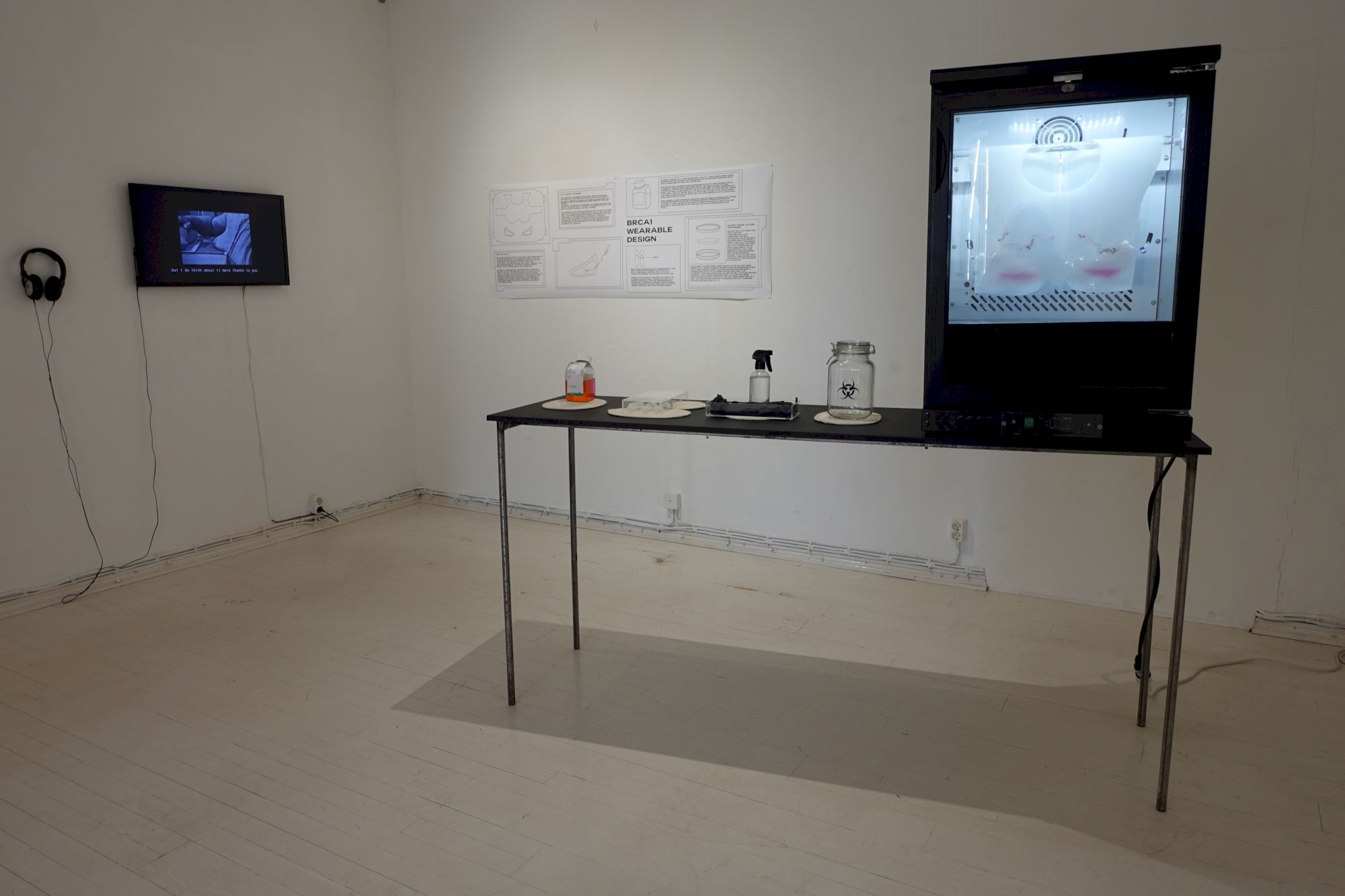
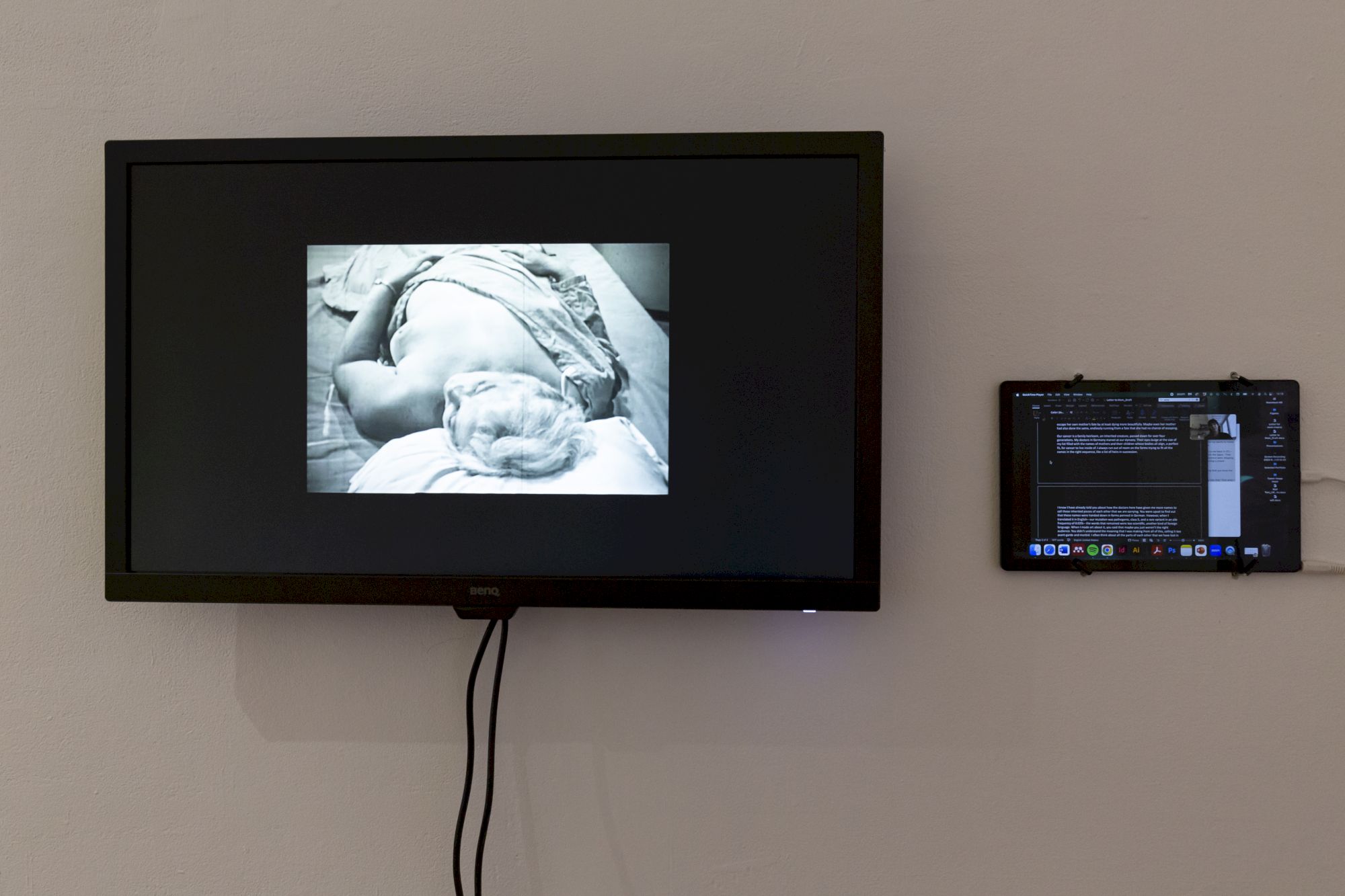
STS scholar Lisa Cartwright writes extensively on the ways in which the treatment of breast cancer is embedded in normative notions of gender performance (24). This is further touched upon in the framework of Self-Care, in the context of my film “Mommagraphy Techniques”. In the film, my mother shares her own story of receiving medical care for her breast cancer and reveals that she elected for breast reconstruction (prosthesis) to please my father and how her doctor made her reconstructed breasts bigger than what she asked for.
I have been both horrified and outraged by the outcome of the treatment and care, or lack thereof, that my mother received. The interconnecting narrative thread is woven between the different artworks that make up Self-Care frames this ongoing battle that I have with myself, my mother, my doctors, and everyone else. I desperately plead with both myself and the audience that there needs to be an answer to the question of whether it is possible to escape the fate of my mother, her mother who came before her, and her mother’s mother, as I have inherited not only their trauma but also their fate with a genetic destiny to suffer the same biological horrors. This question also becomes interlinked with issues concerning my own queerness, as I reckon with both myself and my mother on the issue that by coming out I am also not the daughter she made me to be, simultaneously estranging myself from our family, othering its legacy, and threatening its future.
The mutant that Self-Care asserts embodies a cryptid creature, one that problematises many aspects of the medicalisation of bodies and disease identities and narratives. Inspired by Jason Zingsheim’s Mutational Identity Theory, which positions the mutant as a multiplicity of identity and subjectivities, the mutant that I arrive at exists as a figure whose identity transcends generational boundaries (being a product of biological inheritance), gender binaries and health-disease binaries (25). Mutants in science can only enter discourse when caught, archived and subjected to intense study. However, outside the institution, mutants exist everywhere, and a species’ continuing existence wholly depends on the lurking and unknowable presence of mutants to adapt to shifting conditions in the environment.
While there are many attempts to surveil and experiment on mutants, they can never be truly known, they will always retain a power, a potential, and a threat of escaping the institution. Mutants are generative creatures, each with their own unique differences.
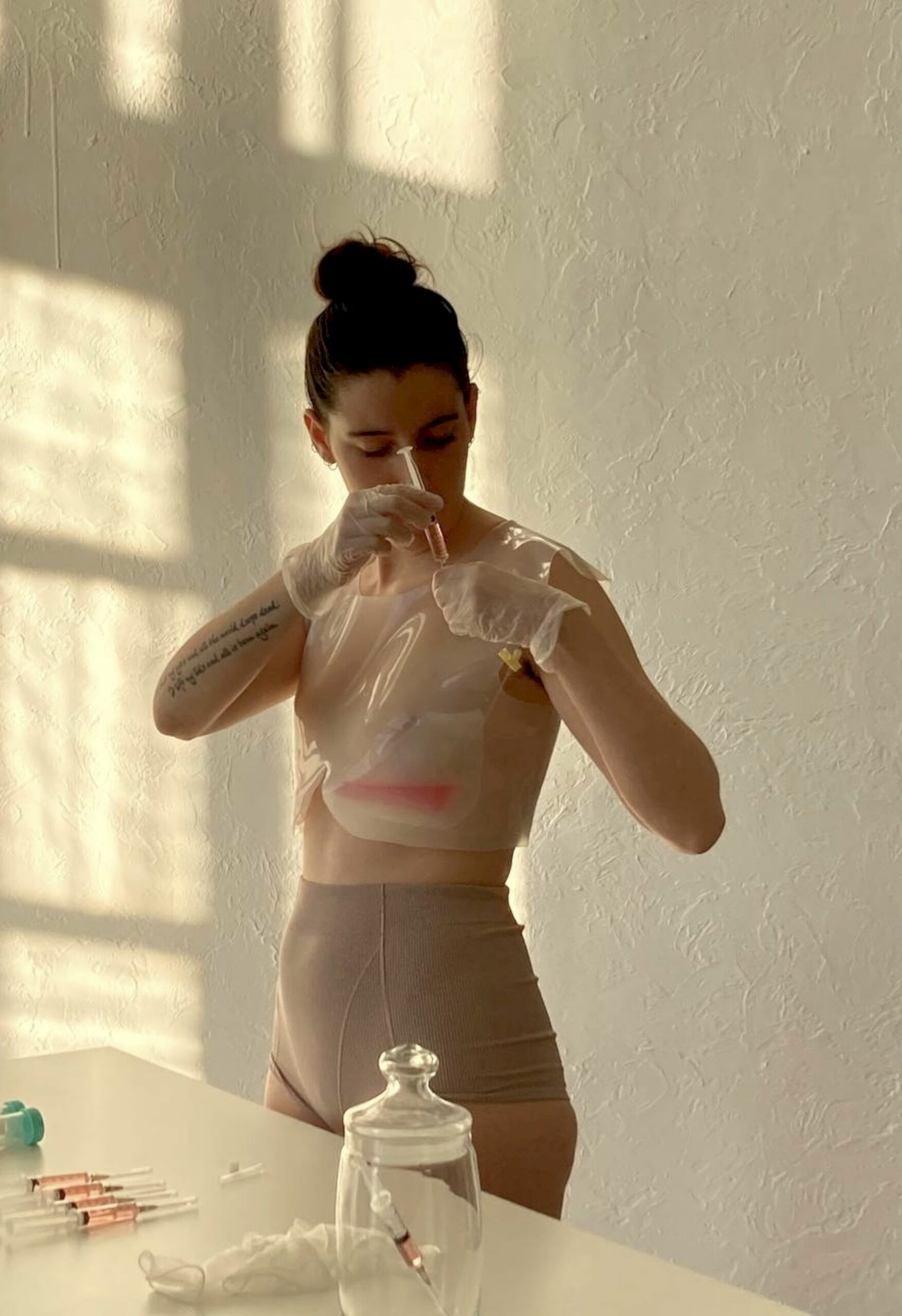
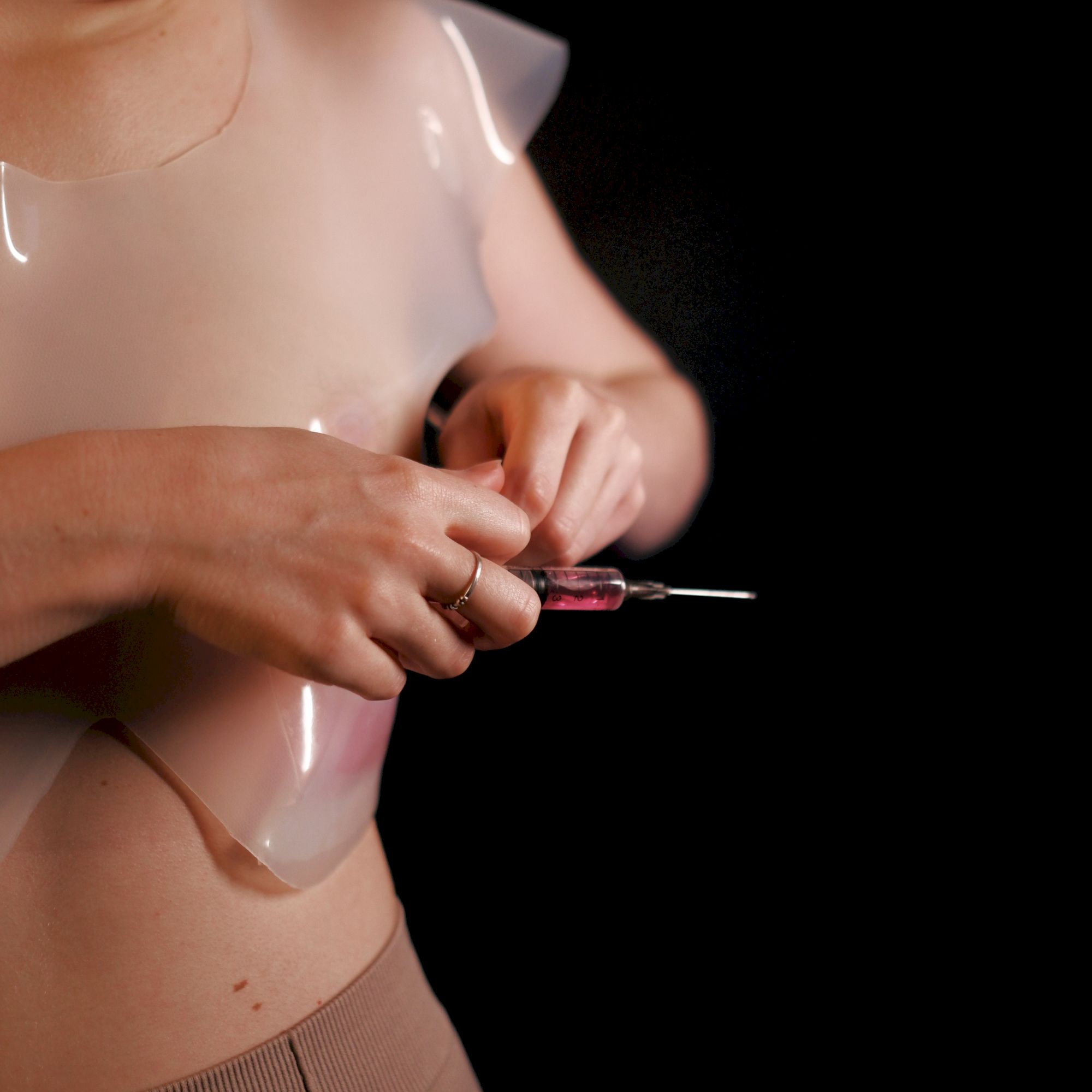
In Self-Care, I end up making myself more monstrous through my own exploration of prosthesis, which features a specially designed chest binder that allows me as its wearer to host and care for living breast cancer cells sharing the same genetic mutation. It is not the chest binder itself that makes me monstrous though. Instead, it is the function of the prosthesis and binder to attempt to articulate a “caring” relationship with the very living entity, my supposed cancer, which I have been medically and genetically foretold will kill me.
Through this device, I engage with performative actions of clinical labour, medical research and biotech in a manner that does not seek to cure or normalise my body and its pathologies but asserts my own experience as the knower-maker. Instead, the technology I generate acts as an interface for generating friction and further problematises normative relationships with bodily functions and health, as even my own mother, a breast cancer survivor, has found it undeniably perverse to want to care for one’s own cancer.
This techno-art-object also leverages an interdependence between myself, my supposed disease, and others as a political technology. The cancer in the binder also serves a functional role in aiding to bind the breasts: a queer act both expressing agency and also revealing the tension and inherent violence involved in living with a body caught in experiences of gender dysphoria.
While I offer up many intimate parts of myself, my family, and my medical history in Self-Care, I also purposely refuse to disclose any information about my own medical decisions and treatment plan for my Hereditary Breast and Ovarian Cancer Syndrome. I never share the often overly publicised aspects of surgeries, reconstruction, or medication that typically frame “previvor” narratives. This decision to have these aspects remain private (and not up for public discussion) is also a political statement.
The “previvor” narrative implies that it is a patient’s actions and personal health decisions that determine if they can survive their Hereditary Breast and Ovarian Cancer Syndrome. However, in Self-Care, the technological positioning I advocate for relies on an understanding that no one can survive a genetic syndrome. The very definition of having a syndrome is that there can be no known definitive cause, course, or treatment for it and its ability to cause disease. I also advocate that individuals cannot be held responsible or discriminated against based on genetic differences, regardless of how their genetic difference is expressed.
Afterthoughts
Since publicly debuting Self-Care in 2022 at SOLU Space with the Bioart Society, I have further found myself questioning, trying to imagine a future, and repositioning my relationship with technology by enacting the commitments of Crip Technoscience.
However, I still carry an immense feeling of anxiety about how impossible it feels to undoom myself and this narrative that has been laid before me. There are many unsettling issues present in my work, but it seems to me that there are also many things that need unsettling.
The ways in which Self-Care sets out to undoom the narrative is not by undooming the potential terminal end that is encoded in genetics and spawned by cancer. Instead, the work focuses on how care, as an ongoing and imperfect practice, can be used as an attempt to undoom oneself by rearticulating and exploring the interdependence of relationships. This brings audience attention back to the now. It is the relationships in the precious now, a time that will never be as endless as the future, when meaning-making and knowledge can emerge. If my imagination can reshape the reality of my present by rearticulating relationships between myself, bodily difference and others, the future undoubtedly also has the potential to be undoomed.
Lyndsey Walsh’s website.
Download the Feral Node Book #2.