
Immersion with Toxics Link in New Delhi: meeting the Kabadiwalas and other upcyclers of e-waste
Artist and researcher Stefanie Wuschitz followed the Indian NGO Toxics Link in New Delhi, which carries out extensive monitoring work on the links between waste and contamination. For Makery, she examines how the work of women in the slums of New Delhi contributes to the urban mining of electronic waste by manually upcycling valuable materials.
Correspondence (text and images by Stefanie Wuschitz),
Behind the sleek surfaces of AI systems and green technologies lies a violent chain of extraction. The minerals that power data centres, batteries, and chips are taken from lands belonging to communities with the least legal protection, leaving behind poisoned water, destroyed forests, and criminalized resistance. These raw materials are converted into high-value technologies that concentrate wealth and power in the hands of a few corporations, while AI-driven platforms filter out reports of activist struggle and the killing of indigenous and environmental defenders. Under the promise of a “green transition,” new mining projects and vast fields of toxic e-waste are presented as necessary sacrifices. Such “sacrifices” are neither inevitable nor just: trading human lives and living ecosystems for technological progress deepens inequality and drives us faster toward environmental and climate catastrophes.
Informal e-waste recycling in Delhi
However, there is hope, as Ravi Agarwal explained to me. He must know, because Ravi Agarwal is researching contamination and waste since decades. His organisation Toxics Link in the heart of New Delhi publishes peer reviewed scientific findings on alternatives to this limitless, feverish and colonialist extraction. India, China and Japan have started to prioritize the prevention of e-waste, and to integrate circular economy principles. Toxics Link has documented this shift of policies and is evaluating it in regular reports. For example, which strategies could lead to a minimization of electronic waste (2021), what indicators we could use to measure successful circular economy (2023) or how easy we can access repair for our electronics (2025). The last Indian government has implemented five of their recommendations. A big success is that burning e-waste is not permitted any longer. A big step towards cleaner air in one of the world’s most smog-tormented cities. Toxics Link is working with international partners but under increasingly difficult conditions, as the current Indian administration does not pay much attention to their expertise.
Fortunately, Ravi transfers knowledge on many levels, as he is not only researcher. Ravi is also a renowned artist who transforms the experiences he makes during field work into intense media installations. His artwork evolves around decolonising the way we relate to the environment, deconstructing the extractivist, narrow minded, colonialist ideology and rather cultivating multiple forms of knowing, entanglement, empathy and accountability when facing the threats of the 6th extinction. Since I work as an artist myself, I had the pleasure to meet Ravi in New Delhi. I asked Ravi, how e-waste is processed in the city. Of the many hotspots of e-waste management in Delhi, he mentioned Mustafabad, New Seelampur and Old Seelampur. Here, plastics are processed in a different circle than the actual electronics. People who collect waste in India are called Kabadiwalas.
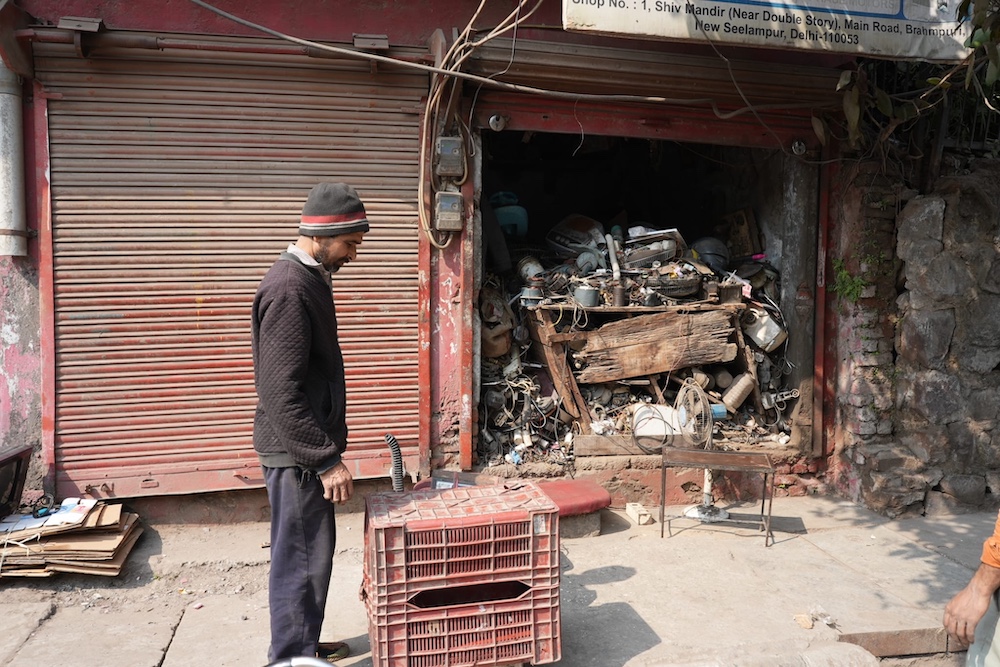
Kabadiwalas live on the bottom of the so-called waste pyramid. They “go to the generators of waste and purchase their waste by paying in cash” (read the report on Waste Electronic and Electrical Equipment – WEEE – plastic recycling). They sell it to people one level higher up in the waste pyramid: small Kabadiwala Shops and big Kabadiwala Shops. They are to be found all over New Delhi with usually four to five male workers. The division of labor here is highly gendered, a large number of people working in the waste pyramid are migrants from other Indian regions and identify as Muslim, their opportunities to work in different professions is low. Women* rather work from home, within a residential area, performing reproductive work, childcare, domestic work and manual labor right there in their living rooms. I will get to this later, because for now, we are only on level two of the waste pyramid: the male dominated small shops make a basic separation of waste and sell it in pre-sorted bulks to bigger shops. Now – at the next stage – the trader becomes specialised on certain recyclable materials. A plastic dealer, for example, will at this level already process the plastic. “A plastic dealer will directedly put the plastic in the material chain which includes sorting, cleaning, grinding and pellet making.” Pellets are then put through a moulding machine to create new products. Often virgin material (Flame Retardant and non-Flame Retardant) is added to the machine, as well as specific colors, to customize the design.
The hope for Circular Economies
A dealer who specialises on EEE (Electrical and Electronic Equipment) will not process the electronic waste himself but sell it to a dismantler. She or he separates the plastic to put it in the plastic chain. On this level still functioning devices will get refurbished and sold. “Wow”, I said “I would really love to see how people do that, which tools they use and how they collaborate!”. Ravi promised to help me visit one of the sites in New Delhi where dismantlers live and work. Dismantlers break up devices that don’t function anymore (non-working WEEE equipment) and separate the components. The printed circuit boards (PCBs) contain a lot of valuables and precious metals, so they are processed separately. Ravi tells me that he can arrange a trip to the neighbourhoods in which people dismantle wires and gives me the number of his long-time colleague, Vinod Kumar.
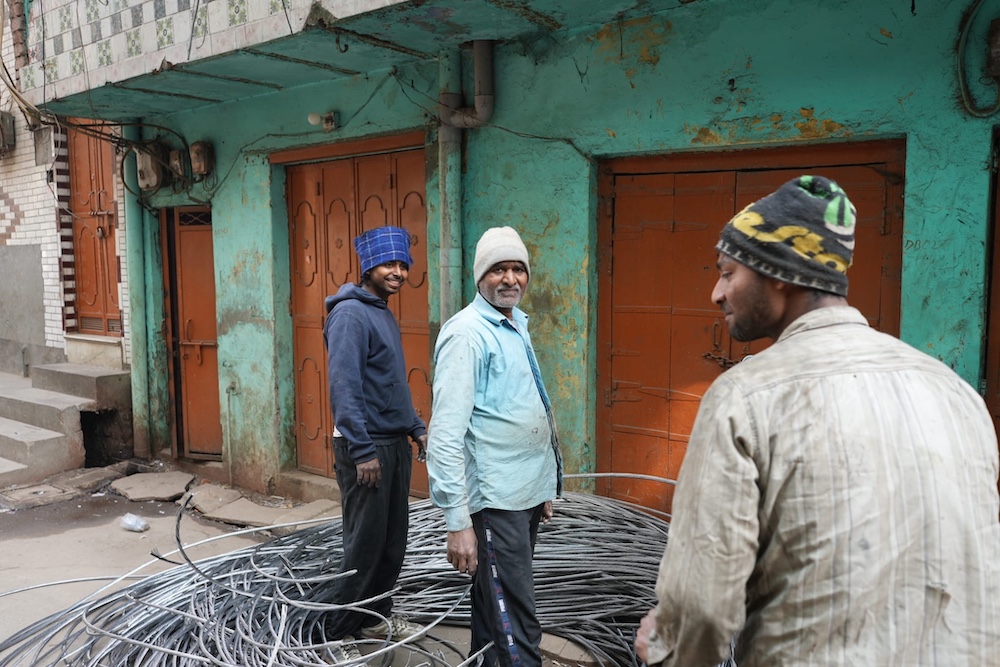
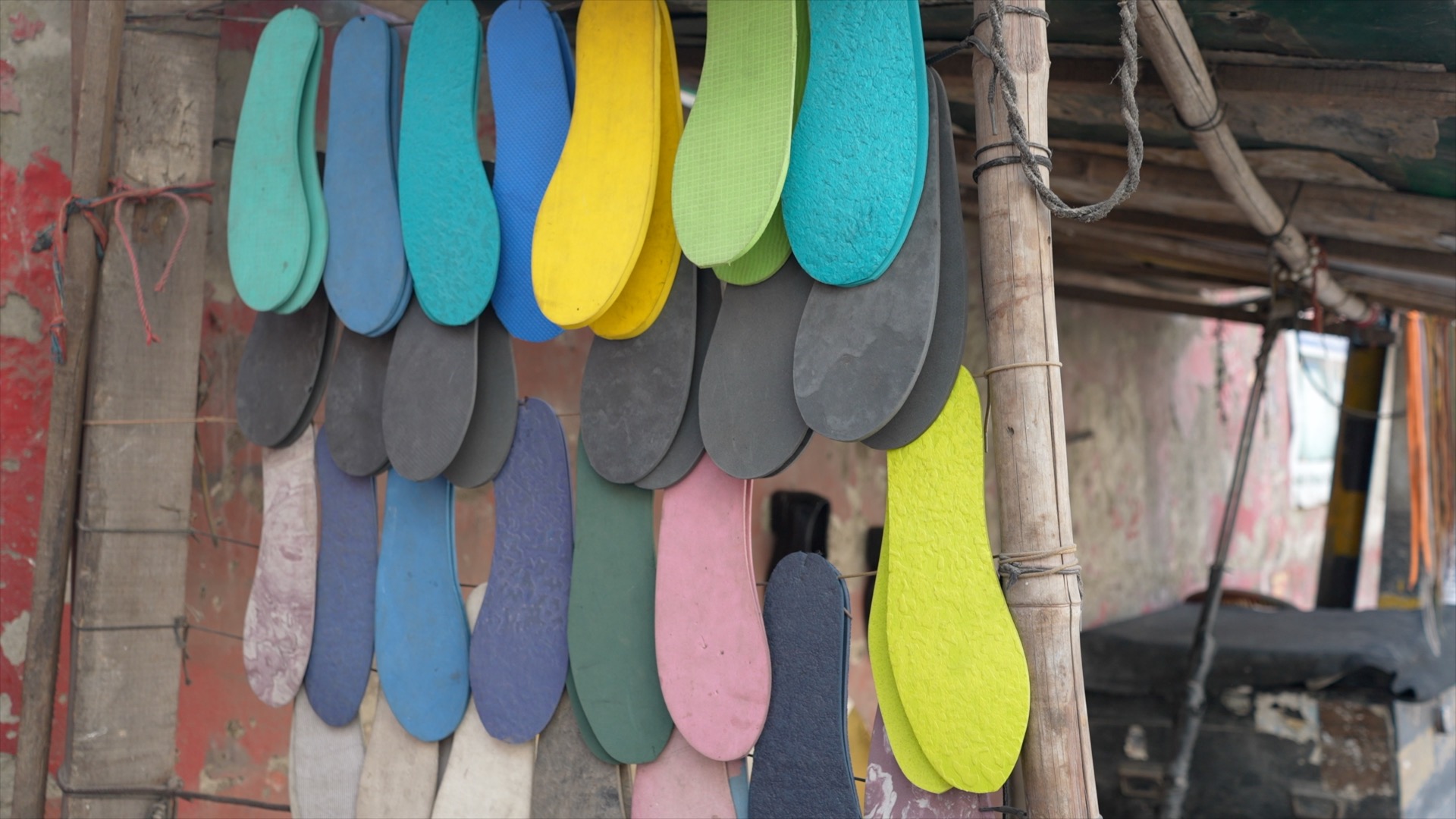
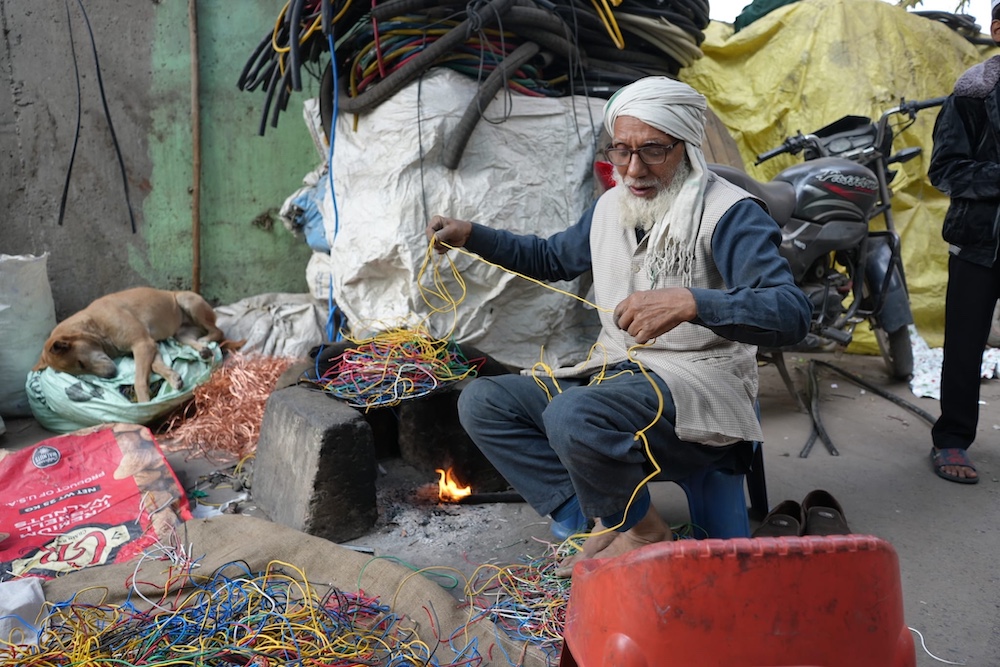
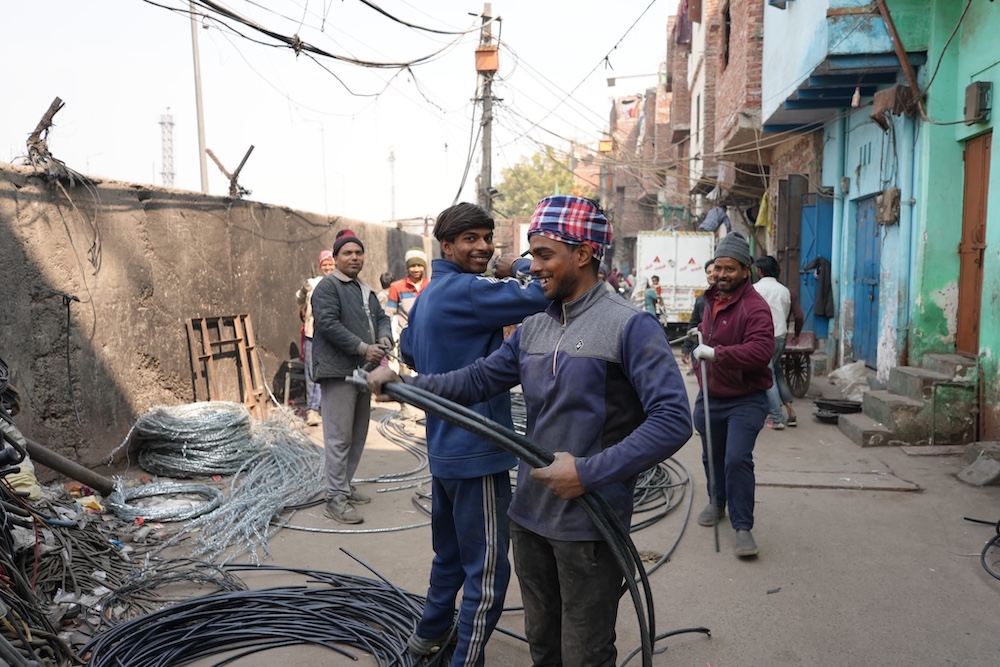
Vinod is an allrounder: in the last twenty years an expert for all kind of urban mined and upcycled materials, for health and safety systems. He explains to me that the plastic around electric wires contains PVC. Until recently the toxic plastic around copper wire was burnt to win the copper. Burning the wires was releasing extremely harmful fumes. There is a regulation now demanding that the PVC plastic wires are stripped to separate the valuable metals from plastic. Fire is only used to soften the plastic, not burn it, because it is precious. Today this plastic is as well sold, grinded into pellets and reused. “Up to five times it will be upcycled” Vinod says and smiles. “And then?” I ask. “And then they make soles for shoes out of it” he answers. I’m deeply impressed by this resourcefulness. I had just bought insoles from a street vendor, now I look at them in awe. Is my shoe’s insole from plastic that has already been upcycled for the sixth time? We finally arrive at the place, where people dismantle e-waste.
The community of New Seelampur
The place is in New Seelampur, consists of very simple dwellings, but has got basic access to water and electricity. In this particular neighbourhood people are specialised on separating wires, so it is only wires, yet in all sizes, shapes and qualities, that are being processed here. Mostly women, young children and elderly people are involved in stripping the plastic off the copper, aluminium and iron wires. They do that at home, in their living room, chatting and joking while working together.
We pass by a room that is directly accessible from the street. My guide, Vinod, asks the ladies sitting inside, if we may enter. They quickly put on their hijab and welcome us in. There is a lady in her 40s who works with her teenage daughter on dismantling a colourful and entangled pile of thin wire. She tells me that she cannot use gloves for protection while cutting off PVC, because she needs to feel the knife to not injure herself. I watch her sitting on a woven carpet, holding one end of the long wire in her right hand, the other end of the wire with the toes of her left foot, pulling the plastic cover with her left hand off the wire. As she continues her hard manual labor I remember how as a child I learned to knot bracelets. I did that in a similar body position, only that instead of pulling off hard plastic coating I was only pulling up a thread to start a new line of knotting on my bracelets. In this way in reminds me of making traditional crafts. Taking off plastic from wire, ripping off ten to twenty centimetres at a time, requires a lot of force. I ask the lady what she would prefer to do, if she can choose: cooking or dismantling wires? She points to a young woman currently preparing bread in the other corner of her living room: “This is my daughter in law. She does the cooking”.
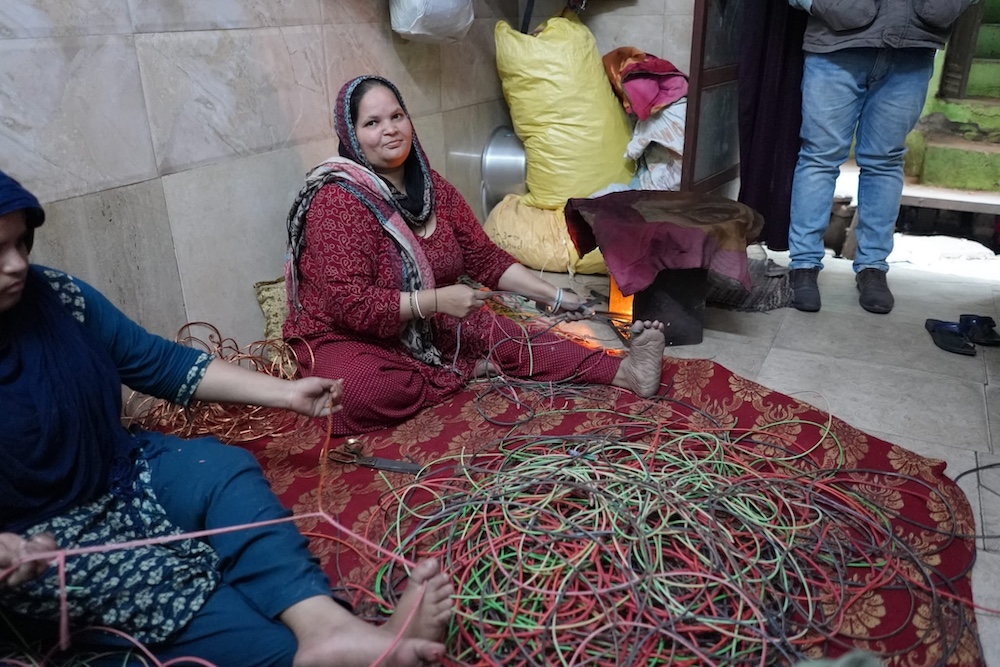
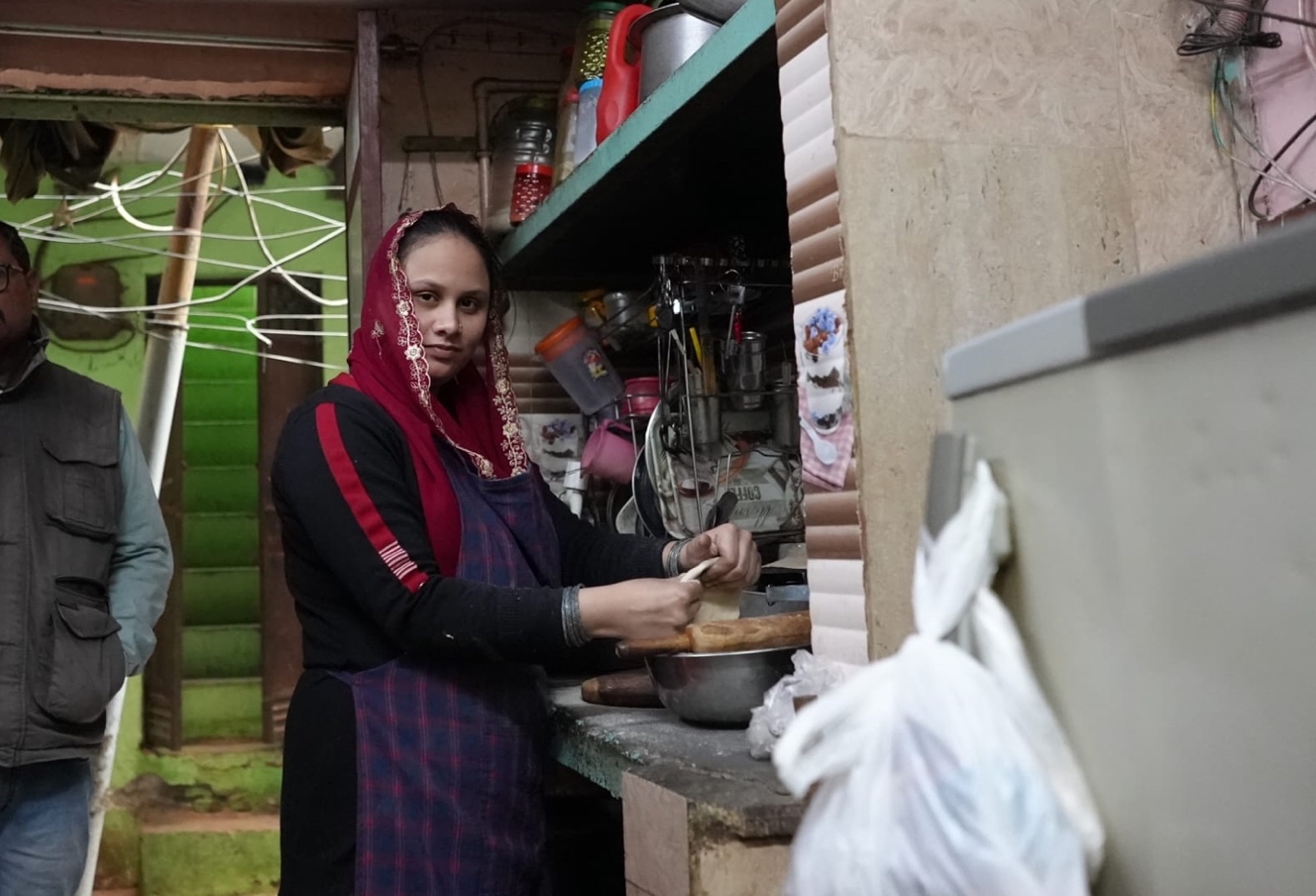
The daughter in law is laughing. The three women spend their entire day in the around eight square meter living room, working side by side. A small wood fire warms the wires to a certain temperature to make the plastic softer. It is the cold season in New Delhi, so sitting next to this fireplace seems cosy. I wonder how cosy it is in the hot season though, when New Delhi reaches up to 40 degrees Celsius? Maybe then the wires are softened on the metal roofs? At the end of the day the shiny pile of 10 kilos of copper, fruit of many hours of labor, will get traded against 1100 rupees per kilo (about 10 €). This is not much, and therefore their community lives on the bare minimum. Their two-story houses were built on land that is strictly speaking not theirs. Like in most illegal slums the streets are so narrow that I almost rub against both walls left and right while passing through. There are cute little kids playing peacefully in groups of three to ten children, I see dogs and other animals, little shops like a small barber shop, I smell food being cooked for lunch.
It is a densely populated area. The sanitary conditions are bad, not enough toilets. Often people cannot wash their hands before eating because they lack water. This means that the toxics on their hands enter their body, one of many physical hazards the workers are exposed to. Lead poisoning, polluting chemicals and harmful urban wastewater pose risks to vulnerable populations like pregnant people and children (see Toxics Link Dispatch Vol. 3, Sept. 2025).
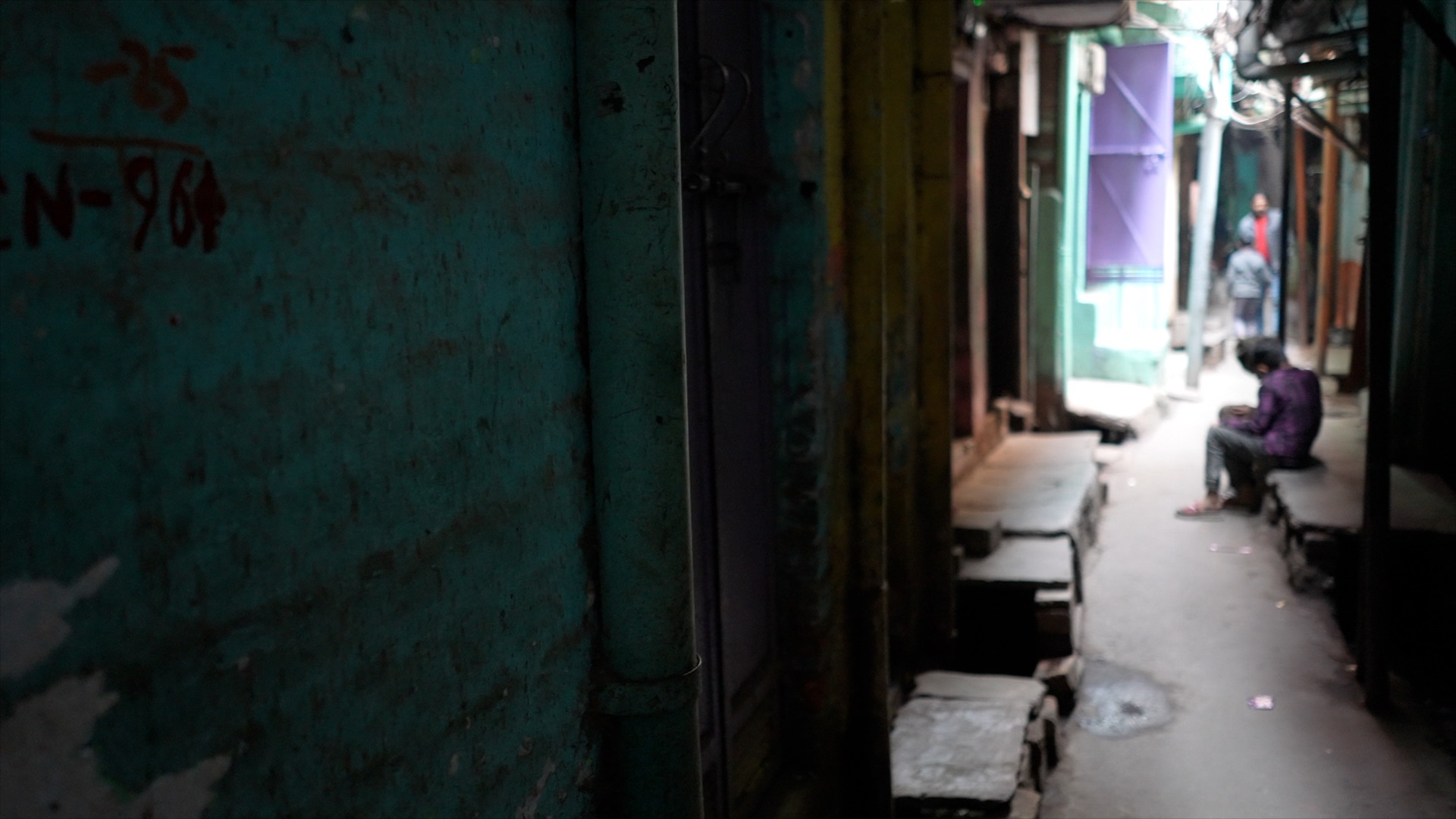
Walking through this slum everyone interacts with me in a cheerful way, making jokes, smiling, making me feel comfortable in this place. The neighbourhood seems like a big city that was scaled down to 10% of its original size. Although tiny, it is still offering all that a large city would offer in terms of shops and public places, only in smaller scale.
Air pollution
What this miniature city also has in common with the rest of New Delhi is the air quality. While I visit the city the air pollution reaches peaks beyond measurement. While the measuring scale ends at maximum 500 on the Air Quality Index, the pollution is usually now up to 600.
Vinod and I walk to the next room that is accessible from the street. An elderly lady sits on a bed and talks to a younger woman sitting right next to her. Vinod asks for me if they would please allow me to come in and talk to them? The old lady seems happy to meet us. I ask her when she arrived in this neighbourhood. She said that she was there from the beginning, she arrived forty years ago. But now she can hardly breath, she is feeling sick, that’s why she cannot work anymore. There would also be no other job opportunity for her than dismantling wires, Vinod later explains to me, as most women here did not get the chance to have any formal training or education. The forty years resident allows me to take a photo of her. I hope she will feel better soon. Vinod translates my answer. I wish her all the best and move on with a sudden sadness in my stomach. Vinod explains that most people’s lungs here are in a bad state. The smog makes people in average die ten years earlier.
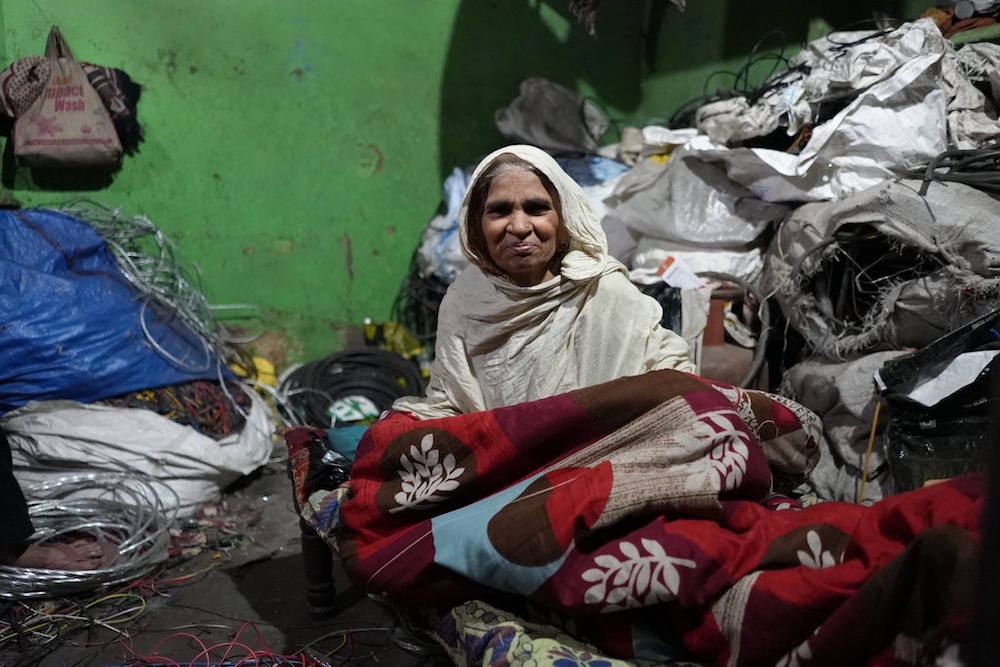
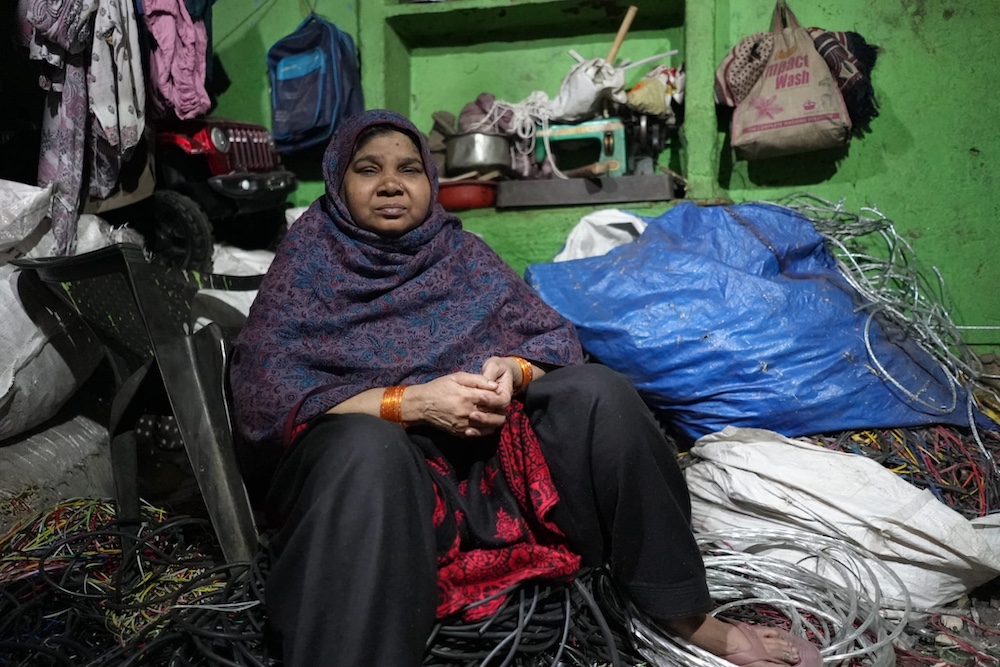
During COVID there were a lot of additional casualties. Around 0.6 million died in India on COVID, the third-highest number of confirmed COVID 19 death in the world (533.847 as of government numbers published 19th of February 2026). But the World Health Organisation estimated that in India in fact around four million people have died, directly and indirectly related to COVID.
There is another existential threat that this community faces. Bulldozers could destroy their dwellings without further notice. As they were built illegally the government can remove them at any time. Just recently thousands of people lost their homes nearby, when the government bulldozed houses that were built there illegally. On top of the destroyed houses the government built a huge new plastic processing plant.
Processing waste is an emerging business; circular economy is increasingly profitable. Up to 100% of the waste is being processed. 70 percent of this work is done by formal, 30 percent of informal workers. Informal e-waste recycling in Delhi is the largest in India, for a long time all Indian e-waste was processed here, in Delhi. An enormous accomplishment.
Repair and reuse are important strategies for reducing e-waste, for conserving resources and mitigating environmental harms. Toxic Links embraces the Right to Repair (R2R) framework as steps into the right direction and advocated for legal enforcement of the Right to Repair. The people in New Seelampur and other communities would have an easier life if they could rely on formal training, get adequate infrastructure and tools to do their work, if there was a way to avoid health risks and if last but not least they would have a higher profit margin. Then they would be the drivers of a resilient, decolonial and environmentally sustainable repair ecosystem.
More on Toxics Link.
More on Stefanie Wuschitz’s work.