

Commemorative monument in A So Airport
The Rewilding Cultures Mobility Conversation grant supports sustainable, inclusive artistic mobility that takes account of creators’ personal circumstances. Kim Đoan Quốc, the 2025 grant recipient for ‘Foliating Memories’, talks to Makery about their project spanning Viêt Nam and France, which addresses Agent Orange pollution by blending ecological memory with visual arts research. Second part.
Kim Đoan Quốc is a visual artist working at the intersection of installation, video and performance. Their work examines the relationship between humans and their ecosystems, interweaving themes of the body and the plant kingdom into layered narratives. The concept of ‘safe space’ is central to their thinking, explored as a means of addressing social justice, ecology and collective wellbeing. In 2025, Kim travelled to Vietnam for a six-month research trip in preparation for the project Foliating Memories, which deals with Agent Orange pollution. The following account, published in three articles, details the processes of reflection and production surrounding this piece.

Filming on location: A So Airport with Mr Phú and the former Nam Cat Tien Airport with Professor Lương Văn Dũng
On my way from Hà Nội to Sài Gòn,I spent a few days in Hue, not far from A Lưới Valley. There I met Thanh Le Ngoc and Hai Le Duc, twin brothers and a powerful duo of lacquer painters. After spending the afternoon together in their studio, a house with a huge workshop and an exhibition space showing their ongoing and achieved works, we talked about the reasons for my trip and what I wanted to do in the area. After talking to Phùng Tửu Bôi, I wanted to see A So Airport : a former US military airport that got depolluted with heat technology, financed by USAID and the Vietnamese Government, contracted to Veolia. “This involved heating the soil to 335 Celsius (635 F) over several months. A specially designed facility was built to house de contaminated soil to ensure controlled heating. The heat causes volatile and semi-volatile compounds to vaporize. These are extracted from the soil, collected and safely decomposed. The higher boiling compounds undergo a significant reduction in the soil, leaving it safe to reuse.” (Veolia’s 2024 report “Five key trends highlighting the urgency to tackle pollution”) Le Brothers put me in contact with one of their friends’ relative who works as a guide in A Lưới Valley, Mr. Phú.
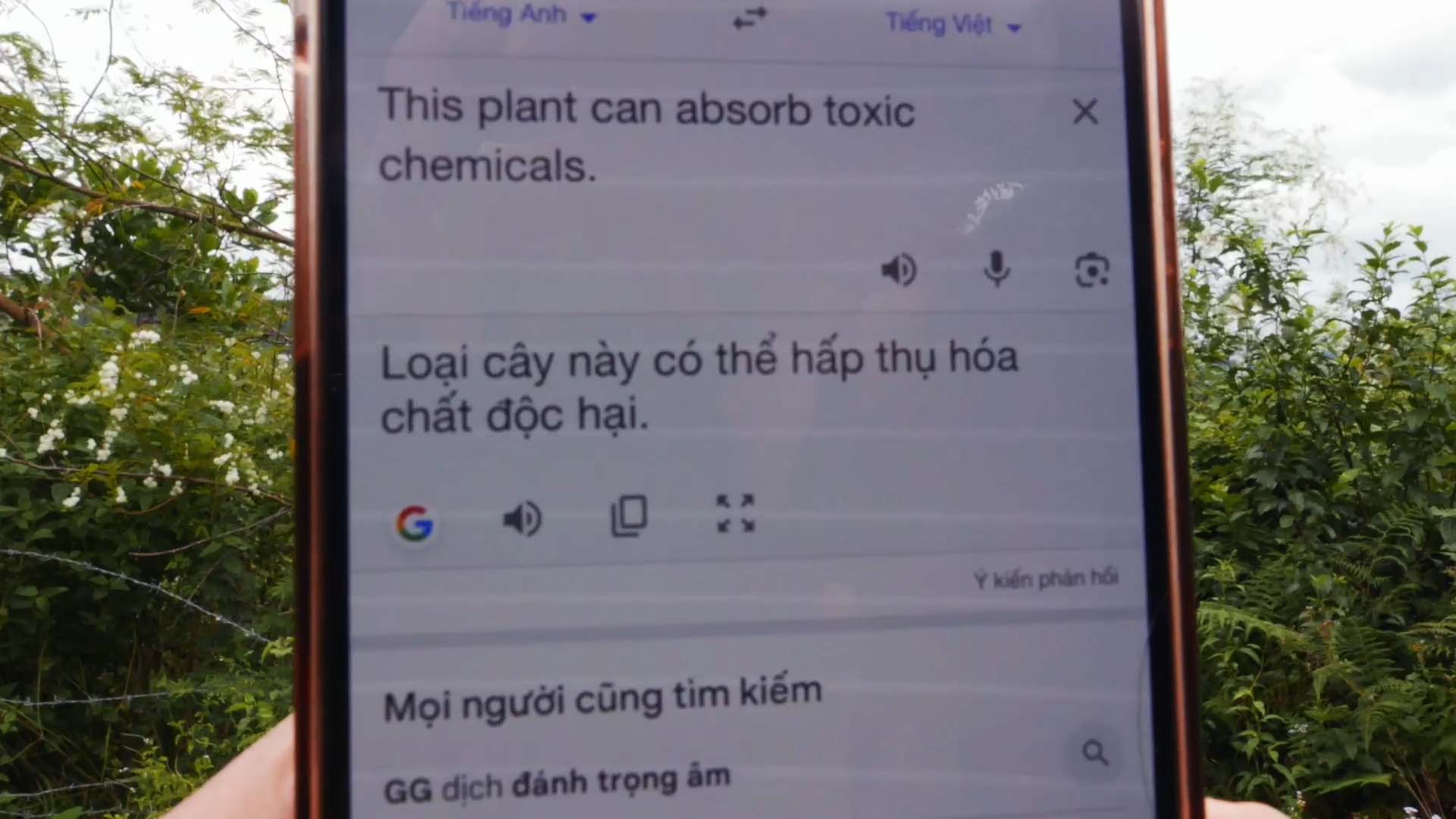
I took a 3 hour bus ride from Huế to meet him in a station in the middle of the countryside. Nobody was there when I got off the bus but two old men, very curious to see me there, who reasonably warned me about mosquitoes. Mr. Phú found me a few minutes later and we rode to the forest and the airport on his motorbike. We crossed many small towns in remote areas with schools and nice roads, « all built thanks to Hồ Chí Minh », my guide told me with enthusiasm. He explains to me, as we drive, that we will need to give to the police to be able to enter the airport zone as it is close to a sensitive border with Laos, “500 000 VND will do”. I obliged without asking for more details. As we rode further, we stopped in front of an Acacia tree and a group of buffalos. As I set up the camera and start filming, Mr Phú tells me that the tree absorbs dioxin from the soil. I can’t help thinking about Phùng Tửu Bôi and the acacia species he made to help people make a living in the A Luoi valley. I remember him saying, as he saw the deception on my face as I realised that trees don’t decontaminate land in his work, that a lot of people were mistaken and believed that his work with forestry was about cleaning the land when it was more about making it livable while time would slowly dilute the pollution. I didn’t dare to correct Mr Phú.
We kept driving to A So Airport. As we were getting closer, villages were a bit more scarce, no brand new schools, smaller roads. I asked my guide how come the villages here were not as well maintained as the other ones we passed. “It’s hard to help them here” We were in the Ta Oi people land, one of the 54 different ethnic groups in Việt Nam. They apparently moved there on their own will on contaminated land after the war. When we arrived at A So airport, a young boy was out to let his buffalos graze on the decontaminated runway of the former US army airport. A marble commemorative stele stands high among the buffalos, stating how Việt Nam and US, former enemies, now combined financial forces as new friends in a world at peace to correct mistakes from the past, bragging about the thermic decontamination of 30,000 m² of soil in this area. More than 400,000 hectares were contaminated during the war.
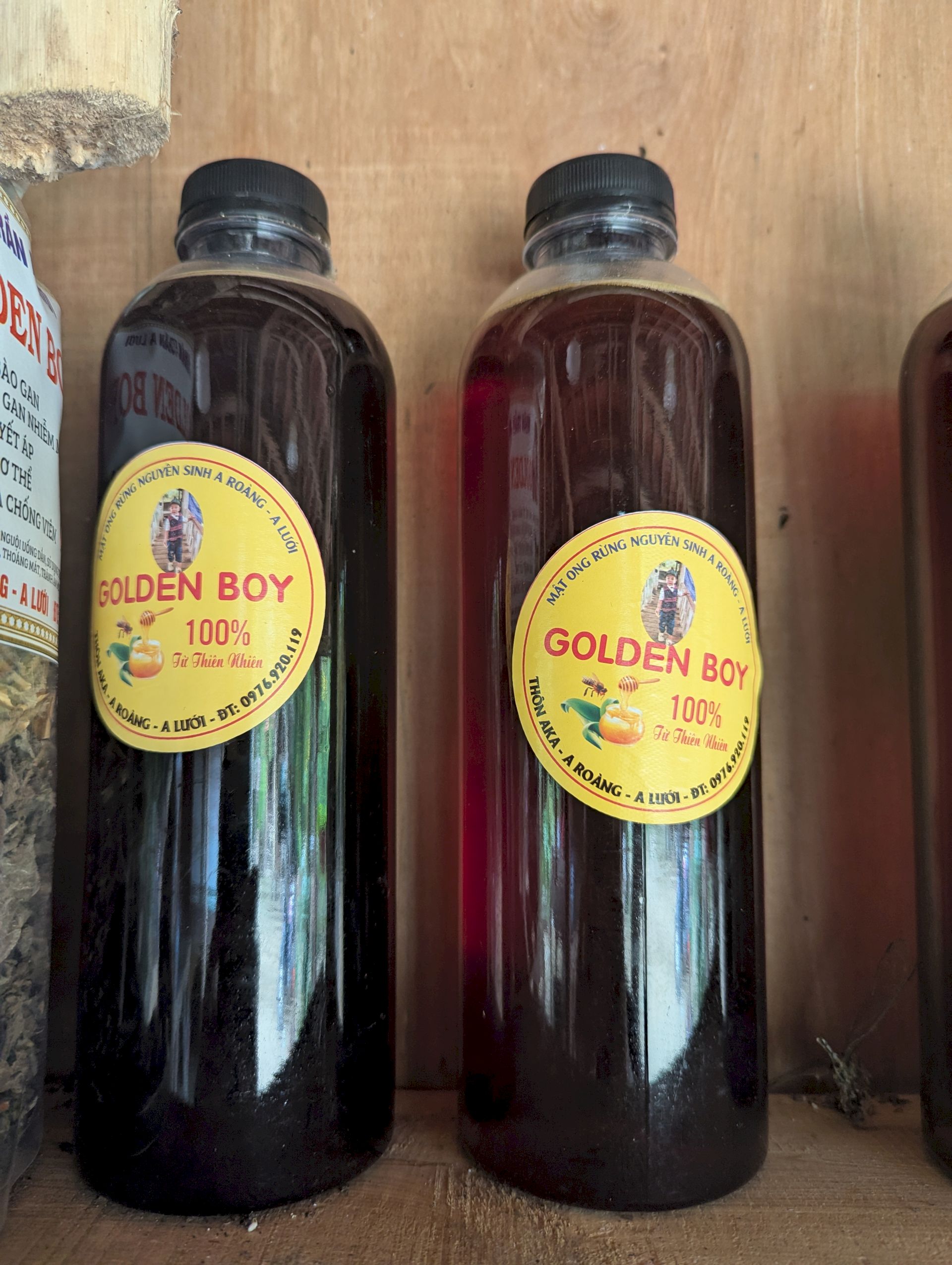
After leaving the airport, Mr Phú took me to his home for a cup of tea before I caught the bus back to Hue. He shows me round his house and the lodges that he and his wife are currently fitting out so they can accommodate a few tourists. He sells berries and honey he collects in the jungle of the A Lưới Valley; on the label of the honey bottle, there is a photo of his eldest son.

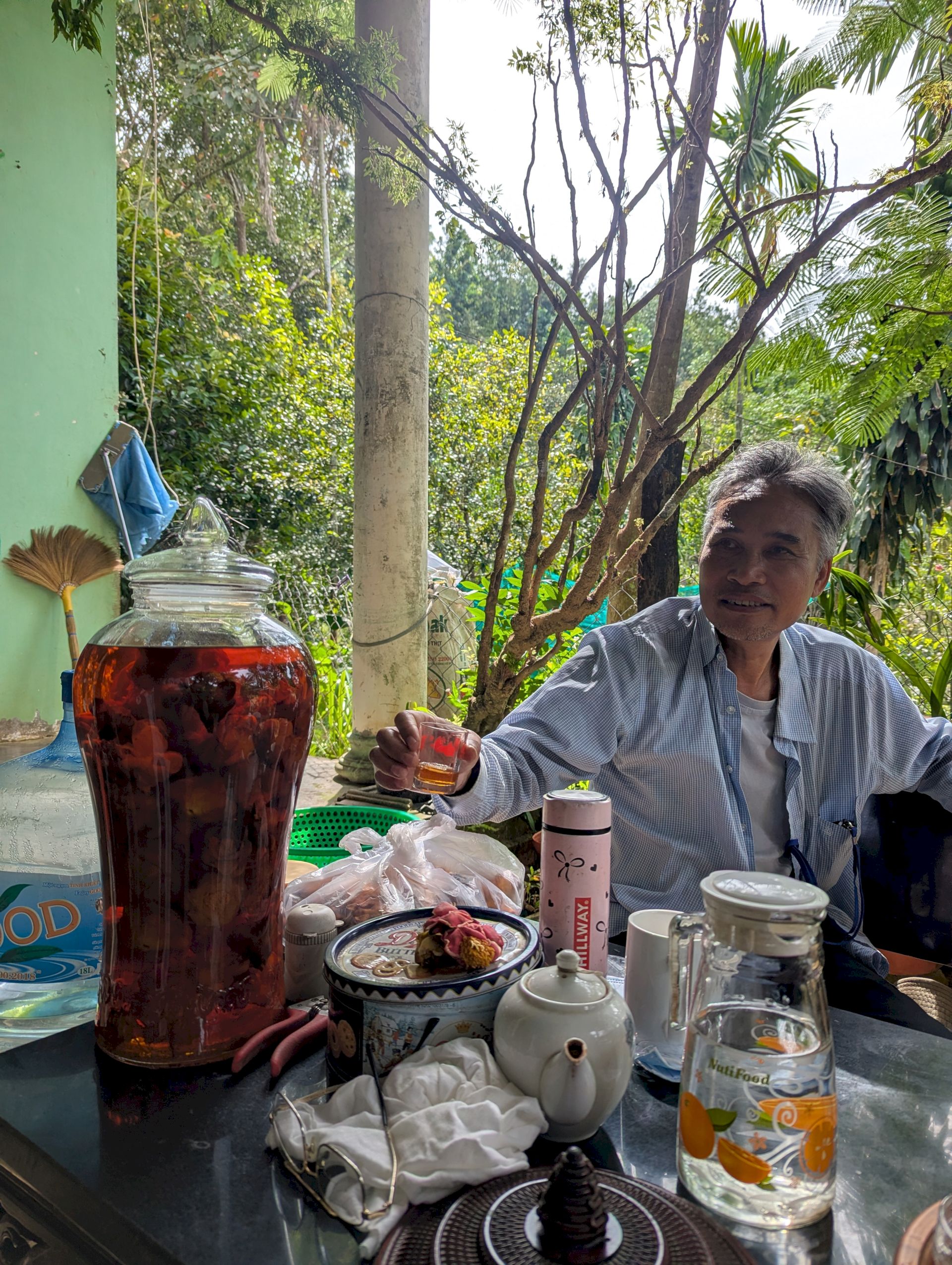
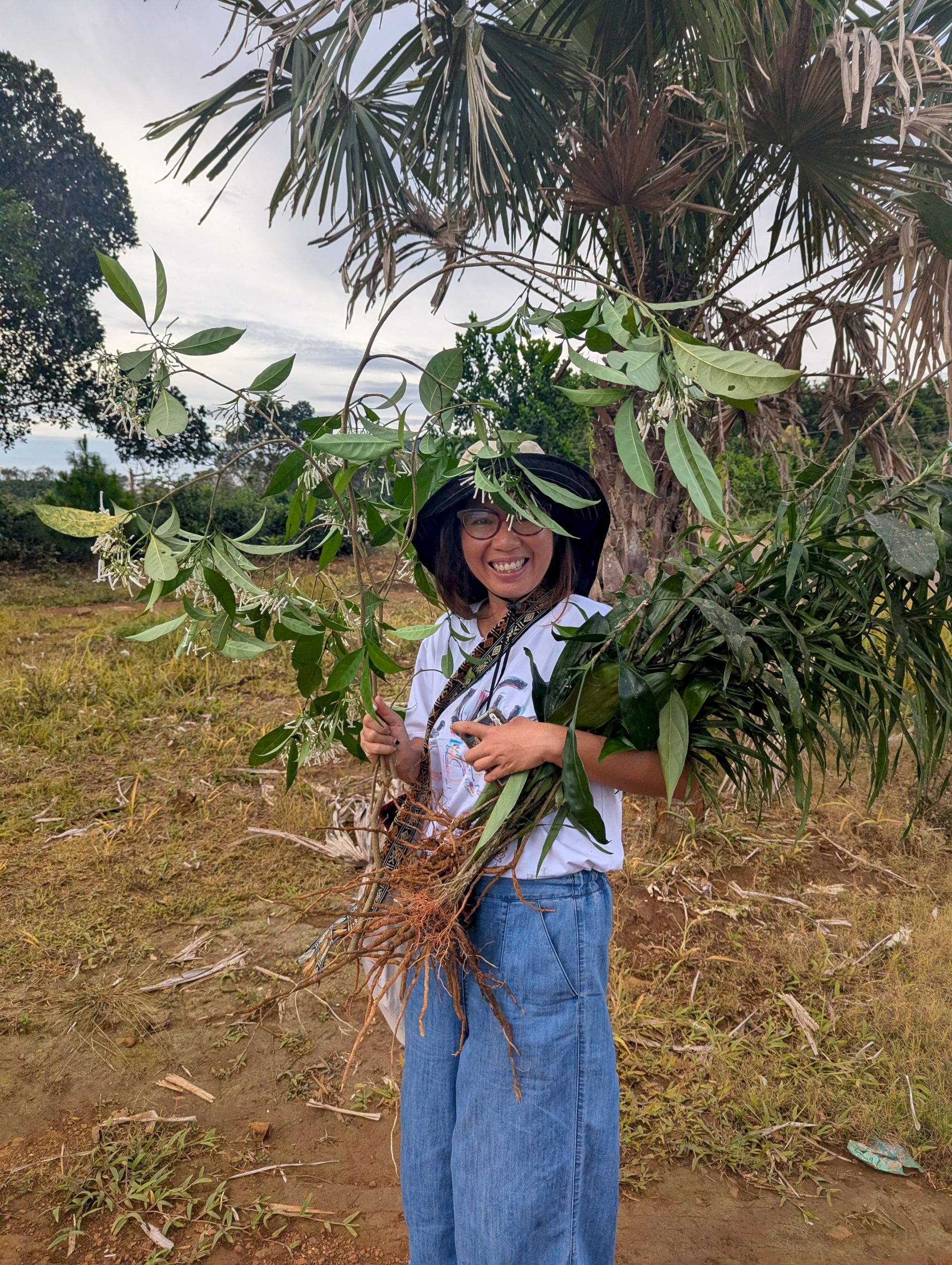
In October, I spent a month of residency in Cù Rú, an artist-run space in Đà Lạt nested in a typical greenhouse of the region. I had the chance to meet Nguyễn Kim Tố Lan, a public figure of the Vietnamese art scene, from a family of artists and a joyful soul, thanks to my dear friend the painter Jo Ngô. She introduced me to Pr. Lương Văn Dũng, a biologist teaching at Đà Lạt University and specialist of the area’s ecosystem. We talked a lot about dioxin and he told me about Rhodomyrtus tomentosa, a pink flower bush very present on a lot of former military facilities he visited. We went to Cát Tiên National Park, where he knew about an abandoned US heliport from the war hidden in the forest, where these trees were growing abundantly. We took the trip together with him and Tố Lan over the week-end. We visit the professor’s colleagues in the region; he is working with local farmers to cultivate a new species of camellia that he found in the forest this year. We also visit friends from the Saray ethnic group, one of Vietnam’s many ethnic minorities. They show us parts of the primary jungle, the edges of which are gradually being encroached upon by the old colonial rubber and coffee plantations that continue to expand. When we arrive at the heliport, the place looked like a simple clearing in the forest with a lot of pink flower bushes. Without Pr. Lương Văn Dũng, I would have never imagined this green and lush place to be a former Agent Orange storage place, which is exactly the reason why I see an interest in shaping a visual presentation about this pollution : time passing, it would be very easy to forget which of these hills are contaminated or what was the landscape or primal forests used to be, a lot of informations were already lost. All that remains is doubts about what and where are the places that are contaminated.
Modeling from former warzones soil
During these few research and personal trips in former warzones or in zones still affected by what happened during the war, I collected samples of soil to later incorporate them into ceramic work. The ceramics pieces are four tea services made with clay mixed and glazed with the natural soils collected, bringing the constant doubt about poisoned food that happens in contaminated land within the installation. Beforehand, I had met the ecotoxicologist Xavier Coumoul in Paris to discuss what would be the possible threats of contamination concerning potential dioxin in the soil. After meeting him, it was clear that it was better to use soil that had not been contaminated with dioxin. Even if the ceramics would have been safe from any contamination after being cooked at 1200 C degrees, there was no evidence that the kiln wouldn’t have been contaminated then. Therefore I wanted to be mindful of which soils I would incorporate in the work.
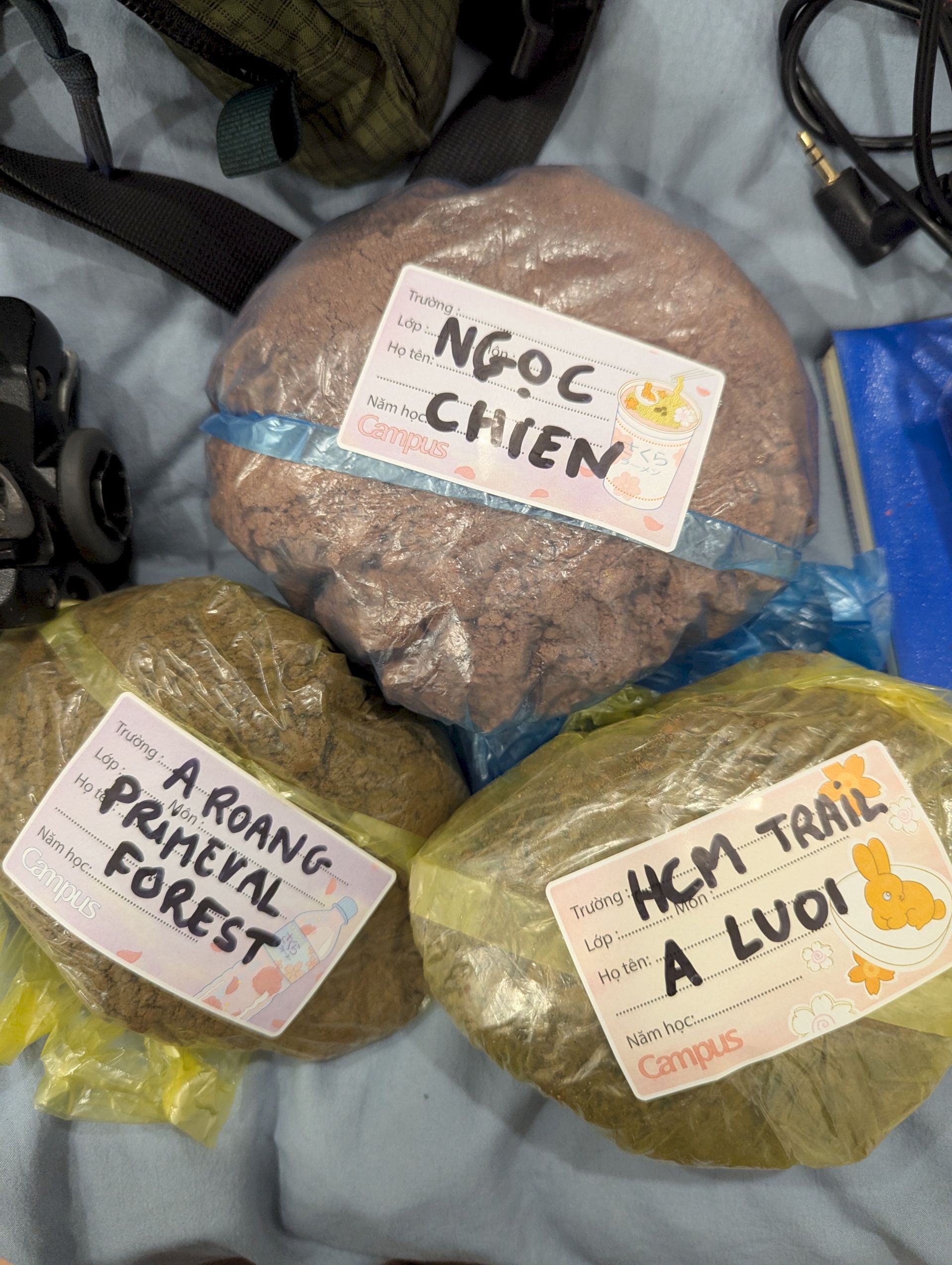
At first Marvin and I visited a dear friend of ours in Sơn La, the musician Yến-Linh Thẩm. A multitude of ethnic groups live in that region, White Thai, Black Thai and H’mong are the ones we encountered. In those mountains, the soil was radiant red. The complex and many ways ethnic groups of Việt Nam got involved during the Indochina wars had an impact on their relations with the government and therefore on how they have access to public facilities. Collecting samples of the soil in this area is a way to make it part of the installation and the attempt of a common narrative within the project. When I visited A So Airport in A Luoi Valley, we visited the primal forest and a part of the Hồ Chí Minh trails, a logistical network of roads and trails that ran in the jungle from North Việt Nam to South Việt Nam through Laos and Cambodia to provide manpower and material to the People’s Army of Việt Nam. This story, of how Vietnamese people collaborated with non-human, making themselves a part of the jungle in order to defeat US imperialism is a tale that still inspires decolonial movements today, had to be a part of Foliating Memories. So I took samples from the primal forest, that had not been touched by dioxin, and from the trail. Later I visited the Sác Forest Museum, an open air museum in Cần Giờ mangroves. The museum shows how the Vietnamese army organized, lived and resisted in the complex ecosystem of mangroves. I took a bit of history and mud back from the walk between the mangrove trees. With these 4 different soils, I also used some sand from Long Hái, a beach near my family’s town in Bà Rịa–Vũng Tàu area, where my father grew up and lost his father, who resisted French colonisation in the war.
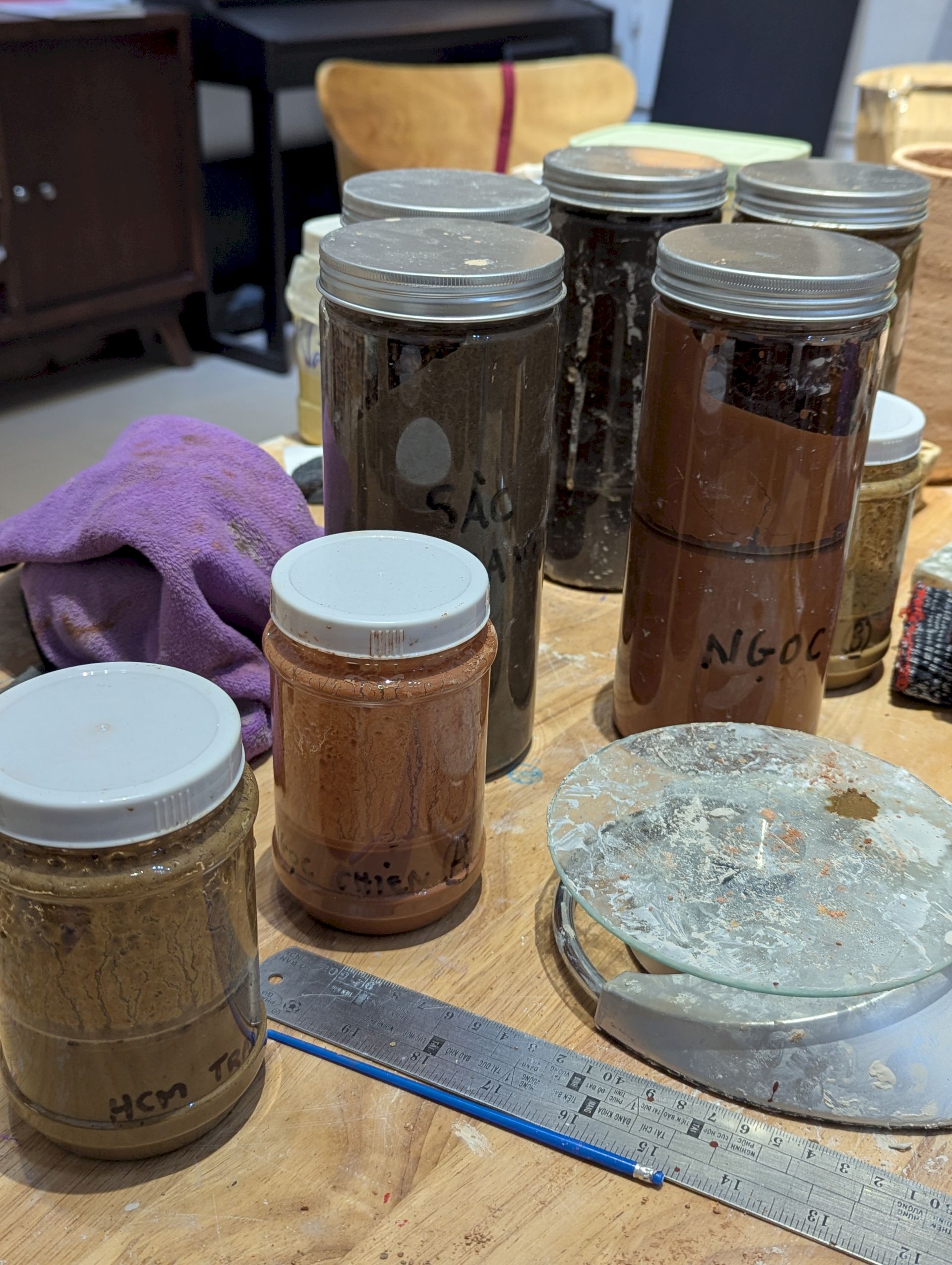
Packed with bags of mud and dirt, I met Dương Văn Tốn, a young pottery genius and collaborator of Cù Rú residency. As a natural soil specialist, he was my ceramic mentor during the residency. On the first day I arrived, we filtered and mixed my samples with water, silicate and clay in order to make the materials I would work from to model and glaze the tea services. Tốn even gave me some titanium sand from his hometown, Quy Nhơn, to decorate some parts of my work. We worked pretty intensely together in order to have the services ready within a month, with carafes and cups. These services are parts of the installation Foliating Memories and were used during the conference organised at Albert Kahn to share the Rhodomyrtus tomentosa tea that Pr. Lương Văn Dũng made especially for this piece.
Lacquer paintings : from forest conversations with Phùng Tửu Bôi to learning lacquer in the suburbs of Sài Gòn
In the installation shown at Museum Albert Kahn in April 2026, there is a series of 6 lacquer paintings that I made in Việt Nam, all representing plant species that are linked with dioxin pollution. Acacia and Rhodomyrtus are patterns for two of them. The choice of the plants come from a discussion with Phùng Tửu Bôi : the four other paintings show representations of a Mangrove tree, one of the most affected ecosystems but also the fastest to regenerate thanks to the flows of water going through it (dioxin doesn’t mix in water), Dipterocarpus dyeri (a tree native to the area before the war, strong enough to protect trees that grow under it), Gleditsia fera, also called bồ kết, with huge spikes growing out of its trunk (used by Phùng Tửu Bôi to build natural barriers to restrict access to the contaminated land), Acacia Hybrid (a species created by Phùng Tửu Bôi to enable local people to make a living from forestry on the contaminated land), Cucurbita (the only plants that absorb dioxin from the soil).
I drew colored pencil sketches of the plants in Sài Gòn. At the same time, I was visiting the fine art museum regularly to look into the lacquer painting collections and what kind of texture I would be aiming at when I start painting. The masters Nguyễn Gia Trí, Phạm Hậu et Mai Thị Kim Uyên inspired me a lot. When I first met my teachers Phù Thành Nguyên and Trẩn Minh Tâm, they recommended me to know what textures, material and effects I wanted to work with. I had met them thanks to Nguyễn Kim Tố Lan, who studied fine arts with them and also initiated me during my residency in Cù Rú, Đà Lạt.
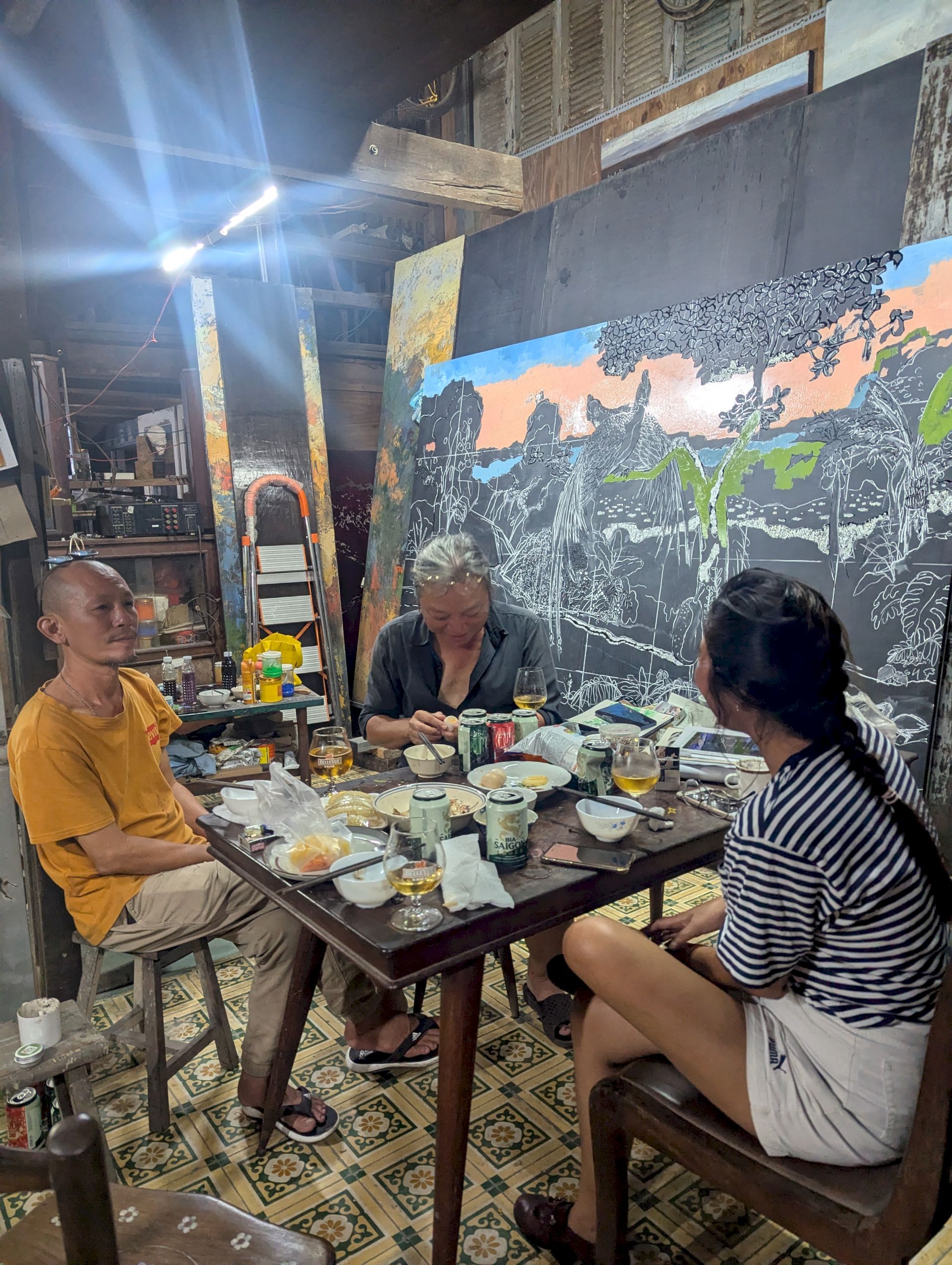
Lacquer painting is a typical technique from Vietnamese fine arts, inspired by traditional artisan crafts and woven into the country’s colonial past with France. In one of the PDFs on the subject that the Lê brothers sent me, Shireen Naziree explains: “Historical dating of lacquer objects found in a number of ancient tombs located near Hai Phong suggests that lacquer painting on objects such as boat oars, household ware as well as lacquer-producing equipment had existed in Vietnam for more than 2000 years (…) In the early 20th century, Vietnamese artists were encouraged by their French art teachers at the École des Beaux-Arts in Hanoi to experiment with traditional media such as silk and lacquer to produce modern paintings, paving the way for a fresh generation of artists to try out new ways of expression.(….) Tardieu, who had graduated from the École des Beaux-Arts de Lyon and later studied in Paris under Gustave Moreau with Henri Matisse and Georges Rouault, embarked for Indochina in 1921 having been commissioned by the French colonial administration to paint two large-scale murals for the University of Indochine and the Central Library, both located in Hanoi. While there he met NamSon, an employee of the colonial administration, who was an accomplished painter practising Chinese ink painting and who had an ardent interest in art education. Together they formulated the infrastructure and the establishment of the art academy. (…) The academy provided a place where talent could be nurtured, and it was here that lacquer craft was transformed into a new art form.(…) While colonial values exploited the Vietnamese, Tardieu conveyed his genuine concern for the people and culture and affirmed that “the Annamese had all the gifts to become artists and they had this right.”(…) By expanding traditional painting practice to adapt European academic art principles, artists created modern perceptions of the visual world and the result of this aesthetic shift in arts and crafts would ultimately elevate their status. The establishment of the art college initiated ‘a new profession’ in Vietnamese culture denoted by the word ‘Hia Si’, meaning painter, to describe a creator of artistic painting as opposed to ‘Thq Ve’, meaning a person who draws or paints as a craft.” (extracts from the book From craft to art — Vietnamese lacquer paintings, Shireen Naziree, published in 2013 by Thavibu Gallery in Bangkok).

The aspect that was first presented to me in the workshop and stroke me is that everything in that technique comes from natural elements: the paint is made from tree sap (Rhus succedanea) mixed with oil and pigments ; the brushes are made of wood and human hair (hair run inside the whole length of the wooden body in order to sharpen the brush like a pencil) ; ornaments are made out of egg shells or mother of pearl. The technique itself is an ode to many actors from Việt Nam ecosystems. The technique takes time, it involves many layers of paint between silver leaf applications, the paint can only dry correctly if the weather is hot and wet, meaning it can only dry in tropical climates. I drove for 45 min every morning to Nguyên and Tâm studio from my small apartment in Phạm Viết Chánh, through Sài Gòn’s heat and traffic on a rental scooter. I was in love with the city, the material, the light, all of it. It meant the world to me to learn this ancient art as a French person of Vietnamese descent with very little connection to my family’s heritage.
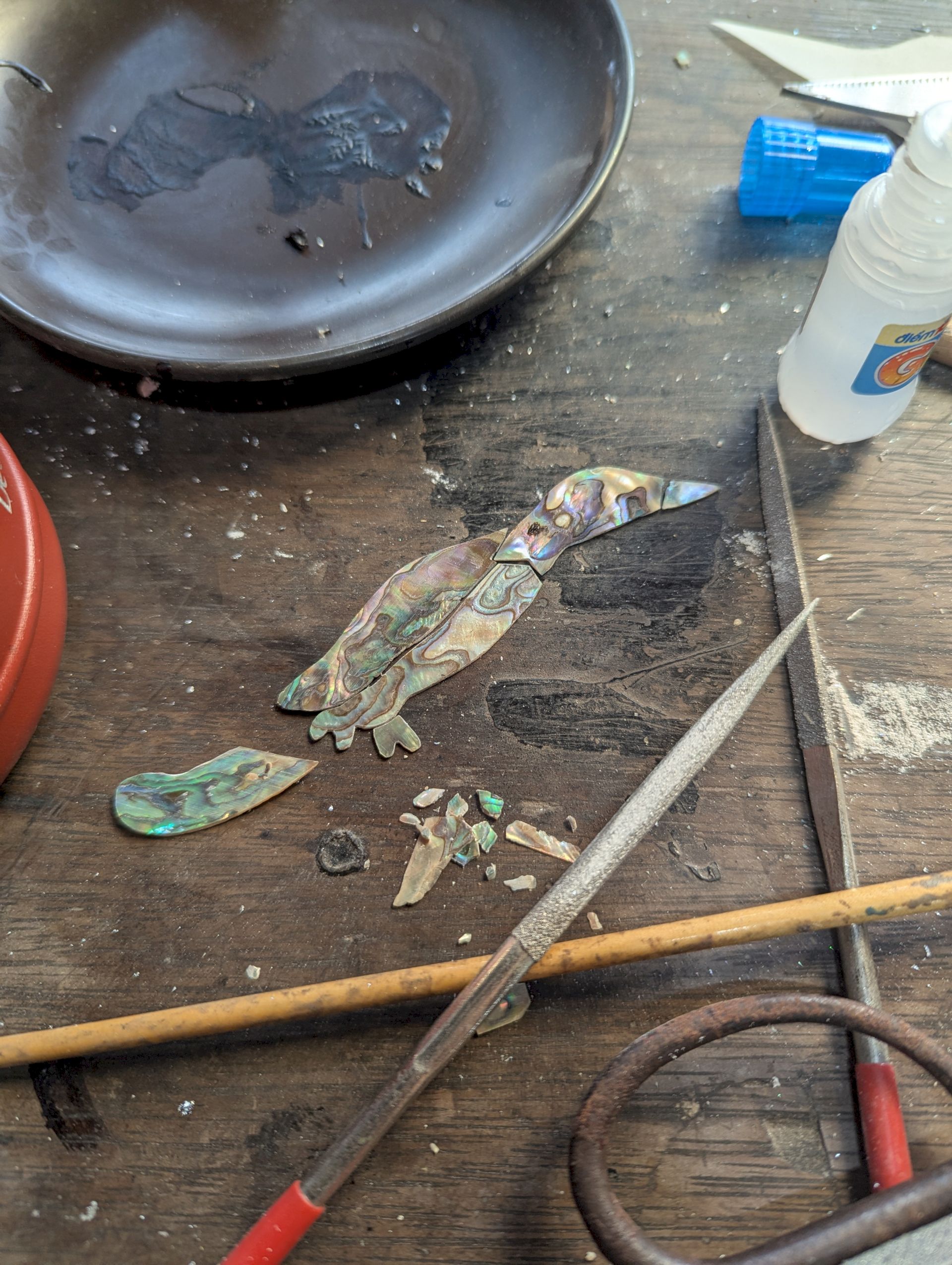
My teachers drew a very concrete line between fine art lacquer and artisan lacquer. When I stayed with them, they were painting giant pieces, about 3 or 4 meters wide, of natural landscape for the boat of a rich friend of theirs. We had long discussions about what I wanted to do with my painting : they were to be tables that the public could sit at during the exhibition. They excused my extravagance being a Viet Kieu from France and “young” artist, it seemed absurd to make tables now that the nobility of lacquer fine arts was finally established, moreover from a person with an art degree from the west. Apart from that, and the fact that I wanted to use burned eggshells, which are rather used for artisan goods than contemporary art, they seemed content that the piece was about environmental issues and Agent Orange. We finished the work just in time before I took my plane back to France. We drank many Sài Gòn beers in front of the carefully packed paintings on my last day at their workshop, hugged goodbye and see you some other time.
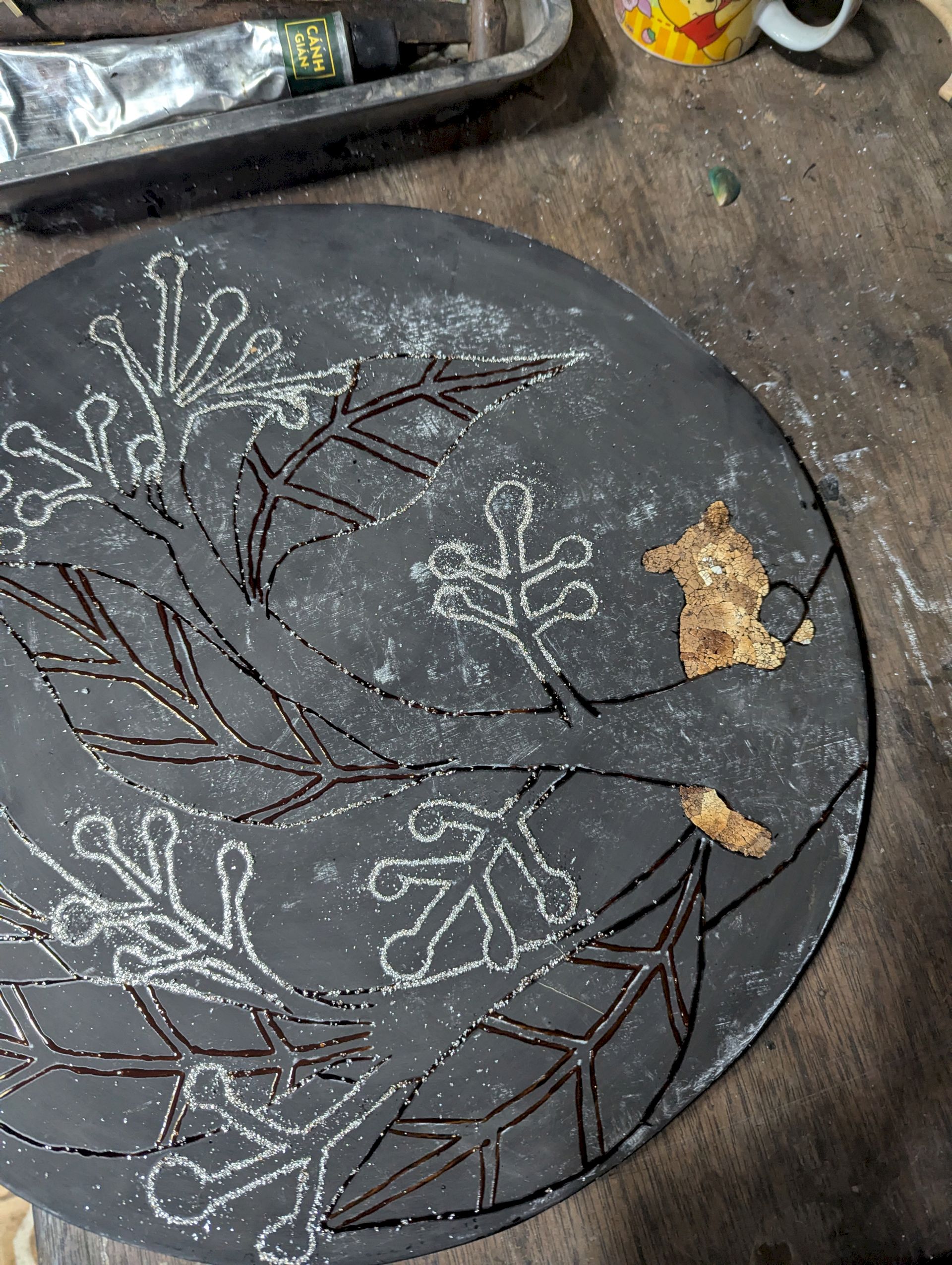
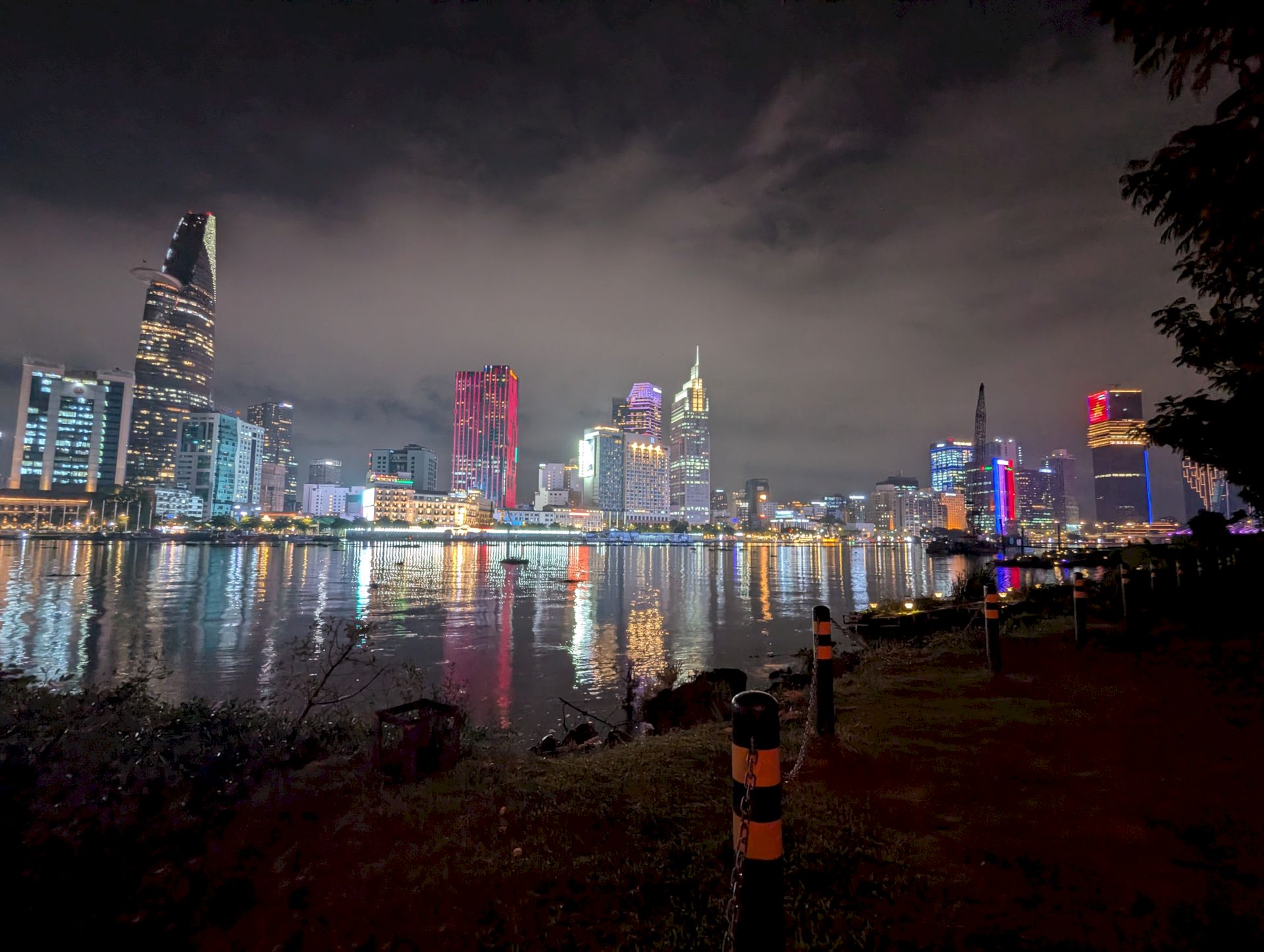
The next day, I carefully placed the parcel in my suitcase, padded on all sides by my clothes, and put the ceramics – packed in bubble wrap – in my hand luggage. I returned the hire scooter. I went to see the Saigon skyline one last time with Marvin. And just like that, within 24 hours, it was all over. I boarded the plane and flew back to Paris. We were in December, the exhibition took place a few months later; I returned to winter and my studio to finish the pieces in time for spring.
Last part next week.
Read the first chapter of this story.
Kim Đoan Quốc’s website.