

The collective of la Halle during the inaugural construction project. Credit: La Halle œuvrière
The collective La Halle œuvrière is a long-term resident at Kerminy, a site for research, artistic practice, and experimentation in Finistère, Brittany, where artistic and ecological practices intersect with local and territorial dynamics. Kerminy welcomes artists, researchers, and collectives to develop forms of creation and cooperation rooted in their environments. This is the first part of a conversation between artists from the collective and Marina Pirot, co-founder of Kerminy, held on the eve of the regional Soil Assembly, taking place on the site from August 28 to 30.
“Épure”: In timber framing, an épure is a full-scale technical drawing, usually made directly on the ground or on a flat surface, used to lay out part or all of a timber frame.
Marina Pirot spoke with three members of Kerminy’s La Halle œuvrière collective, about folklore, anonymous traces, and an archaeology of skills, techniques, and gestures.
Makery presents a written transcription of this exchange—an attempt to give form to a moment of oral conversation, fixing in writing what was only partly said aloud, then revisited through writing and further discussed by correspondence.
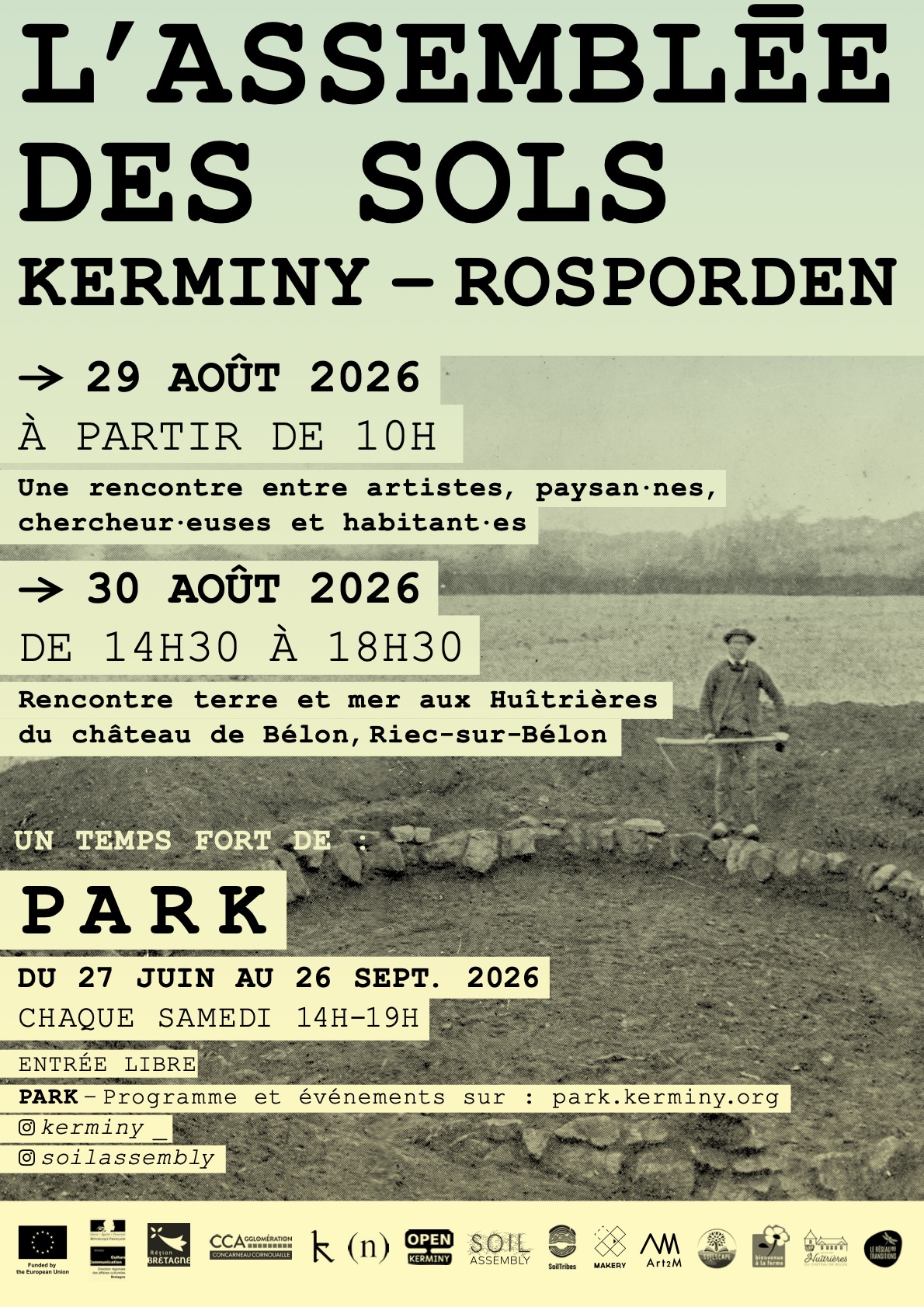
La Halle œuvrière will present some of its work during the Assemblée des Sols, taking place at Kerminy and at Les Huitrières du Château de Bélon from September 28 to 30.

Marina Pirot: There are three of you here, halleur·euses, as you are called at Kerminy. What does it mean to be a member of La Halle œuvrière? Do you feel able to speak on behalf of this emerging collective?
La Halle œuvrière: Each of us is a member of La Halle, which is made up predominantly of artists by training, but also of architects, craftspeople, designers, agriculture workers, inventors, performers, and many other things besides—and often several of these practices at once!
For the time being, being a member of La Halle means having taken part in several collective projects, both theoretical and practical, at Kerminy, and having an interest in the project as well as in the place itself. It also requires a degree of commitment. Several people orbit around and participate in La Halle without necessarily being at the heart of the project. We are currently working on defining its legal structure and, more broadly, what it means to be a halleur·euse. It is indeed a work in progress. We’re experimenting with different approaches. Nothing is set in stone; everything that’s been said is mainly under consideration.
Marina Pirot: Why a “Halle”? And how did it emerge? How did your group come together?
La Halle œuvrière: Why did we embark on La Halle? Because Kerminy seemed to us to be the “place” where it might be possible to extend the kinds of living stories and traditions that each of us encounters in our practices, but which today are tending to disappear, along with all the political and cultural consequences this entails.
The interest of a “halle” lies in its ability to move beyond the contradictions of our time. It is an architecture of conviviality and hospitality in the making, where networks of interdependence, assemblies, workshops, markets and fairs—and living beings themselves—can take shape. We all very quickly found ourselves drawn to this place and to the architectural imaginary of a “halle”—it simply made sense.
It was an artist who initially had, let’s say, the visions, following some smaller-scale projects and a long internship at Kerminy in 2022. These ideas began to take root and to encounter theoretical contributions, particularly through seminars held at the Ferme de la Mhotte, which laid the groundwork for the “Network of Territory-Schools,” bringing together art and ecology theorists, artists, and researchers.
These sessions of collective reflection brought to light the lack of places for concrete forms of practice—places that could embody, in a grounded way, artistic and ecological thinking around the transformation of environments.
The idea of La Halle subsequently met with shared aspirations from two other artists. There was a desire to build a wood-fired kiln for collective ceramic firings. This embryonic, dreamlike idea took over from the initial Kampus project, imagined by you, Marina, and Dominique (Dominique Leroy, also a co-founder—ed.), which involved setting up artists’ workshops in the outbuildings and ruins of the château, creating opportunities for exchanges of practices and engagement with the wider Kerminy territory.
This idea of establishing practices and experiments connected to the territory and its resources was inspired by projects such as the Floating University in Berlin and other situated forms of artistic research. You were asking yourselves what a Black Mountain College—the experimental college established in North Carolina, USA, in the 1940s and ’50s—might look like in an ecological age, and, ironically enough, in close proximity to the Montagnes Noires of Finistère.
The project of La Halle thus gradually took shape from these initial ideas, conversations, and practices taking root on the site, which needed to become collective. The Kerminy site seemed particularly conducive to creating a workshop open to the world, thanks to the reach of the place at different scales—local, national, and European—but also because of the many forms of knowledge and skill it brings into play: building renovation, raw materials available on site, and the functional and cultural needs of the site related to market gardening, forestry, and artistic creation; as well as the revaluation, reinvention, and reclaiming of popular aesthetic codes. Kerminy has hosted La Halle’s initiative since 2025 (see Marina Pirot and Dominique Leroy’s article on Kerminy in Makery—ed.)

Marina Pirot: Why La Halle œuvrière? How is this collective project actually put into practice?
La Halle œuvrière: The project got underway fairly quickly. We already wanted to bring together a group of artists and craftspeople with a range of skills that could be useful for our plans around knowledge-sharing and rehabilitation.
Around forty invitations were sent out to people we wanted to bring together for a first meeting at the site: friends, acquaintances, and people we had identified as potentially interested in joining the adventure.
After a tentative first attempt in the summer of 2025, a first meeting took place in October 2025, with around twenty people attending, some of them travelling from quite far away. Over the course of a weekend, we discussed, among other things, questions of rurality, forms of knowledge and skill within the contemporary art world, and plans for future collective projects. This was the moment when La Halle was born.
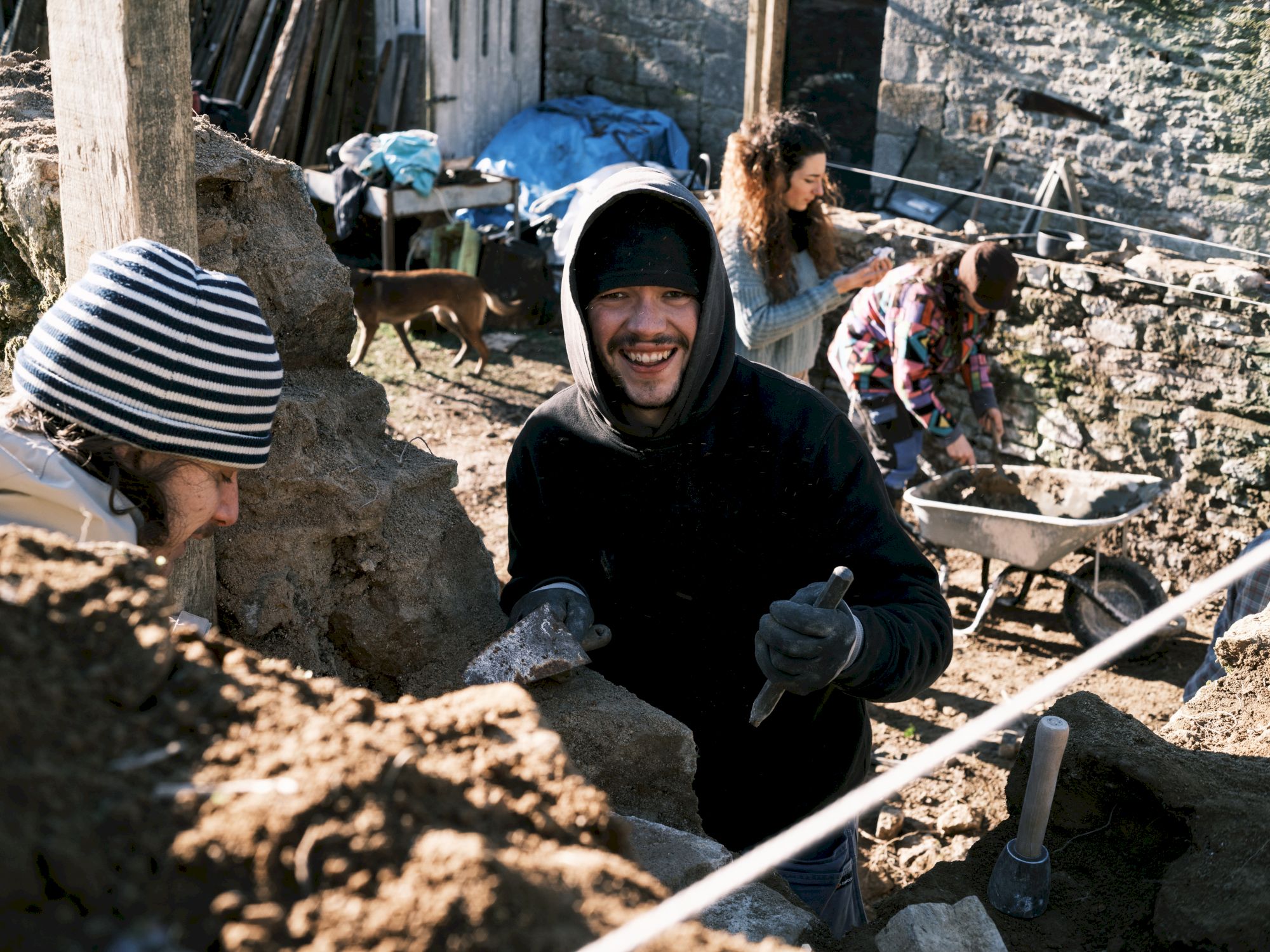
What emerged most strongly from that first gathering was a unanimous desire to organize the very first collective project—which took place between late December 2025 and early January 2026. It allowed us to continue developing our ideas and exchanges while joyfully working together to rehabilitate a ruined wall, around which a metalworking and blacksmithing workshop is now beginning to take shape.
It was probably here that the dimension of La Halle œuvrière became tangible: the aim was to make, build, and work together, rather than simply to “produce artworks.” This implies a transformed relationship to work, one that breaks with the paternalistic continuity of generational transmission while paradoxically drawing on the reclaiming and circulation of knowledge and techniques inherited from previous generations.
The idea was to establish at Kerminy a supportive resource space for young artists who no longer wanted to depend exclusively on traditional art institutions, and who wanted to step outside the competitive model—open calls, artist residencies, exhibitions—that we are subjected to upon leaving higher art education, a model that is also deeply precarious.
The question, then, was how to imagine the conditions for artistic practices beyond conventional frameworks, which are often shaped by extractivist logics: how can we produce, research, and create without simply extracting from territories, narratives, or forms of knowledge and reinvesting them solely within the art world?
Beyond that, we came together around what seems essential to us: social connection and the idea of making things together—something that can easily be lost after leaving education, at a moment when we often have very few technical or financial resources.
We wanted to create our own material conditions, within an environment conducive to continuing our practices and experiments, while also continuing to learn from one another—and, above all, not remaining alone in the face of the system.
This reflection also responds to the cultural urgency of rural territories, which are too often regarded simply as reservoirs of resources, landscapes, or traditions to be reclaimed. Instead, we want to imagine practices based on reciprocal relationships with environments and their inhabitants, rather than on the one-off, non-reciprocal appropriation of their knowledge, histories, and ways of life.

Marina Pirot: Why do gestures, materials, and forms of knowledge and skill occupy such an important place in your practices?
La Halle œuvrière: Here, our relationship to material is reversed: it is no longer a pre-existing idea that determines the choice of a material according to its symbolic or theoretical significance. Instead, the desire to make guides the form of the project.
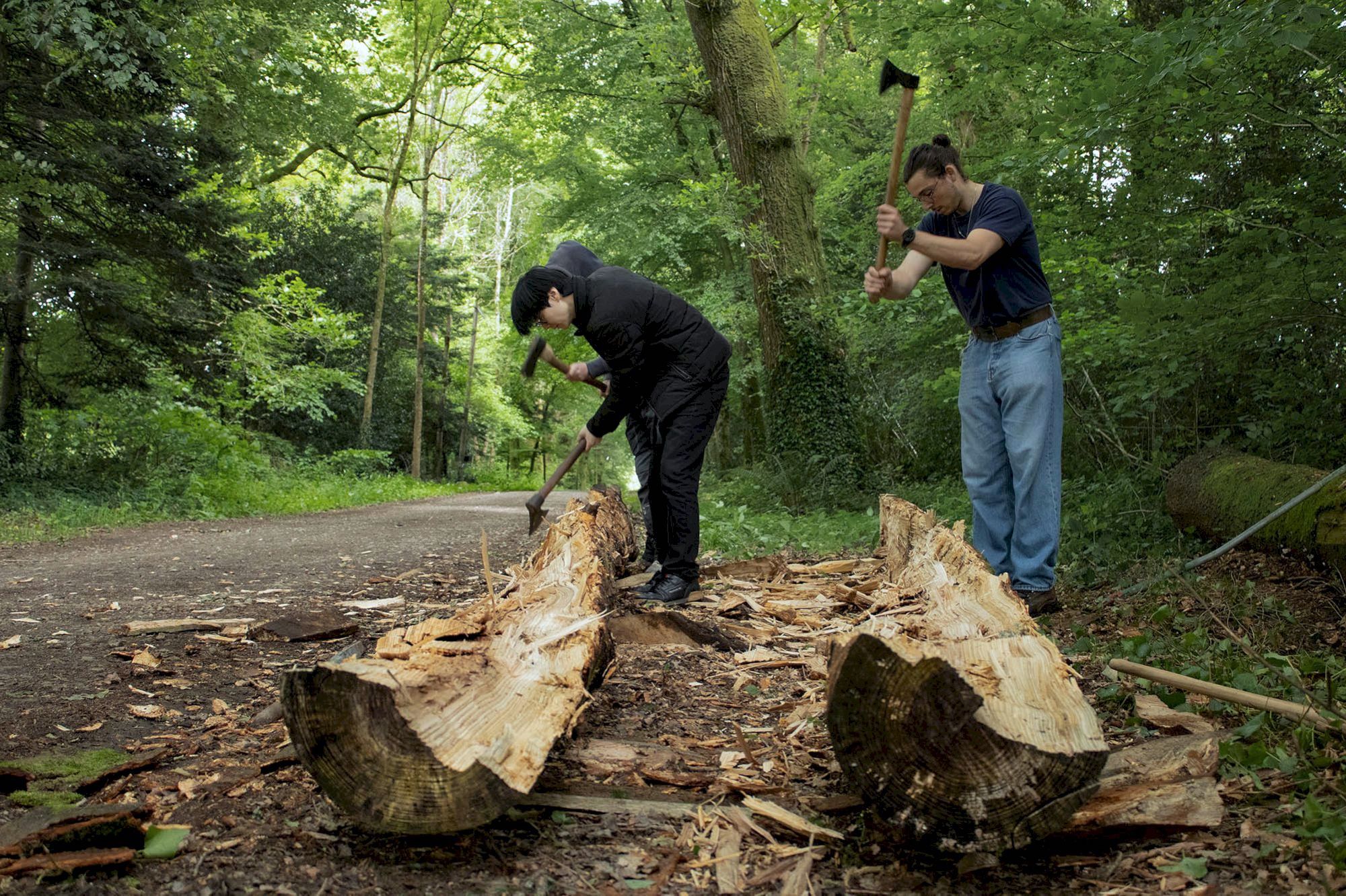
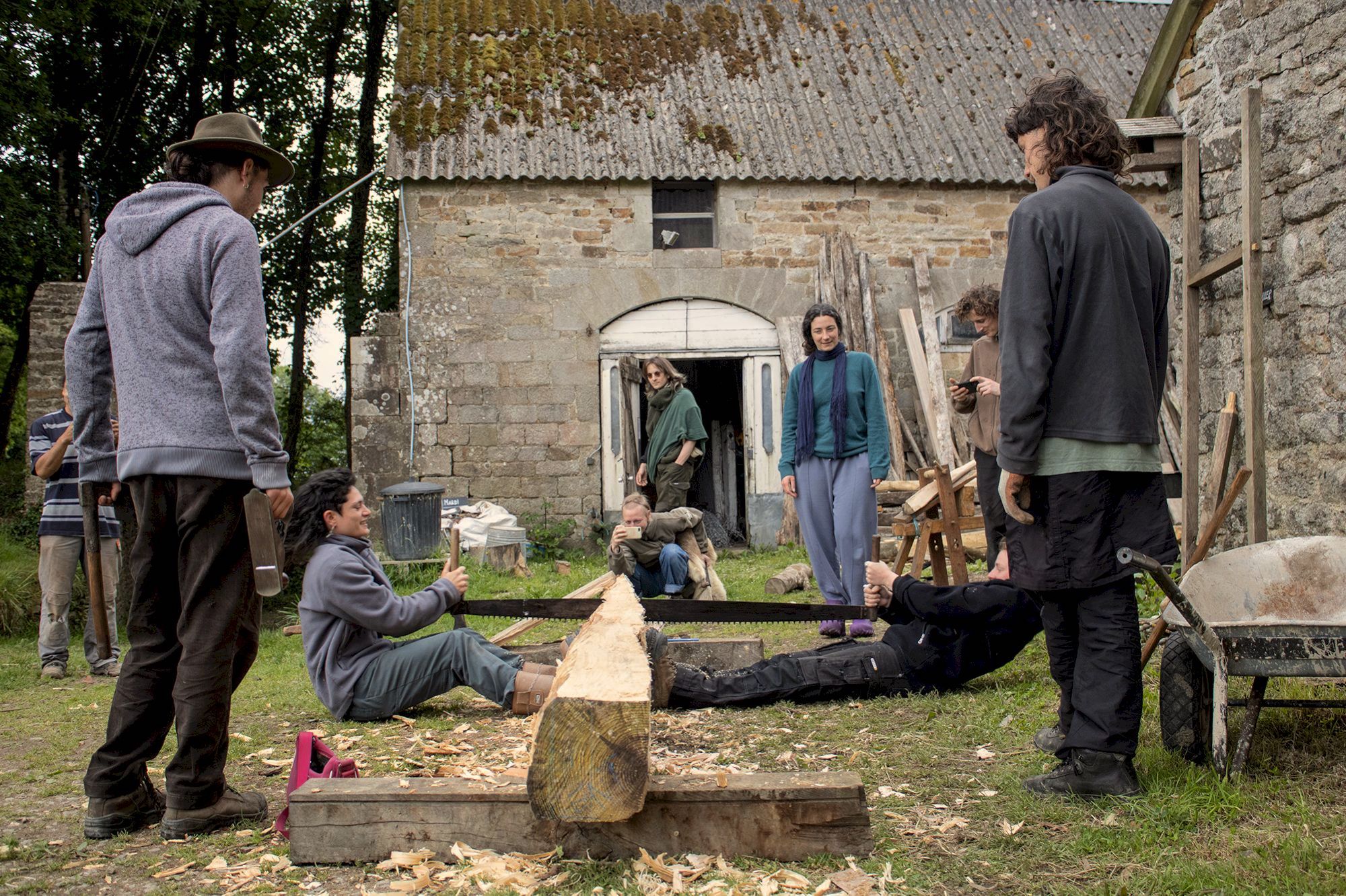
Making bread, shaping wood, working clay, spinning fibre, or building become meaningful practices in their own right. The material—its properties, its resistance, and the gestures it calls for—directly participates in shaping the final form. The work thus emerges from the pleasure and attentiveness involved in making, rather than from the execution of a previously defined intention.
The gestures we observe today in rural environments are individual or collective traces, often anonymous, of a prolonged relationship between hands and environments. Because they largely escape industrial processes, these gestures produce forms that we consider particularly important to our sensory understanding of the world: they are tangible, observable, legible, and sometimes still active.
There is therefore a logical continuity in extending these gestures through the hand—not in order to reproduce them identically, but to put them back into circulation and allow them to evolve in the present.
This approach also contributes to redefining the artistic process itself. The work no longer necessarily resides in a finished object, but may emerge through a succession of gestures, through learning, transformation, or an ongoing relationship with an environment.
The process becomes a way of producing knowledge as much as a way of producing forms. Ultimately, this leads to a more radical shift in artistic practice: we are gradually leaving the art world as our frame of reference, and with it the imperative to produce artworks.
It is no longer necessarily a question of making an object that is to be recognized as an artwork, but of engaging in practices, gestures, relationships, and concrete transformations of an environment. In this sense, we are almost leaving the artwork itself behind.
What matters then is not so much what is produced, but what “making” makes possible in terms of transforming, transmitting, understanding, or connecting. The artwork may remain, but it becomes a possible consequence of the process rather than its end goal.
The “ruin” also occupies an important place in this approach to an archaeology of gestures. It is a trace of past gestures and a source of inspiration and reclamation, but it is not considered an incomplete state that must necessarily be restored. Instead, it presents itself as a form already transformed by time, which we can observe, inhabit, or extend while respecting its ruined state.
This is therefore not about giving in to a fever of total restoration, seeking to return things to some presumed original state. Such an approach could freeze the environment and precisely cancel out its capacity for transformation.
This is where the notion of œuvre-milieu, roughly translatable as “work-environment,” comes in. It is grounded in the tension between what is inherited, what remains, what changes, and what can be re-engaged with without being entirely restored.
We are also experimenting with gestures through the use of tools.
We are deeply attached to the question of the traces left by gestures, embodied in a form of anonymity. The most telling examples of anonymity are undoubtedly found in landscapes—embankments, hedgerows, trees, and so on—in architecture—farm buildings, dressed stone, timber frames—and in popular aesthetic and utilitarian art: graffiti, carved wood, ceramics, basketry, ploughs, tools, and so forth. These forms have emerged through centuries of labour.
The gestures we observe today in farming communities are anonymous individual and/or collective traces. These traces, which do not emerge from industrial processes but are made by hand, are, in our eyes, among the most important elements of our sensory perception of the world around us.
They are tangible. We can touch them, feel them, read them. They are close to us. They already enact a form of transmission…

Marina Pirot: What role does transmission play within La Halle?
La Halle œuvrière: The question of learning skills and ensuring their continuity through transmission seems essential to us today. Most discussions tend to revolve around dualisms such as verticality/horizontality or knower/learner, always implying that there is some “middle ground” on which we must position ourselves. But perhaps we should instead ask: what are the ways of living in this place from which learning and transmission emerge? Learning does not need to establish a separation between the person who knows and the person who learns in order for transmission to have a shared purpose. It does not require this distinction. We therefore try to resist these false dualities that arise from what we have been taught more broadly.Above all, it is about expanding our collective experience of the place, while leaving room for each person’s singularity, if we want, in the long term, for a network of cooperation to emerge and extend transmission to a larger number of people, all of whom can feel that they belong. We cannot hope to achieve anything if we remain caught within the knower/learner relationship.
Based on these observations, the different projects carried out at Kerminy become collective moments in which everyday forms of learning take shape: through gestures, through language, at the level of the soil, around shared tables, while walking and mapping a territory, or gathered around a fire.
We need to reconnect with this shifting balance of learning, which requires us to constantly work at renewing it. Transmission takes on its full meaning through the lived environment and the care we give to it—and the care we give to ourselves and to one another.
It is within these evolving everyday practices that we learn, both individually and collectively, and that we are able to remember past experiences. Because what is the point of failing to learn from our mistakes if we want to be able to ensure transmission?
Perhaps it is within this question that the œuvre-milieu takes on its full meaning. It is a kind of portmanteau term that emerged from Kerminy’s collective council and, for us, it was a discovery that immediately brought us back to the ground of our practices, both artistic and artisanal.
The œuvre-milieu brings together memories, traces, uses, and forms of knowledge which, starting from Kerminy, make new worlds possible—worlds that depart from models of thinking based on creation ex nihilo. Finally, there is room to discuss, to learn, to transmit; there is material with which to put our hypotheses to the test.
Check out the second part of the interview next week.
Learn more about Kerminy, the Halle œuvrière, and the Soil Assembly network.
TheSoil Assembly in Kerminy is part of a series of regional assemblies supported by SoilTribes and the European Union.