

László Moholy-Nagy, Photogram, 1926. In the collection of The Metropolitan Museum of Art, New York, USA.
As the Feral Labs network’s “Rewilding Cultures” program draws to a close, it is publishing its third “Node Book,” titled “Fa Fa Futures.” This month, Makery is publishing several essays excerpted from this 416-page, freely available volume. In the first essay presented here, Martyna Groth examines László Moholy-Nagy’s futurist tactility and Bauhaus methods, which used tactile experiments and material studies to develop sensory and manual skills, and connects these ideas to contemporary interests in touch, the “do-it-yourself” culture, makerspaces, and embodied knowledge.
The Feral Labs Node Books are a series of interconnected publications produced by the Feral Labs Network within the framework of Feral Labs (2018-2021) and Rewilding Cultures (2022–2026). Combining theoretical reflection, artistic research, ethnography, speculative writing, and visual documentation, the books foreground practice-based knowledge and experimental forms of collaboration. Rather than functioning as closed or complete publications, each volume acts as a “node” within a larger evolving network, gaining meaning through its connections to other contributions and previous editions. Across the three published volumes, the Node Books trace seven years of evolving “feral practice,” moving from grounding and methodological reflection to proliferation and future-oriented modulation.
The Feral Labs Node Book #3: Fa Fa Futures explores how feral artistic and research practices interact with institutions, infrastructures, crises, and systems of control. The volume focuses on accountability, survival, care, and the continuation of practices beyond temporary funding structures. Inspired partly by a Talking Heads song about anxiety and disconnection, the title also carries provocative symbolic meanings in a Slavic context. Structured in three “rhizomatic” sections, the book approaches ferality as a cosmopolitical practice that moves across indigenous knowledge, feminist technoscience, institutional critique, artistic research, and strategies for infrastructural survival. It highlights plural futures, embracing uncertainty and failure as productive and transformative forces.
A Hand Makes a Human (1)
Paper and scissors … and what about the rock?
Let out free,
drawing rings on the water.
The hand stays in the lateral oblique
as if surprised by its own agen/efficien/cy.
If we could still return
to what was primary?
Touching the words and objects just like that,
simply, with fingers.
Feeling the molecules of light,
our, non-digital,
with no shining sheet of screen …
They say that you can train the sensitivity
of the fingertips, asking each papillary
line for mindfulness (2).
Martyna Groth
We are not only homo opticus or homo auditus, but also homo hapticus. Touch, as emphasised in the above Manifesto of Manualism, allows direct contact with diverse shapes, surfaces, and their properties—that is, materiality in all its complexity. It is the most primordial sense, connected to the whole body, capable of experiencing (self-)touch, although it is most commonly associated with sensitive hands. This part of the body can grasp and encompass meaning, has become a tool of labour and has shaped the development of humanity—including the emergence of writing, tools, and art. The hand and touch are our primary mediums for understanding the world.
Each upper limb has natural grooves in its inner layer, which Juhani Pallasmaa called “prenatal hieroglyphs of individuality”. By around the fourth month of life, these papillary lines stabilise into a consistent pattern, changing only slightly over time due to ageing. This unique pattern constitutes our individual identity, and fingerprints serve as its trace, enabling verification both in forensic studies and in biometric identification systems. Hands play a key role in tactile and haptic processes.
From a neurophysiological perspective—following Martin Grunewald, author of Homo Hapticus: Why We Cannot Live Without the Sense of Touch (2007) — tactile impressions arise from external physical stimuli or interactions, whereas haptic impressions occur when we actively touch someone or something, triggering a response from our nervous system. This distinction differs from the one rooted in art-historical tradition, where tactile experience is based on an engaged, touch-based relationship with the artwork, occurring within an expanded multisensory hapticity.

In this paper—following Marta Smolińska—I consistently adopt the second definition. Moreover, in line with the non-dualistic orientation of new materialism, emerging in the 1990s, it is important to question artificial oppositions such as nature/culture, matter/mind, and human/non-human. This approach crosses disciplinary boundaries, emphasises change, and takes a particular interest in the emancipation of matter—its materiality and processes of materialisation. From the perspective of new materialism, the embodied, post-human subject engages in intra-actions with agentive and non-innocent matter. Matter is thus not a passive object but an active partner, co-creating and constituting reality. Knowledge and identity emerge within this material relationality.
This approach strengthens experimental practice, responsive to the resistance and possibilities of matter, and fosters curiosity-driven creativity. Through experiential practice and exploring the properties of different materials and tools, the body acquires asystemic knowledge, or mētis. This represents ingenuity and tactical intelligence, enabling control over processes, circumventing the constraints of material properties. As craft scholar Ewa Klekot notes:
“‘Mētis’ is knowledge acquired primarily through participation and very difficult to generalise. It is largely non-linguistic, based on experience and practice that confronts us with successive, similar yet never identical situations requiring rapid adaptation. It is non-discursive bodily knowledge, which, by not formulating general laws, easily adapts to changing circumstances; knowledge inseparable from concrete experience, a profound understanding of matter as a dynamic force of change”.
Importantly, mētis is not merely located in the body but in the relationship between the body and the world. Returning to the hand, we must recognise that finger movements activate millions of sensors in muscles, tendons, joints, hairs, and skin, sending cascades of signals to the brain, which integrates them into a coherent cognitive result. This creates a precise image of what the hand has detected. The hand reaches for nearby objects; the eye surveys those at a distance. Perhaps this helps us appreciate touch, the primordial sense of our existence and development? Patriarchal, vision-centred hierarchies historically relegated touch to the lowest sensory tier, associating it with animals and women. Yet while our eyes receive roughly 80% of sensory information, engaging 10% of the cerebral cortex, they are not our sole sensory organ. Karol Gromek and Marcelina Obarska, in the anthology of 702 fragments entitled Histories of Touch, attempt to reverse these proportions:
“The sacred part of my body is the fingertips; I focus 80% of my attention there. They do and accomplish. I caress screens and panels with them. What changed when we stopped pressing and began barely touching surfaces? We did not become gentler. Our choreography may have gained fluidity, but the subtlety of the gesture is an illusion. In reality, we permit increasingly cruel movements. Choreography unfolds where previously there was only a gesture’s seed. I touch—it is the beginning and the end, silence.”
Already, creators of the great avant-garde instigated a sensory turn in art, aiming for holistic, sometimes synesthetic, development of human sensory perception.
Futuristic Tactilism
Futurists recognised the potential of this undervalued sense: they claimed that art should be based primarily on tactile sensations. Filippo Tommaso Marinetti explored this experimentally, subjecting his own body to intensive training to sensitise its various parts. He developed a tactile scale with four first-degree categories and two second-degree categories, each linked to materials:
• Certain, abstract, cold touch (sandpaper, tinfoil)
• Cool, persuasive, contemplative touch (smooth silk, crepe silk)
• Exciting, warm, nostalgic touch (velvet, wool, silk and wool crepe)
• Nearly irritating, hot, decisive touch (coarse silk, frotté)
• Soft, warm, human touch (suede, horse or dog hair, human hair)
• Warm, sensual, witty, friendly touch (rough metal, soft brush, sponge, metal brush, plush, peach fuzz, bird feathers)
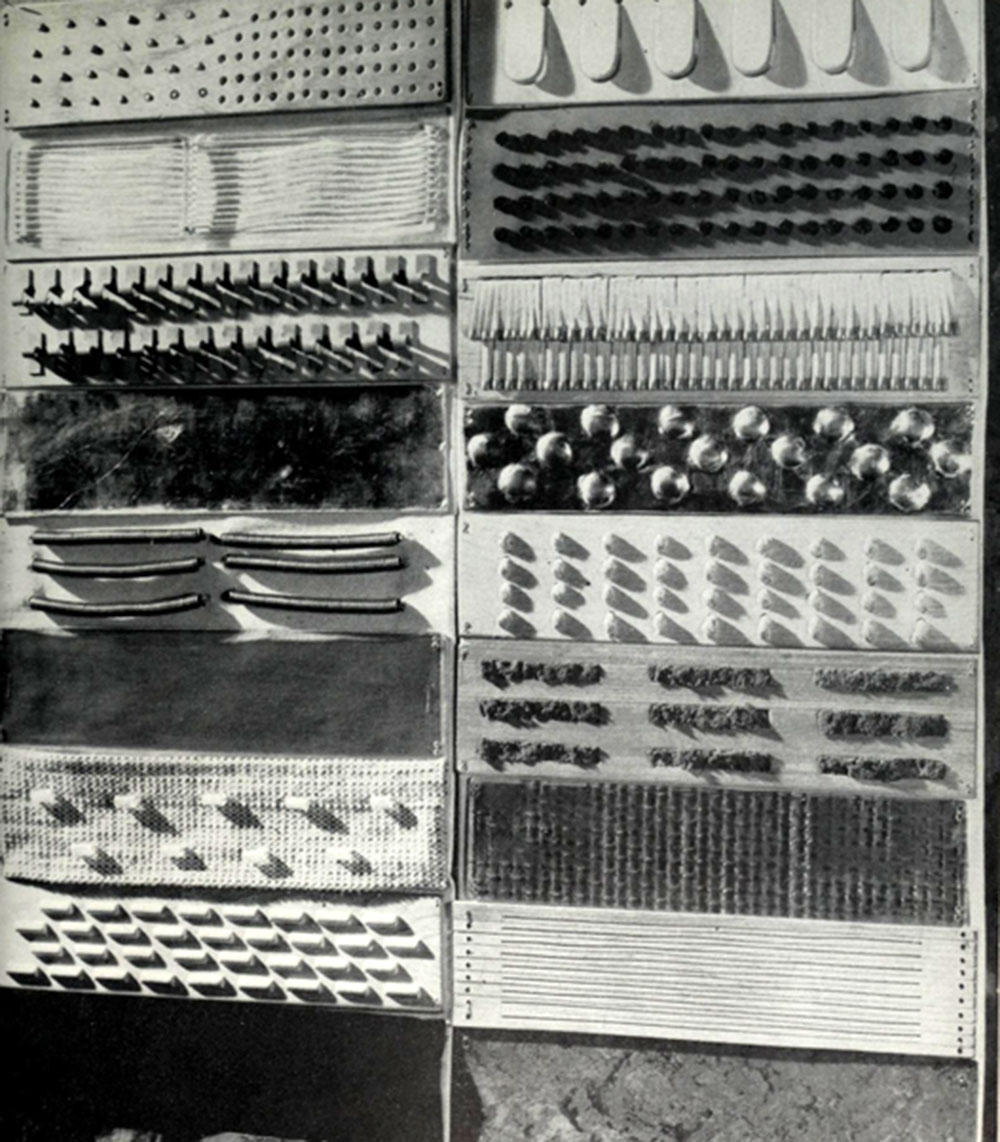
These experiments led to tactile boards, combining different tactile values. Marinetti displayed them to audiences, encouraging interaction with various materials. The most famous board, Soudan-Paris, featured rough, prickly, or burning materials (frotté, sponge, sandpaper, wool, tinfoil) for Soudan, and soft, pleasant materials like silk or down for Paris. Benedetta Cappa, Marinetti’s partner, created the board. Audience reception varied: the work was received coolly in France, but warmly in Italy.

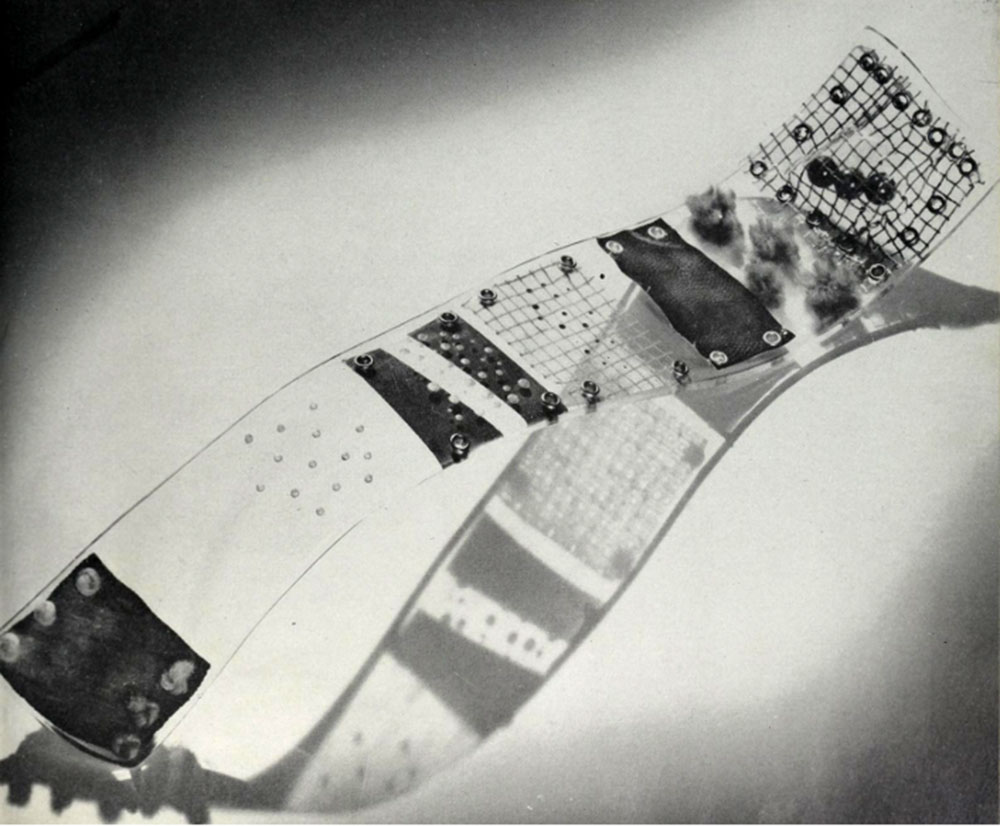
Tactile boards were also used during poetic evenings of words in freedom, where a performer would express tactile sensations through vocal equivalents, ideally under a sharp light to avoid excessive abstraction. In Il Tattilismo (1921), Marinetti wrote that it is tactile objects, furniture, and scenography that stimulate touch. He proposed expanding the tactile experience to the theatre, where movable tapes would be used so that sequential impressions could be felt by hand and would be accompanied by music and colourful lights. While not limited to hand-based experience, touch would be activated alongside visual and auditory stimuli. Marinetti argued that identifying five senses was arbitrary, and tactilism could reveal more. Culinary theatre, engaging smell, taste, and touch, exemplified this multisensory vision.
The Human as Whole: Bauhaus
Almost concurrently, at the German Bauhaus, Hungarian constructivist László Moholy-Nagy conducted from 1923-1928 preparatory courses (Vorkurs) and metal workshops. His program combined slöjd principles with Montessori-inspired sensory pedagogy, emphasising polysensory education. Students focused on one sense at a time, gradually increasing stimuli. Montessori also designed tactile learning materials and exercises.
“The sense of touch was developed through sorting (with eyes closed) tablets with various, uneven surfaces (fabrics, paper), or by recognizing objects enclosed in a bag (Séguin exercise)”.

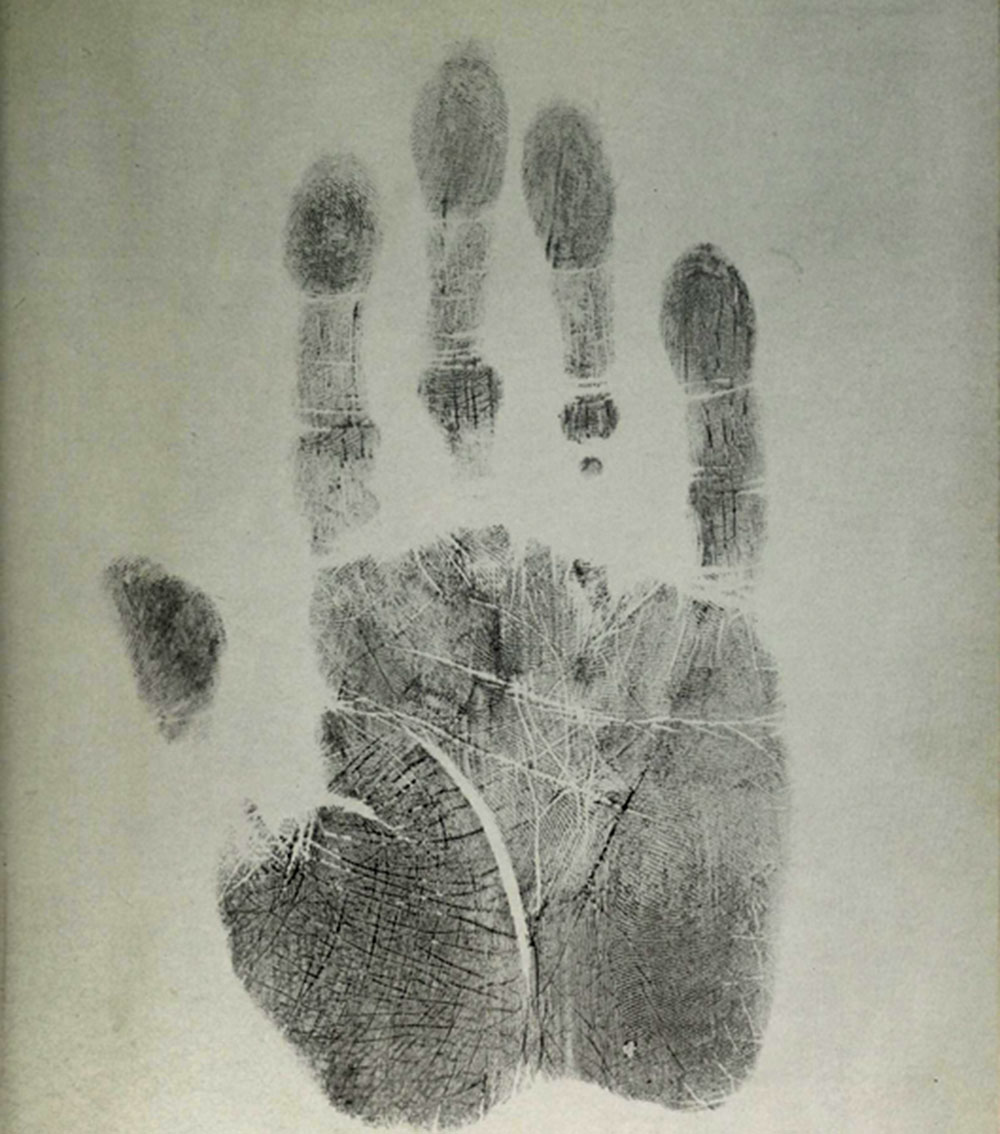

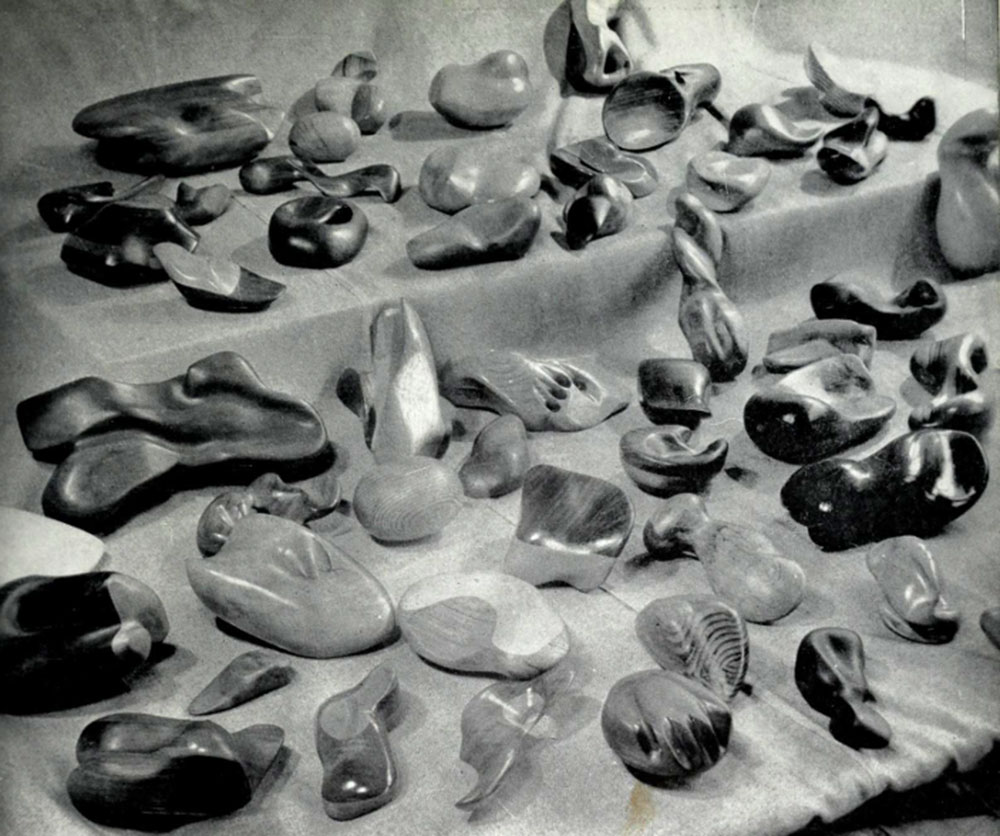
Moholy-Nagy built on futurist tactilism and the work of Johannes Itten, continuing exercises in perceiving qualities, creating tactile boards, and translating tactile impressions into other media, stripped of mysticism. Though an artist-engineer rather than a craftsperson, he investigated materials—from hard to soft, smooth to rough, wet to dry—and their tactile properties. Students explored ergonomic and tactile aspects, sometimes blindfolded, translating impressions into collages or assemblages—hand sculptures—to study natural hand functions: grasping, rotating, lifting, pressing, weighing, probing holes. These three-dimensional teaching tools developed proprioceptive and haptic awareness, teaching thinking and ergonomics via bodily experience, not visual effects.
The New Bauhaus in Chicago aimed to be an experimental collective:
“Initially, the goal was for individuals to discover the full potential of their [psycho-physical] abilities, receptive and creative capacities, powers of understanding and expression. Later, experimental tasks would concern societal needs and mass production.”

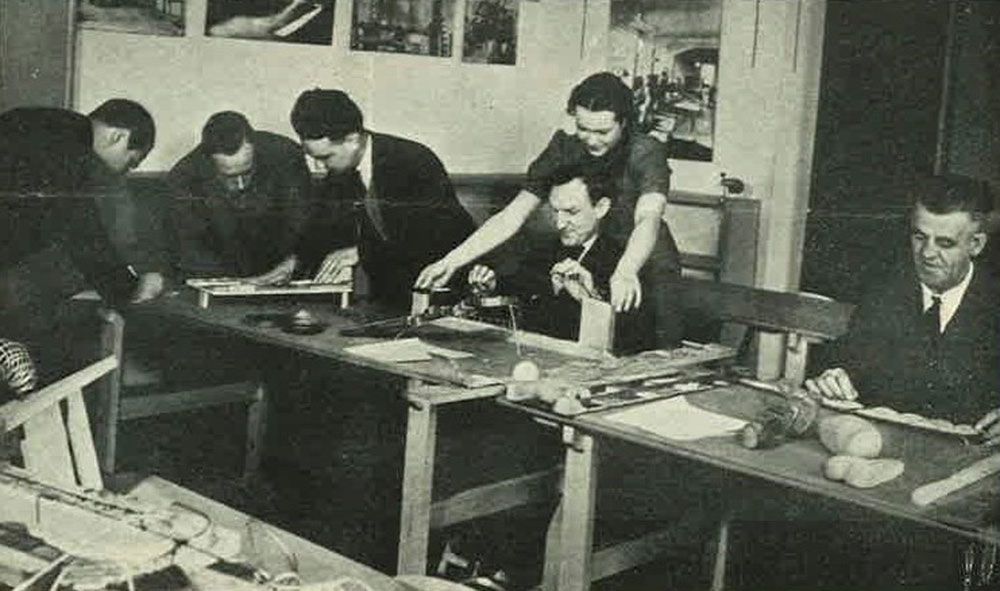
Holistic development, sensory awareness, experiential knowledge, and innovative use of tactile boards in veteran rehabilitation exemplify Moholy-Nagy’s pedagogy. He connected tactility to photography, capturing the structural properties of objects both macro- and microscopically. He even experimented with camera-less processes on photosensitive paper, attributing tactile energy to light, producing subtle gradations of light and shadow via direct contact with hands or objects.
The Hapticus Project
In December 2024, I realised the Hapticus art-research project, was supported by the Polish Ministry of Culture and National Heritage. Drawing inspiration from Moholy-Nagy’s Vorkurs pedagogy, I created a bridge to contemporary artistic education, emphasising materiality, direct contact with materials, and hand-based work. A pop-up exhibition where tactile boards juxtaposed natural and artificial materials in contrastive combinations: hard/soft, cold/warm, rough/smooth, flat/three-dimensional, fluffy/ compact. Participants, blindfolded or eyes closed, explored materials and described sensations. Verbalising tactile impressions proved challenging.
Then their “attempted to recreate compositions from memory, often with limited fidelity, realising how rarely they engage in nuanced manual exploration”.
Some boards were exhibited alongside tenfold enlarged “hand pads” filled with fragrant ingredients (lavender, rose petals, buckwheat, cotton) to hug, touch, smell, and observe, highlighting the significance of hands as tools for mastering and producing the world, including education and art.
The renaissance of haptics in the post-postmodern era aligns with new materialism and embodied experience. It reinforces the role of workshop practice and tools in material engagement, requiring asystemic bodily knowledge developed through practice. Hierarchies of the senses are reconsidered; touch is valorised. Knowledge becomes multisensory, relational, and dialogical. Tactile boards, first conceived in futurism and Montessori pedagogy and developed in Moholy-Nagy’s laboratory courses, serve as integral elements of art education programmes promoting holistic, multisensory development, material literacy, and ergonomic design. The Hapticus project examined contemporary tactile sensitivity, exploring how hands reproduce the unseen and emphasising manual dexterity in an age dominated by smooth screens and keystrokes.
Notes
1.The author thanks Prof. Ewa Klekot for the inspiration behind this title.
2.The Manifesto of Manualism included below is an original work by the author and has not been previously published.
Bibliography
Brach-Czaina, J. (2003). Błony umysłu [Membranes of the Mind, title translated by author]. Dowody.
Feliniak, A. (2020). Popularyzacja metody Marii Montessori na łamach czasopisma “Wychowanie Przedszkolne” 1925–1939 [Popularisation of Maria Montessori’s method in the Magazine “Wychowanie Przedszkolne”, 1925–1939, title translated by author]. Przegląd Historyczno-Oświatowy, (3–4), 97-125.
Grunewald, M. (2017). Homo hapticus: Warum wir ohne Tastsinn nicht leben können [Homo Hapticus: Why We Cannot Live Without the Sense of Touch, title translated by author]. Droemer Knaur.
Gromek, K., & Obarska, M. (2023). Historie dotyku [Histories of Touch, title translated by author]. Wydawnictwo Naukowe.
Gurgul, M. (2009). Manifest taktylizmu i teatr dotykowy [Manifest of Tactilism and Touch Theatre]. In W drodze do gwiazd: O teatrze i dramacie włoskiego futuryzmu [On the Way to the Stars: On the Theatre and Drama of Italian Futurism, title translated by author] (pp. 92–95). Jagiellonian University Press.
Klekot, E. (2018). Mētis: Wiedza asystemowa [Mētis: Tacit Knowledge, title translated by author]. Teksty Drugie, (1), 79-90.
Marinetti, F. T. (1922, January 11). Il tattilismo. Il Futurismo.
Moholy-Nagy, L. (2019). From Material to Architecture (M. Ujma, Trans.; excerpts) [original work Von Material zu Architektur (Bauhausbücher, Vol. 14), published by Albert Langen, 1929-1930]. Konteksty: Polish Folk Art, 73(4), 144–145.
Pallasmaa, J. (2009). The Mysterious Hand [Ręka tajemnicza, title translated by author]. In The Thinking Hand: Existential and Embodied Wisdom in Architecture (pp. 24–45). John Wiley & Sons Inc.
Preliminary course: MoholyNagy. (1938, p. 90). In H. Bayer, W. Gropius, & I. Gropius (Eds.), Bauhaus, 1919–1928. Museum of Modern Art; distributed by New York Graphic Society.
Smolińska, M. (2020). Wprowadzenie [Introduction]. In Haptyczność poszerzona: Zmysł dotyku w sztuce polskiej drugiej połowy XX wieku i początku XXI wieku [Expanded Hapticity: The Sense of Touch in Polish Art of the Second Half of the 20th Century and the Beginning of the 21st Century, title translated by author] (pp. 9–39). Universitas.
Download the Feral Labs Node Book #3: Fa Fa Futures