

A day at PIF Camp in Slovenia (2018 edition) © Katja Goljat
As the Feral Labs Network’s Rewilding Cultures programme (2022–2026) comes soon to an end, Makery publishes a series of essays drawn from the 2024 Feral Labs Node Book #2 and the upcoming #3 issue. In this essay Chessa Adsit-Morris takes a look back at the “laboratory turn” in art and culture since the 1960s, leading to a reflection on the ideas underlying the Feral Labs Network itself.
Chessa Adsit-Morris is a curriculum theorist and assistant director of the Center for Creative Ecologies housed within the department of the History of Art and Visual Culture at the University of California, Santa Cruz. She writes widely on the intersection of curriculum studies, posthumanism(s), ecological thought and SF, and is the author of “Restorying Environmental Education: Figurations, Fictions, Feral Subjectivities” (Palgrave Macmillan, 2017).
A few days after receiving an invitation to contribute to the second edition of the Feral Labs Nodebook, I attended a works-in-progress lecture by my colleague Dr. Kriti Sharma at the University of California, Santa Cruz (UCSC). Originally trained as a microbial scientist, she has recently been hired in the humanities as part of the Department of Critical Race and Ethnic Studies, and is in the process of establishing a transdisciplinary laboratory. Her lecture, “Liberatory Laboratories: Undoing the Entanglement of Science and Ruling Class Power”, explored the possibilities of (modestly) undoing the entanglements of science, imperialism, and colonialism by actively undermining the weaponisation of science in both ideological and technological forms. She proposed engaging with anticolonial and anticapitalist approaches to both science and multi-species relations through transdisciplinary research in the sciences, arts, and ceremony (1). Her aim in establishing this new institutional space is to try to think and do laboratory work otherwise in order to collectively build a different and more equitable future.
I couldn’t help but wonder how ferality—as both a concept and a category, an adjective and a verb, a being and a doing—could aid in this project. I also couldn’t help wondering what might be gleaned from exploring the history of what I describe as the “laboratory turn” in art and culture since the 1960s (2). Both of these conceptual projects—contemporary engagements with ferality and historical analyses of art/media labs—have their own (sometimes overlapping) entanglements with imperialism, colonialism, and capitalism that need to be grappled with. Yet, they also offer (in different ways) a more prismatic view of historical and contemporary formulations of power and privilege that shape various cultural and scientific institutions, practices, and relations. The Feral Labs Network, as a collective of diverse experimental art-science-technology laboratory spaces, is quite possibly the perfect case study for this venture. Although it was only officially formed in 2019, the Feral Labs Network includes projects that have been in operation for varied durations, including Marko Peljhan’s Makrolab, a nomadic self-sustaining medialab that was launched at the quinquennial contemporary art exhibition documenta X in 1997, and a number of do-it-yourself (DIY) and do-it-with-others (DIWO) creative community spaces that emerged in the 2010s during the maker movement.


As I have argued elsewhere, what makes ferality such a powerful and useful conceptual tool is that it can operate on different scales and across different dimensions including acts, entities, relations, qualities, collectives, infrastructures, ecologies, and futures, to name a few (3). As a process of de-domestication it signifies a move away from human-centric practices of control and domination, while also troubling the nature/culture divide in generative ways. And yet, it is also both a product (or side effect) of imperialism, colonialism, science, and biocapitalism, and oftentimes, as Max Liboiron reminds us, “an enactment of ongoing colonial relations to land” (4). It is wrapped up in messy biopolitics and decolonial struggles. This essay aims to provide—drawing on the invitation put forth in Feral Labs Nodebook I—a “challenging and truly feral reflection” on the institutionalisation of modern science, its entanglements with the military-industrial complex, and the potential for institutional liberation (5). How might the concept of ferality help do the critical anticolonial and anticapitalist work of untethering both ideologies and technologies from their colonial histories and contemporary formulations of power and privilege? And how might it help us grapple with inherent contradictions and incommensurabilities in doing this work within dominant colonial and capitalist institutions?
From pure science …
The concept of “pure science” as it was developed and articulated at the turn of the 20th century, was envisioned as a “noble effort” wherein individual scientists devoted themselves to understanding the order of the universe (6). By the 1920s and 1930s an idealised, and rather pastoral, conception of pure science emerged in the public sphere, viewing it as separate from society. Scientists cloistered in the lab or off in “remote” landscapes free to pursue intellectual pursuits without social or political distractions, endlessly searching for objective truths through free intellectual inquiry (7). Science was viewed as autonomous and inherently good, never to be impeded (or influenced) by socio-political concerns. Its ideologies propped up by the imperialist doctrine of discovery, colonial imaginaries of nature, and laissez-faire individualism. It was this conception of modern science that was then institutionalised, becoming more and more specialised and professionalised, ensuring its hegemonic discourses and structures of power and privilege would endure. The aim of institutionalisation was two-fold: to demarcate legitimate scientists from amateurs (or those practising “applied” science) and to protect it from public involvement (i.e. critique) and social oversight.
World War II and its aftermath—including the emergence of advanced capitalism—transformed the political economy of U.S. scientific research. As David Hollinger describes:
As a result of the Manhattan Project and its several administrative aftermaths, especially the creation of the National Science Foundation in 1950, physical scientists found themselves enmeshed in a system of capital-intensive research funded by a government responsive to popular political pressures and preoccupied with military priorities. (8)
These shifts in policymaking and funding helped give rise to what U.S. president Eisenhower dubbed the military-industrial complex, leading to what he warned would become unjust concentrations of power (9). Modern science became entangled within a larger system of institutions, all with vested interests in high levels of defence spending. The post-war boomerism of science and technology that emerged was prolific, including developing new hardware technologies used in communications, data processing, and control and command instrumentation which led to a new generation of software systems that were also of great interest to artists.
Indeed, the arts, particularly as they expanded to include new practices and technologies during postmodernism, were not immune to these influences and entanglements. 1967 saw the emergence of three of the first art and technology programs, all with direct ties to military organisations and industrial manufacturing companies: Experiments in Art & Technology (New York, USA); the Art and Technology Program at the Los Angeles County Museum of Art (LACMA); and the Center for Advanced Visual Studies at Massachusetts Institute of Technology (MIT) (10).

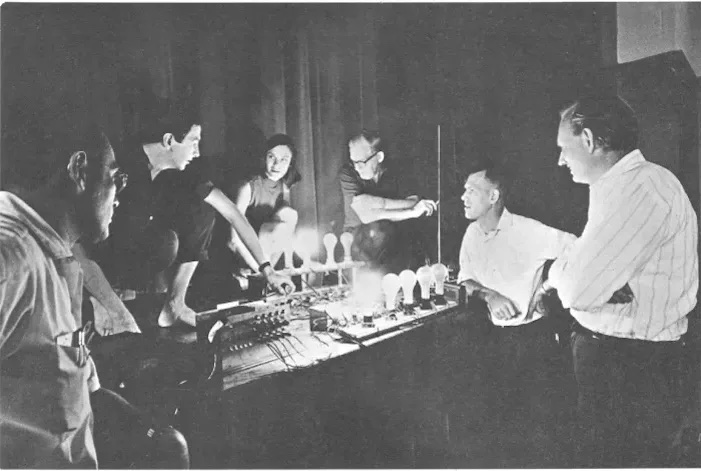
These early experiments in collaboration laid the groundwork—and created a model—for future media labs including the MIT Media Lab, founded in 1985, which has received millions (and millions) in funding from industry partners, the U.S. Department of Energy (DOE), and the U.S. Defense Advanced Research Projects Agency (DARPA) (11). As Peljhan described in an interview with Makery:
[W]hen you really start to look at this history, you realize the interconnectedness of technology, space, the military and industrial and scientific complexes. You realize the world is not black and white, but with a lot of shades of grey (sic), and lots of projections and scopic views.
Peljhan decided to embrace this complexity, creating a number of versions of the Makrolab by gathering technical documents and data from the defence industry using a fake company. However, many of these early experiments, as Peljhan alluded to, adopted a utopian techno-libertarian orientation towards the future, promoting universal technocratic solutions that often naturalised domination and control, and served as a distraction from the politics and power relations wrapped up in these endeavours, ultimately reinscribing settler futurity.
To A Feral Science …
On May 11th 2004, Steve Kurtz, co-founder of the Critical Art Ensemble (CAE), called the police after waking up to discover his wife, Hope Kurtz, was not breathing (12). The police who responded to his 911 call found scientific lab equipment, biological agents, and books on biowarfare at his home and subsequently called the Federal Bureau of Investigation (FBI). The FBI, working with Homeland Security, the Joint Terrorism Task Force, and the Sheriff’s office, searched his home and confiscated all his equipment, computers, books, notes, and other personal documents under the recently established USA PATRIOT Act, a post 9/11 expansion of the U.S. Biological Weapons Anti-Terrorism Act of 1989. Kurtz was illegally detained despite explaining to the authorities that the bacteria in his possession was harmless and being used for an upcoming art exhibition at MASS MoCA (13). In the coming weeks, Kurtz’s friends and collaborators were subpoenaed and he was charged—along with his collaborator and science advisor Dr. Bob Ferrell—with mail and wire fraud for purchasing bacterial agents (14). Kurtz was then enmeshed in almost four years of legal battles due to what many of his colleagues believed was because of the CAE’s growing body of work documenting and criticising the ways in which science and the military-industrial complex “colluded against the public good” (15).

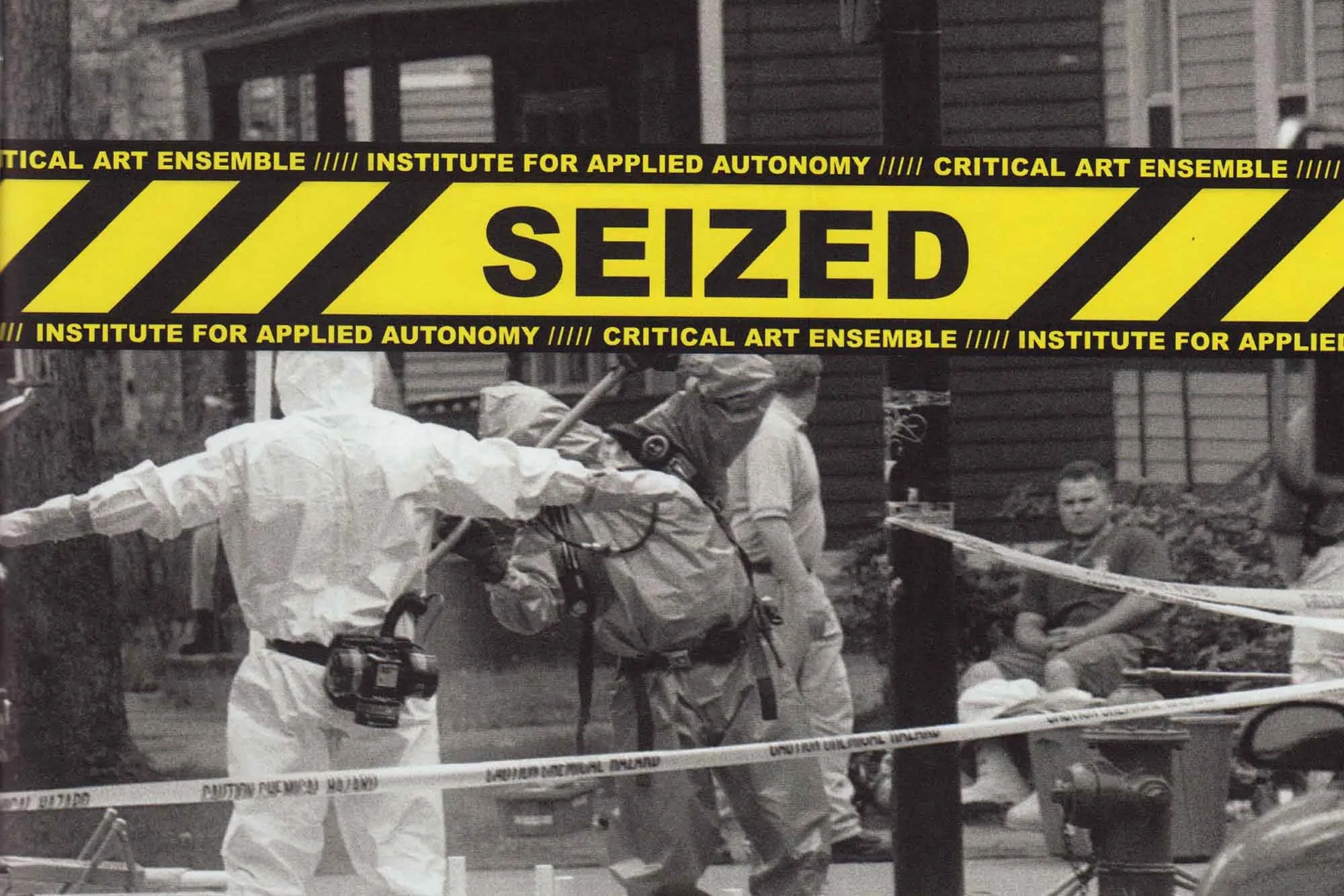
It was a year after Kurtz’s arrest in 2005 when Robert Carson announced in WIRED that the “era of garage biology” was upon us (16). Spurred by governmental policies promoting the commercialization of scientific technology—creating cheap and accessible equipment—DIY labs began to pop up in the kitchens and garages of artists, hackers, and amateur scientists. This marked the emergence of a truly feral science, one that had escaped the domesticated structures of academia and the purview of professional scientists, requiring new modes of containment and control. As Michael Scroggin describes in his essay, “A Feral Science? Dangers and Disruptions between DIYbio and the FBI”, governmental surveillance of these labs emerged as a driving force for their institutionalisation (17). Beginning in 2010 the FBI sponsored yearly conferences and gatherings with the DIYbio community, ensuring governmental influence and oversight, creating an environment wherein DIYbiologists ultimately policed themselves in true Foucaultian fashion. This association also ensured that DARPA and venture capitalists had access to, as Scroggin concluded, “a steady stream of disruptive innovations, ready to be bent to new ends” (18).
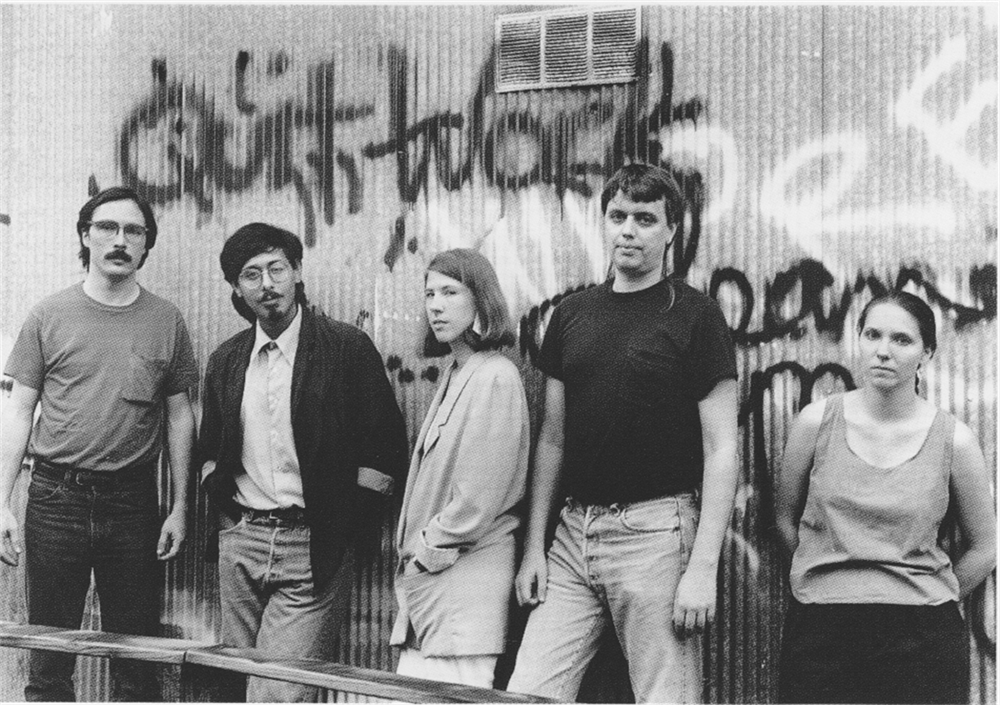
Although many DIYbiologists were (and still are) quite familiar with Kurtz’s case and view it as a stark warning, the CAE’s development of “protest biology” through a practice of critical intervention into systems of power and privilege, is substantially more important to institutional liberation. Drawing inspiration from artistic movements including the Situationists and artists engaged in institutional critique, CAE utilised tactical media to directly confront the weaponization of science and technology. They describe an intervention as: “Any deliberate act outside of domestic space that is designed to disrupt, subvert or shift the material and/or the symbolic orders of the status quo.” (19) A truly feral act. Adopting an amateur (i.e. feral) position, the CAE aims to create a permanent cultural revolution able to challenge the ongoing processes of colonial and capitalist invasion and co-option (20). Through my own work, I’ve come to understand ferality as a continual process of becoming other/wise that requires particular forms of performative collaboration and remains always unfinished. Feral politics and decolonial struggles for liberation are precarious and ongoing, and require as a starting point—as Kriti Sharma described in her talk—the demilitarisation of science.

To Feral Labs …
As a conceptual artist, Peljhan’s practice focuses on the tactical use of new technologies, embracing their complexity and mapping their power structures, in order to build what the artist collective Not An Alternative calls counterpower infrastructure (21). Establishing for example Projekt Atol, one of the first non-profit institutions in Slovenia, to create a hub for artists interested in communication infrastructure and scientific and technological research. Projekt Atol comprises various projects associated with the Makrolab including the Arctic Perspective Initiative, which is dedicated to creative, geopolitical and infrastructural cooperation in circumpolar areas, and the Feral Labs Network. These projects use communal isolation, taking artists outside the domesticated artistic and scientific spheres they are used to and situating them in remote and radically different environments as a tool to foster what I describe as feral subjectivities (22). This is not a move to innocence, nor a mode of escapism, but a practice of disruption and defamiliarization that helps reveal normative assumptions, power structures, and entanglements. As Antti Tenetz, an artist who participated in a residency facilitated by Bioart Society at the Kilpisjärvi Biological Station, described:
In the past few years, in addition to helicopters and hydroplanes belonging to the Border Guard, the Defense Forces, TV and fishing groups, we have also seen unmanned civilian aircrafts and robots used as instruments in joint experiments and research between science and [the] arts. (23)
These encounters provide openings for artists to do site-specific work that engages with these hybrid ecologies because, as Tenetz later reflected, there is no escaping the technosphere (24).
The labs that are part of the Feral Labs Network take a variety of approaches to engaging with these complex hybrid ecologies, as Erich Berger—previous director of SOLU Bioart Society—explained, many of the labs have:
[A] feral turn to their activities that could kind of mean a lot of different things … [for] some it had to do with their locality, with some it had to do with their kind of methods they were applying. With some it had to do with [the] kind of breaking out of this kind of cultured way of working. (25)

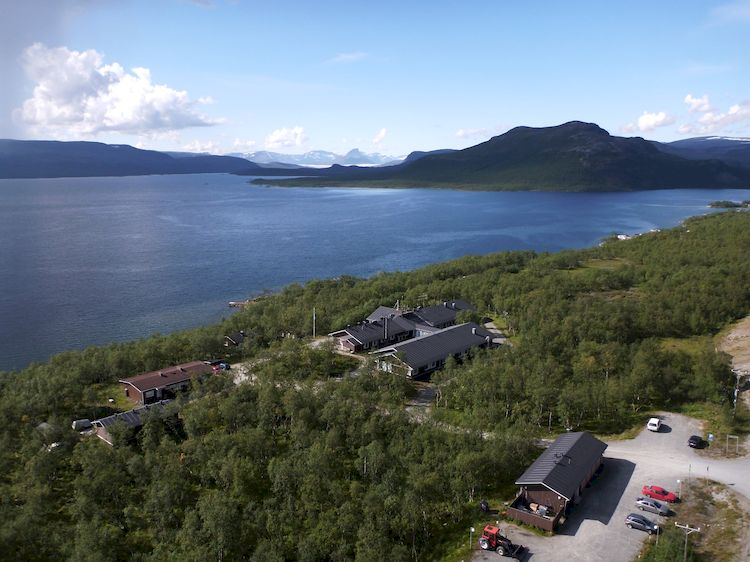
At the Kilpisjärvi Biological Station, for example, they aim to decenter scientific research from the traditional laboratory—a homogenous site that could be situated anywhere—to the land. As Berger explained in an interview: “it’s to do research on the site about the site and with the site” (26). This means grappling with the complex and often contradictory political ecologies present, including the colonial entanglements of the biological station itself. Centering the land, Berger noted, also requires giving up control and losing power over the scientific experience, tainting the “pureness” of the research by opening it up to situated politics, cultures, ideas, methodologies, and practices. Many times, this also requires a philosophical shift towards posthuman critical theories and indigenous cosmologies, opening up dominant ideologies to other ways of thinking and doing.
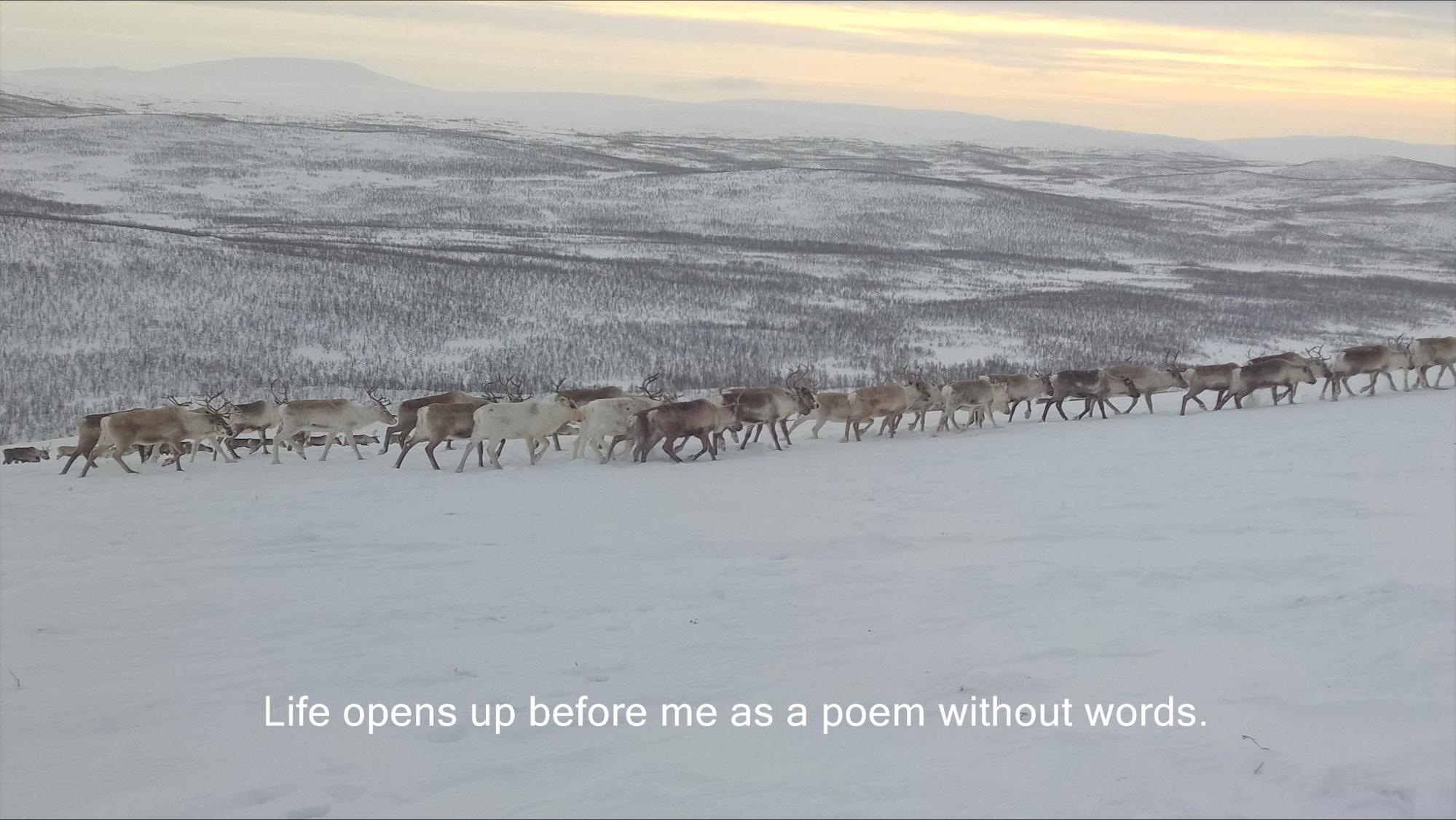
Often, these practices also include authentic engagement and collaboration with local stewards and indigenous communities, which the MTL Collective rightly identifies as a precondition for creating decolonial solidarity and institutional liberation (27). The Arctic Perspective Initiative, for example, which is a long term and ongoing collaboration between Peljhan, Matthew Biederman, and local communities in the arctic and antarctic, is aimed at creating open source infrastructures (technological and educational) to help empower and sustain these cultures and communities in the face of both extractive geopolitics and climate change (28). The infrastructure allows local indigenous communities to direct, manage, and share their own environmental research, monitoring, and assessment. Artist and filmmaker Leena Valkeapää whose partner and collaborator, Oula A. Valkeapää, is a working reindeer herder of the Sámi cultural tradition, reflected on her residency at the Kilpisjärvi Biological Station by wondering if these experiences “might serve not only as a laboratory for transdisciplinary fieldwork and collaboration, but also as a test site for the gradual decolonization of artistic and scientific practices” (29).

Towards Liberatory Labs
At the end of her talk, Kriti Sharma listed a number of laboratories beginning to explore and adopt anticolonial and anticapitalist practices including: Eve Tuck’s Tkaronto Circle Lab, Max Liboiron’s CLEAR Lab (Civic Laboratory for Environmental Action Research), Ambika Kamath’s F.L.A.I.R. Lab (Feminist Lenses for Animal Interaction Research Laboratory), Nick Shapiro’s Carceral Ecologies Lab, and Ruha Benjamin’s Ida B. Wells Just Data Lab. From training indigenous scientists, to participatory research with youth and incarcerated communities, to arts-based research and creative approaches to data conception, production and circulation, these labs are committed to social change and oriented towards equity and justice. All these labs recognize that colonialism, capitalism, and racism are the dominant organising force in institutions and must be contended with in a multiplicity of ways. My aim here has been to bring into the conversation artistic movements that have strived towards institutional liberation, entangling and implicating art-science research—and their institutional formulations (i.e. art/ media labs)—along the way. What can these movements learn from each other? And how might they inform the radical liberation of institutional research?

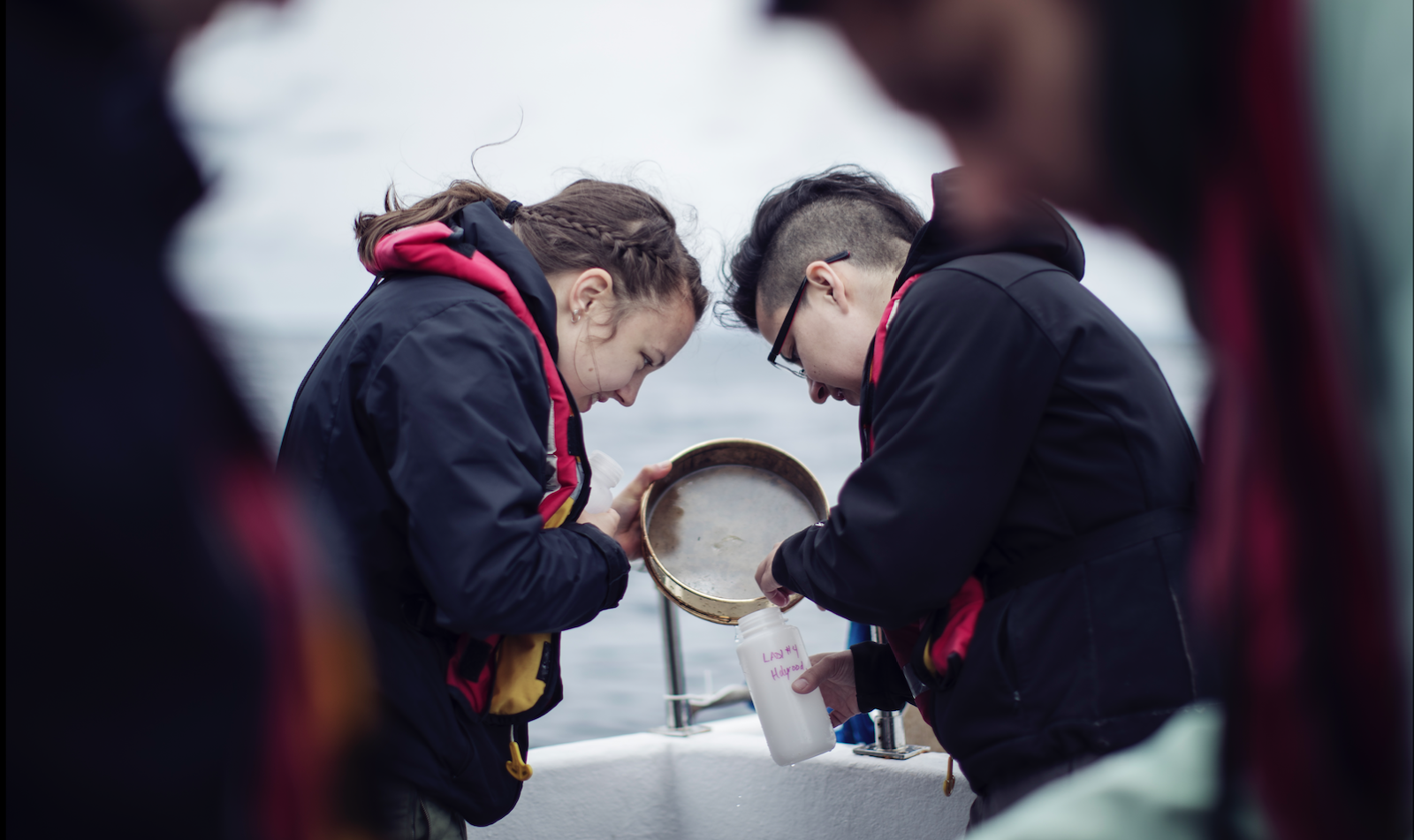
To start, we’ve learned that liberation requires the constant and ongoing questioning of one’s own location in the colonial matrix of power—in both ideological and technological forms—questioning normalised and internalised narratives, and grappling with complex disciplinary histories and practices. It also requires the de-weaponisation of science—at least through funding and access—prioritising instead historically marginalised and vulnerable communities. Most importantly, it requires centering the land, as Liboiron reminds us: “all forms of research and activism have land relations, and those can align with or against colonialism as a particular form of extractive, entitled land relation.” (30) 1 The artists and creative practitioners we’ve reviewed in this essay have provided a range of practices to draw from, including subverting the material and/or symbolic orders of the ruling class through critical interventions and the building of counterpower infrastructure. Recentering collaborative and collective communities of practice that work with the land in all its complexity and reject techno-utopian orientations towards the future, embracing instead multiple superimposed episto-ontologies and indigenous cosmologies.
My contention is that these anticolonial and anticapitalist practices require ferality in its multiplicity of forms. Particularly as we move to liberate people, practices, and institutions through the complex and messy process of de-domestication—or rewilding as this project proposes—moving away from human-centric (or more specifically euro-centric) practices of control, domination, and weaponization. Creating “laboratories otherwise” as Kriti Sharma proposed, requires thinking and doing science differently, as an embodied, collective, and political practice. We need collectives of practitioners not afraid to taint the purity of science or question its institutionalised structures of power and privilege. We need a feral science, one that operates in, on, and with messy multispecies politics and ongoing decolonial struggles in order to collectively build a different and more equitable future.
Download the Feral Labs Node Book #2.